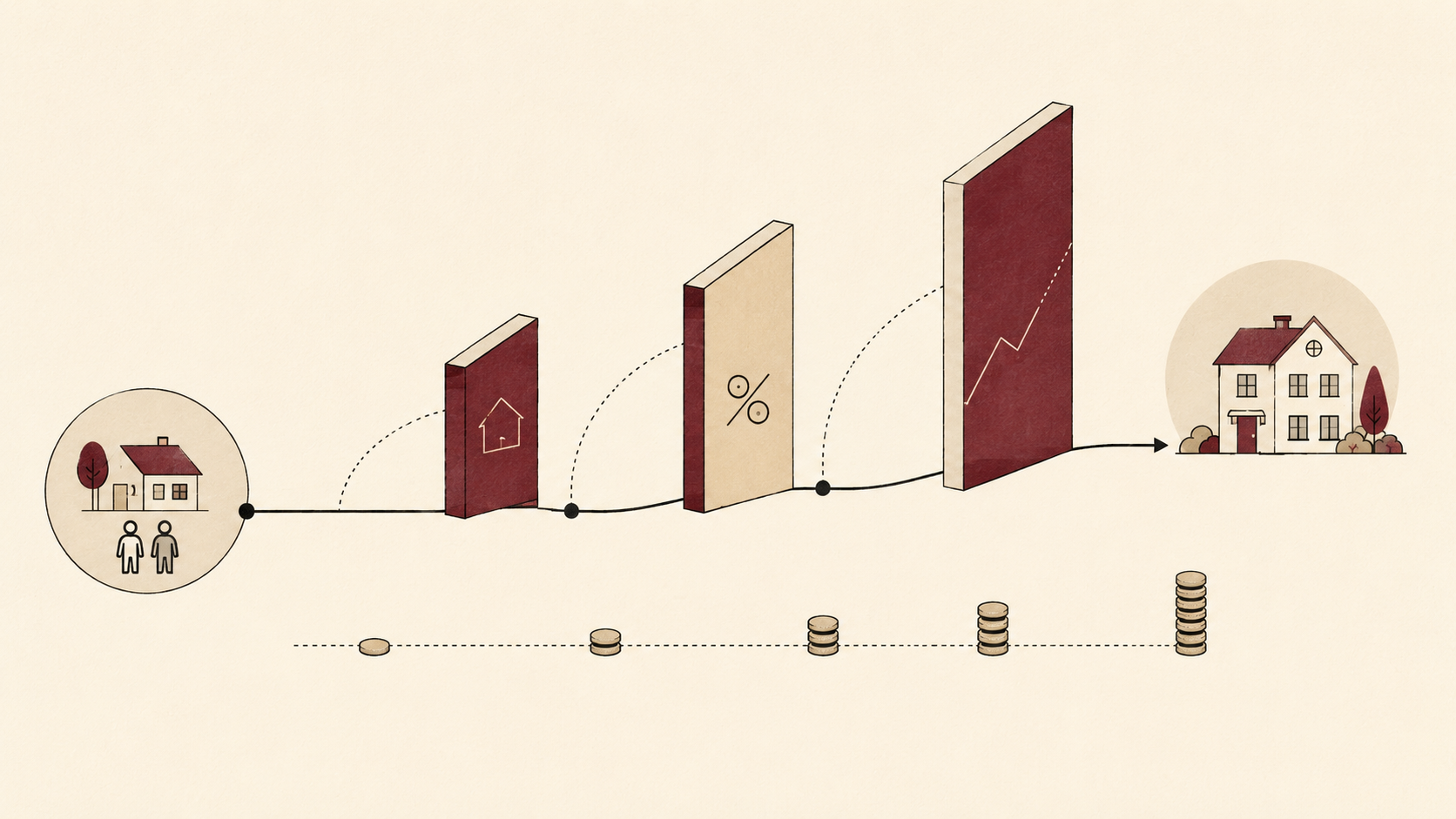
Homeownership has historically been one of the primary ways households build wealth. When younger generations buy homes later, the effects extend beyond housing and influence consumer spending, wealth accumulation, financial services, and economic mobility. The trend is becoming a broader economic issue rather than simply a real estate problem.
- Young adults in both the U.S. and South Korea are purchasing homes later than previous generations.
- Higher mortgage rates have significantly increased the cost of buying a home even when prices stabilize.
- The biggest barrier for many first-time buyers is accumulating a down payment rather than managing monthly payments.
- Delayed homeownership affects industries ranging from banking and construction to furniture and consumer retail.
Homeownership Is No Longer Following the Old Timeline
For decades, buying a home was considered a major milestone of early adulthood.
The traditional sequence was relatively straightforward: graduate, find a job, save for a down payment, and purchase a first home. Today, that timeline is becoming less common.
Across developed economies, young adults are waiting longer to buy homes than previous generations. In the United States, the median age of first-time homebuyers has climbed significantly over the past decade. In South Korea, homeownership among younger households remains under pressure as housing prices continue to outpace income growth in many urban areas.
The reasons vary by country, but the underlying economic challenge is remarkably similar: housing has become more expensive faster than young workers' ability to afford it.
The Math Has Changed
One of the biggest shifts has been the cost of financing.
In the United States, the Federal Reserve's rate-hiking cycle pushed mortgage rates to levels not seen for many years. Even when home prices stabilize, higher borrowing costs can significantly increase monthly payments.
Consider a simple example. A buyer purchasing a $500,000 home with a mortgage today may face monthly payments hundreds of dollars higher than someone who bought a similarly priced home when mortgage rates were below 3%.
The challenge is not limited to the U.S.
South Korea experienced one of the fastest housing booms among developed economies during the pandemic era. While apartment prices have cooled in some regions since their peak, affordability remains a major concern, especially in Seoul and surrounding metropolitan areas where housing demand remains concentrated.
For many young professionals, the problem is no longer simply saving for a home. It is saving enough to keep pace with housing prices while managing higher living costs at the same time.
Why Wages Are Not Keeping Up
Housing affordability is ultimately a relationship between prices and income.
In many major cities, home prices have risen faster than wages over long periods. Even when salaries increase, those gains often struggle to match increases in housing, rent, healthcare, education, and transportation costs.
Young workers entering the labor market face a different economic environment from previous generations.
A larger share of income is often directed toward rent. Student debt remains a significant financial burden for many Americans. In South Korea, education expenses, rising living costs, and competitive urban housing markets create similar financial pressures, even when student loan burdens are lower than in the United States.
The result is that down-payment savings take longer to accumulate.
Homeownership Has Become a Capital Problem
Many discussions focus on housing prices, but the larger issue may be access to capital.
A young professional might earn enough to manage monthly mortgage payments. However, accumulating the initial down payment is often the greater obstacle.
This has created a growing divide between households that receive family financial support and those that do not.
In both the U.S. and South Korea, parental assistance has become increasingly important in helping younger buyers enter the housing market. Family wealth is playing a larger role in determining who can purchase a home and when.
The housing market is increasingly influenced not only by income, but also by existing wealth.
The Business Impact Extends Beyond Real Estate
Delayed homeownership affects far more than housing markets.
A first home purchase typically triggers spending across multiple industries. New homeowners often buy furniture, appliances, electronics, insurance products, renovation services, and financial products.
When home purchases occur later in life, those spending cycles are delayed as well.
This matters for homebuilders, banks, mortgage lenders, home-improvement retailers, furniture companies, and consumer brands.
The housing market is not simply a real estate story. It is an economic engine connected to large sections of consumer spending.
What Could Happen Next?
Governments in both countries continue to search for ways to improve affordability.
Policy tools include housing supply expansion, mortgage support programs, tax incentives, and measures aimed at helping first-time buyers.
However, affordability ultimately depends on a balance between three forces:
- Housing prices
- Interest rates
- Income growth
If wages fail to grow faster than housing costs, homeownership may continue shifting later into adulthood.
For young professionals, the challenge is no longer whether homeownership remains desirable. The challenge is whether the economics make sense.
The dream of owning a home has not disappeared.
The timeline, however, is changing.
The housing story is increasingly becoming a capital-access story. Public debate often focuses on home prices, but the real divide may be between those who can access family wealth and those who cannot. As down payments become larger and financing becomes more expensive, homeownership shifts from being primarily income-driven to wealth-driven. That change has implications not only for housing markets but also for long-term wealth inequality and consumer spending patterns.
- Government data U.S. Census Bureau — Homeownership Rate by Age and Household Characteristics
- Economic data Federal Reserve Economic Data (FRED) — 30-Year Fixed Rate Mortgage Average in the United States
- Economic data OECD Housing Prices Database and Housing Affordability Indicators
- Government data Statistics Korea (KOSTAT) — Housing and Household Statistics
- News Reuters — Coverage of housing affordability, mortgage rates, and first-time homebuyer trends in the U.S. housing market