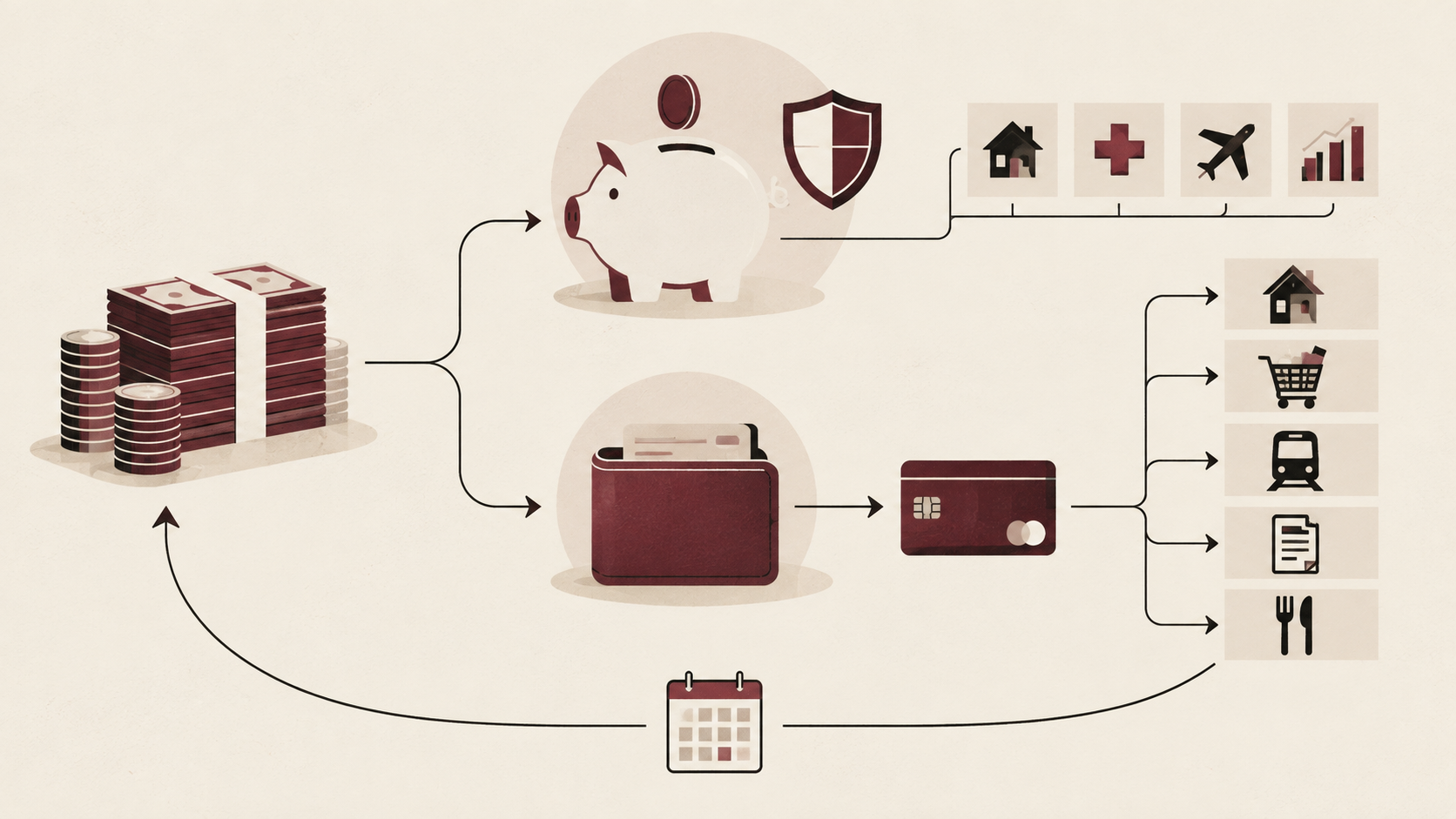
A bank balance shows how much money is in an account, not how much should be spent. Giving checking and savings different roles can make that distinction visible, creating a simple spending boundary without requiring a complicated budgeting system.
- Total cash and monthly spending money are two different numbers.
- Checking can hold money allocated for current expenses while savings keeps future money separate.
- There is no universal percentage that everyone should keep in either account.
- A credit limit represents available credit, not an extension of a monthly spending budget.
During a recent visit to a Bank of America branch, a banker suggested two ways to separate savings from everyday spending. One was to keep roughly 80% of the money in savings. The other was to decide in advance how much to spend each month and keep only that amount in checking.
For example, if this month you only want to spend $1,000, you just put $1,000 in your checking account.
Neither approach is a universal Bank of America budgeting rule. They were suggestions from an individual banker. But both point to the same useful distinction: the amount of money you have and the amount of money you plan to spend do not have to be the same number.
Two Accounts, Two Different Jobs
Checking and savings accounts often appear side by side in the same banking app, making them feel almost interchangeable. They are not.
Bank of America describes checking accounts as designed for spending and everyday access to money. Savings accounts are designed for setting money aside for longer-term goals and can earn interest on their balances.
That difference can also be used to organize a monthly budget.
Imagine someone has $10,000 in cash across their bank accounts. They determine that $1,000 is the amount they can spend this month after accounting for their financial obligations and goals.
One approach would be to leave all $10,000 in checking and simply try to remember that only $1,000 is available for spending.
Another would be to separate the two numbers physically: keep the planned spending amount in checking and the rest in savings.
The person still has $10,000 either way. What changes is what each balance represents.
The savings balance is money being preserved for future expenses, emergencies or other goals. The checking balance becomes the pool of money available for current spending.
That turns an ordinary bank account structure into a basic budgeting tool.
The Point Is Not a Perfect Percentage
This does not mean everyone should move the same percentage of their money into savings.
Someone with high monthly rent, tuition payments or irregular income may need significantly more cash available in checking than someone with lower or more predictable expenses. Moving too much money out of checking can also create problems when bills or automatic payments arrive.
The important decision is therefore not whether 70%, 80% or another percentage belongs in savings.
It is deciding how much needs to remain available for current expenses — and separating that amount from money intended for later.
Bank of America itself presents several budgeting approaches rather than one universal formula. Its Better Money Habits program, for example, describes methods ranging from the 50/30/20 framework to “pay yourself first,” while noting that budgeting methods can be adjusted to fit individual circumstances.
The account system works on a different level. It does not determine how much someone should spend. It makes the amount they have already decided to spend easier to see.
Saving Before Spending
There is also a difference between this approach and simply saving whatever happens to remain at the end of the month.
Consider two sequences.
Income → Spending → Savings
Under this approach, saving depends on how much money survives the month's spending.
Now reverse it:
Income → Savings → Planned spending
Money intended for savings is separated first. What remains available for current expenses becomes clearer.
The Consumer Financial Protection Bureau has recommended automatic saving as one way to build this habit. Consumers can arrange recurring transfers from checking to savings or, where available, split direct deposits between the two accounts.
Automation is not necessary for the system to work. But it can make the separation happen before the money gets absorbed into everyday spending.
A Credit Limit Is Not a Budget Either
The same logic becomes especially useful when a credit card enters the picture.
Suppose a card has a $3,000 credit limit.
That does not mean the cardholder suddenly has another $3,000 available to spend. The limit represents the amount of credit the lender has made available. It says nothing about how much spending fits within the cardholder's monthly budget.
If the planned spending amount for the month is $1,000, a $3,000 credit limit does not turn that budget into $3,000.
The credit card is a payment method. The budget is still determined by the cardholder's own finances.
This distinction can become less obvious because a credit card purchase does not immediately reduce the checking account balance. The cash leaves later, when the credit card bill is paid.
That makes it possible for three different numbers to appear at the same time: total cash, the checking balance and available credit. None automatically tells someone how much they can afford to spend.
A spending plan has to do that.
Why Keeping Money Separate Matters
The distinction matters beyond ordinary purchases.
Emergency savings provide a financial buffer when an unexpected expense appears or income suddenly stops. Yet that buffer is far from universal.
The Federal Reserve's 2025 household survey, released in May 2026, found that 63% of U.S. adults said they could cover a hypothetical $400 emergency using cash, savings or a credit card paid off at the next statement. Fifty-five percent said they had savings sufficient to cover three months of expenses.
Among adults ages 18 to 29, only 37% reported having three months of emergency savings.
Keeping money in a separate savings account does not create an emergency fund by itself. But separating money reserved for the future from money available for everyday spending can make the boundary more visible.
That may be especially useful when someone is beginning to manage rent, groceries, credit cards and other expenses independently for the first time.
The Number That Matters This Month
Personal finance can quickly become complicated. There are budgeting apps, spreadsheets, spending categories, credit limits, savings targets and dozens of rules about how income should be divided.
But a basic system can begin with a simpler question:
How much can I spend this month?
Once that number is determined, checking and savings accounts can give it a physical boundary.
If the answer is $1,000, the relevant spending number does not have to be the $10,000 sitting across all of someone's accounts. It can simply be the $1,000 deliberately made available for the month.
The rest still belongs to the same person.
It just has a different job.
Disclaimer: This article is for informational purposes only and does not constitute financial advice. Comments attributed to an individual Bank of America employee do not represent official Bank of America guidance.
A conversation with a banker at a Bank of America branch in Boston offered a practical way to think about budgeting: separate the money being saved from the money available to spend. The advice became the starting point for this explainer on how checking and savings accounts can serve different roles in everyday money management.
Bank of America branch, Boston, Massachusetts | September 2026The useful idea here is not a particular savings percentage. It is turning account structure into information. When all available cash sits in one spending account, the balance answers only “How much money is here?” Separating savings from checking allows the balances to answer two more useful questions: “How much am I preserving?” and “How much have I made available to spend?”
- Company research Bank of America Better Money Habits — What is the difference between checking and savings accounts?
- Company research Bank of America Better Money Habits — Saving and budgeting resources
- Government guidance Consumer Financial Protection Bureau — Looking for an easy way to save money? Make it automatic, Aug. 26, 2019
- Government data Federal Reserve Board — Report on the Economic Well-Being of U.S. Households in 2025: Savings and Investments, May 2026