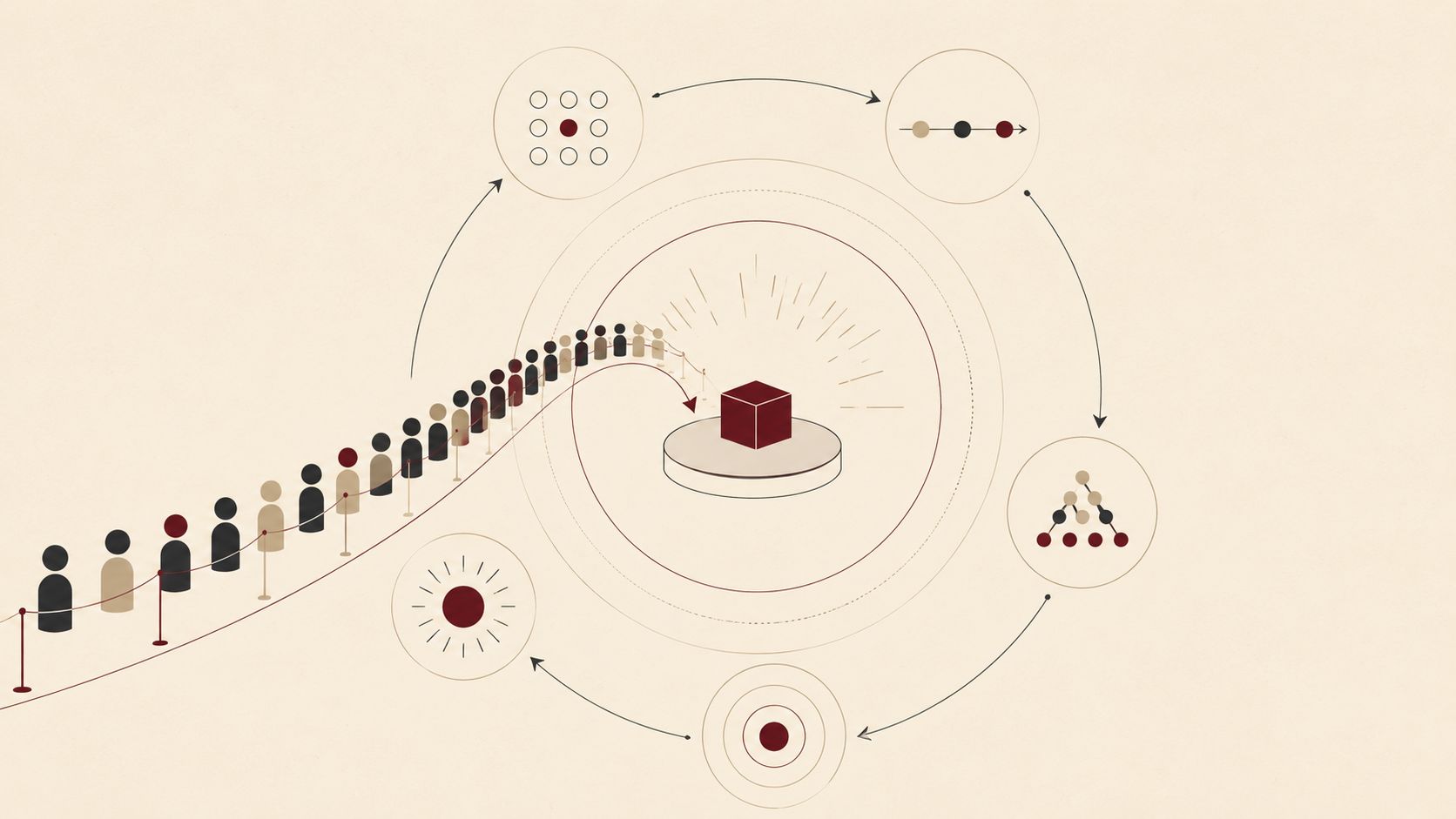
Waiting lists demonstrate that demand is not always driven by availability. For certain brands, scarcity itself becomes a competitive advantage. Understanding this mechanism helps explain why some companies prioritize exclusivity over volume and why access has become a valuable product category in its own right.
- Hermès and Rolex have built brand value partly through supply constraints that keep demand above availability.
- Waiting lists can increase perceived value by signaling strong consumer demand.
- Restaurants and reservation platforms are increasingly using scarcity as part of the customer experience.
- The most successful waiting-list businesses sell exclusivity and access, not just products.
Why Waiting Feels Like Demand
Most businesses try to reduce waiting.
Luxury brands often do the opposite.
For decades, companies have invested heavily in shortening delivery times, expanding inventory, and making products easier to buy. Yet some of the world's most desirable brands continue to operate with waiting lists that stretch for months or even years.
The result is a business paradox: customers want products more when they cannot immediately get them.
The waiting list is no longer just an operational constraint. In many industries, it has become part of the product itself.
Hermès Doesn't Need More Customers
Few companies illustrate this strategy better than Hermès.
The French luxury group, known for its Birkin and Kelly handbags, has spent decades limiting production despite growing global demand. Unlike many luxury brands, Hermès has largely resisted rapid expansion.
According to the company's annual reports, leather goods and saddlery remain its largest business segment, while demand for flagship bags continues to exceed supply in many markets.
The scarcity is intentional.
Customers cannot simply walk into a store and purchase a Birkin. Access often depends on purchase history, customer relationships, and product availability. The waiting process reinforces the perception that ownership is exclusive.
For Hermès, scarcity protects pricing power. The company can raise prices without relying on discounts while maintaining some of the highest operating margins in the luxury industry.
The waiting list is not a side effect of demand. It helps create it.
Rolex Sells Time as Much as Watches
A similar dynamic exists in luxury watches.
Demand for popular Rolex models has regularly exceeded authorized dealer inventory for years. Waiting lists for certain models can extend far beyond official production cycles.
This imbalance has helped fuel a thriving secondary market where watches frequently trade above retail prices.
The business effect is significant.
Consumers often interpret long waiting lists as evidence that a product is worth owning. A watch that requires patience appears more valuable than one available immediately.
In economic terms, scarcity becomes a signal.
The longer the queue, the stronger the perception that demand is real.
Restaurants Are Turning Access Into a Product
The same principle is increasingly visible outside luxury goods.
Reservation platforms such as Resy have helped create a new economy around access. At highly sought-after restaurants in cities like New York, London, Tokyo, and Seoul, securing a reservation can be almost as difficult as purchasing a luxury handbag.
A fully booked dining room sends a message.
It tells consumers that the experience is worth pursuing.
Many restaurants benefit from this perception because exclusivity often increases attention, social media visibility, and customer interest. Limited seating creates urgency. Urgency encourages faster decisions.
In some cases, the reservation itself becomes part of the experience.
People discuss how difficult it was to obtain a table before they even discuss the meal.
Why Scarcity Works
The mechanism behind waiting lists is surprisingly simple.
Scarcity reduces supply relative to demand.
That imbalance generates social proof. Consumers assume that if many people are willing to wait, the product must be valuable.
The waiting period also increases psychological commitment. After spending weeks or months anticipating a purchase, customers are often less likely to abandon it.
This creates a powerful business flywheel:
Limited Supply → Waiting List → Higher Perceived Demand → Stronger Brand Value → More Demand
Not every company can use this strategy successfully.
Artificial scarcity can backfire if consumers believe a company is manipulating supply without delivering exceptional quality. The product must justify the wait.
For brands such as Hermès and Rolex, decades of craftsmanship, reputation, and consistency help support the model.
Without those foundations, a waiting list is merely a delay.
The Rise of the Access Economy
The broader lesson is that companies are increasingly selling access rather than products alone.
Luxury brands sell exclusivity.
Restaurants sell access to experiences.
Membership clubs sell access to communities.
In each case, scarcity becomes part of the value proposition.
The waiting list transforms from an operational challenge into a marketing asset.
What to Watch
As social media amplifies status and visibility, the economics of scarcity may become even more important.
Companies across industries are experimenting with limited releases, invite-only products, exclusive memberships, and controlled access systems.
The question is no longer whether a product is difficult to obtain.
The question is whether the difficulty itself has become part of the product.
Many consumers assume waiting lists are evidence of operational limitations. In reality, some of the most successful brands treat waiting as part of their business model. The deeper lesson is that scarcity changes how customers perceive value. In an economy where products are increasingly abundant, limited access itself has become a premium offering.
- Company filing Hermès International — Universal Registration Document 2025 Annual Report
- Company information Rolex — Official Company Information and Product Availability Statements
- Official release American Express — Resy Platform and Reservation Services Information
- News Reuters — Coverage of luxury demand, Hermès pricing power, and luxury goods industry trends
- Industry data Bain & Company — Luxury Goods Worldwide Market Studies