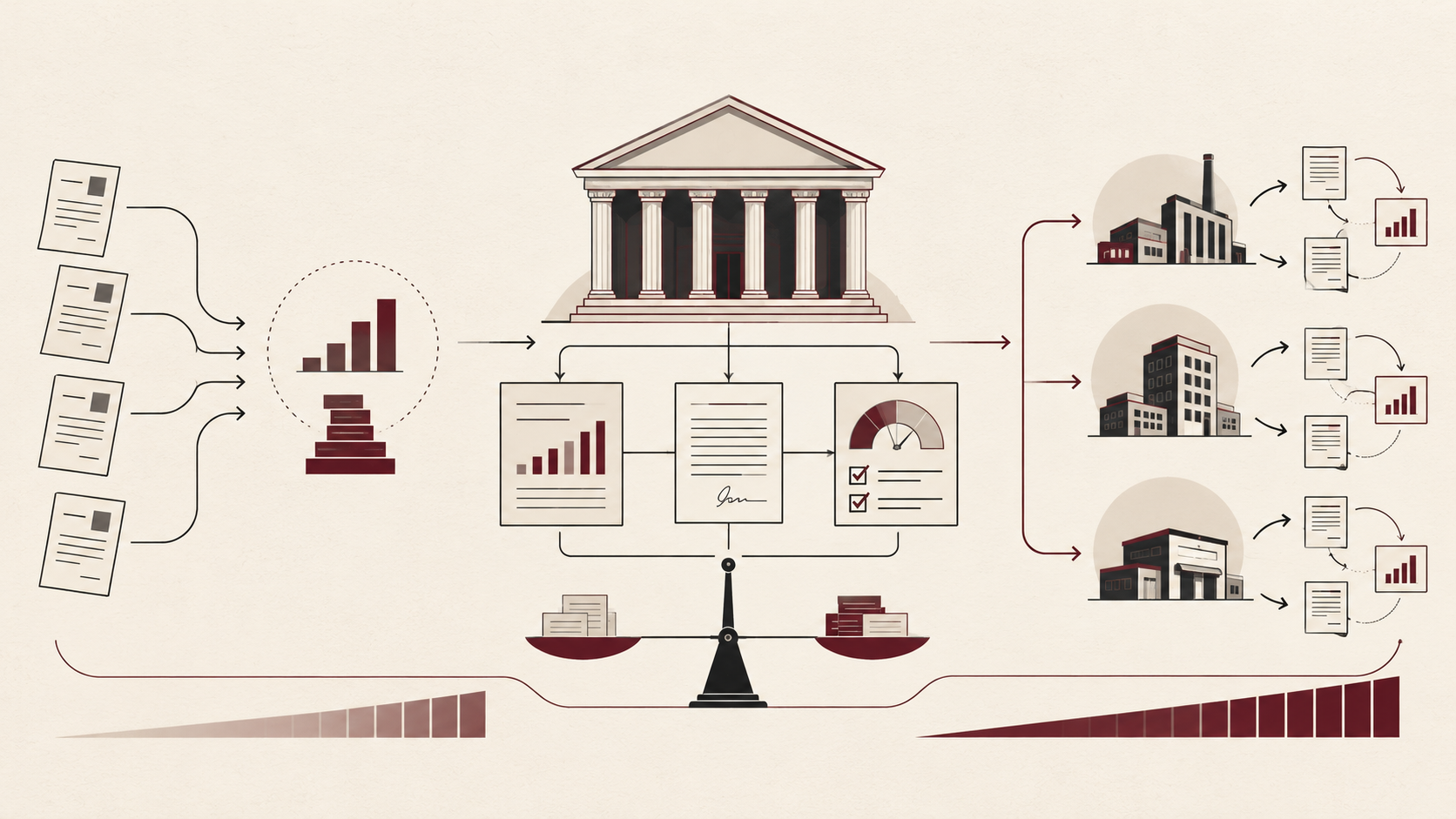
Banks earn revenue by extending credit, but the financial outcome of a loan may take years to become clear. Incentive structures that account for risk alongside lending activity can help align employee decisions with a bank's long-term performance. Borrower relationships add another dimension by supporting information gathering, credit monitoring, and future business opportunities.
- Loan volume alone does not determine a bank's profitability because lending also involves funding costs, credit risk, and potential losses.
- Federal Reserve guidance emphasizes balancing employee compensation with financial performance and risk.
- Relationship lending allows banks to accumulate information about borrowers through repeated interactions.
- The long-term value of lending depends on credit quality, ongoing monitoring, and sustainable borrower relationships.
A bank makes money when it lends. But approving more loans does not necessarily mean earning more profit.
Every loan creates an opportunity to collect interest, while also exposing the bank to the possibility that the borrower will not repay. For bankers responsible for originating loans and managing clients, the challenge is not simply finding more customers. It is identifying borrowers who can repay, structuring suitable financing, and maintaining relationships that remain valuable over time.
That raises an important business question: If a bank wants employees to generate more lending revenue, how should it reward them without encouraging unnecessary risk?
The answer involves more than bonuses. It connects employee incentives, credit risk, and the economics of relationship banking.
When More Lending Is Not Necessarily Better
Consider two commercial bankers working at the same institution.
One originates $20 million in new loans during the year. Another originates $15 million, but works with established borrowers whose financial performance and repayment capacity are well understood.
If the bank evaluates employees only by the dollar value of loans originated, the first banker appears more successful. But loan volume alone cannot establish which portfolio will ultimately produce greater value.
The bank must also consider interest income, funding costs, credit quality, operating expenses, and potential losses. A loan that generates revenue today may become costly if the borrower struggles to repay several years later.
This creates a potential difference between what benefits an employee in the short term and what benefits the bank over the life of a loan.
Economists describe this broader issue through agency theory: the interests of employees and the organizations they represent do not always align perfectly.
In banking, compensation arrangements are one way to address that problem.
The Federal Reserve's guidance on incentive compensation emphasizes that employee rewards should account for both financial performance and risk. The guidance recognizes that short-term revenue can differ substantially from long-term profitability because the consequences of lending decisions may take years to become clear.
How Banks Can Design Better Incentives
A banker may be responsible for attracting borrowers, evaluating financing needs, coordinating credit approvals, and managing existing client relationships.
Each activity contributes to the bank's business, but not every contribution is immediately reflected in revenue.
A compensation system focused narrowly on new lending volume could encourage employees to prioritize transactions that produce quick results. A more balanced approach can recognize the quality and durability of the business being generated.
Banks can incorporate risk-adjusted performance measures, longer evaluation periods, and deferred incentive payments. Under such arrangements, compensation may reflect not only the revenue an employee generates but also the risks associated with that revenue.
For example, two bankers could produce similar interest income while exposing the institution to different levels of credit risk. A risk-sensitive compensation system would recognize that difference rather than automatically rewarding them equally.
Federal Reserve guidance identifies several methods for aligning compensation with longer-term outcomes, including adjusting awards for risk and delaying payments until more information about those risks becomes available.
The principle extends beyond banking: employees respond to what organizations choose to measure and reward.
For lenders, that makes compensation design part of financial management, not simply a human resources decision.
Why Borrower Relationships Have Business Value
A lending relationship does not necessarily end when the bank transfers money to a borrower.
Commercial borrowers may need additional financing, changes to existing credit facilities, or banking services as their businesses grow. Maintaining a relationship gives bankers opportunities to understand how a client's operations and financing needs develop.
That knowledge can also support lending decisions.
Financial statements provide information about revenue, profitability, assets, and liabilities. Yet they may not capture every factor affecting a business's ability to repay debt.
A banker who has worked with a borrower over several years may develop a better understanding of its management, operating patterns, and business environment.
Economists call this relationship lending, a form of banking in which information accumulated through repeated interactions contributes to credit decisions.
Federal Reserve research by Allen Berger and Gregory Udell describes the importance of information gathered over time by loan officers, particularly in small-business lending.
Relationships can also have measurable economic value.
A 2013 Federal Reserve Bank of Boston study found that small commercial and industrial loans contributed value to smaller banking organizations, with the strongest value-enhancing effect associated with loans originally worth $100,000 or less. The researchers connected those findings to the benefits of relationship lending.
This does not mean longer relationships automatically produce safer loans. Familiarity cannot replace independent credit assessment, and existing borrowers can still experience financial difficulties.
But it helps explain why a bank might value a banker who understands and retains clients, even when that employee does not originate the largest volume of new loans.
What Happens After a Loan Is Approved?
The economics of lending also depend on what happens after the agreement is signed.
A commercial loan contract typically establishes the principal, interest rate, repayment schedule, and conditions the borrower must follow.
Some agreements include financial covenants, which require borrowers to maintain specified financial conditions or provide regular information to the lender.
For example, a lender might monitor the borrower's debt relative to its assets or its ability to cover interest expenses using operating earnings.
These measures help the bank evaluate whether the borrower's financial position remains consistent with the terms of the loan.
The Office of the Comptroller of the Currency reinforced the importance of managing lending risks throughout the life of a loan in its June 2026 Lending and Loan Portfolio Risk Management handbook. The publication addresses lending practices and risk management across the loan life cycle, rather than treating loan approval as the final stage of the process.
For banks, ongoing monitoring and borrower communication are therefore connected to the financial performance of the lending business.
A loan may generate interest income for years, but its value depends on the borrower's continued ability to meet its obligations.
The Business Behind a Banker's Performance
The connection between incentives and relationships reveals something important about how banks operate.
Lending revenue may begin with a transaction, but the bank's economic return develops over time.
That creates several dimensions of employee performance: bringing in business, assessing risk, maintaining credit quality, and developing relationships that support future financial activity.
These objectives can complement one another, but they are not always perfectly aligned.
A banker who focuses exclusively on generating new loans may overlook the value of existing clients. Conversely, maintaining strong relationships without generating sufficient revenue does not necessarily create a profitable lending business.
The challenge for banks is to establish performance measures that recognize both commercial activity and the quality of the resulting loan portfolio.
This is particularly relevant because the employee making or managing a lending decision may receive compensation long before the bank knows the full financial outcome.
Well-designed incentives can help narrow that timing gap.
Ultimately, the question is not whether banks should reward employees for lending. Lending remains a central source of banking revenue.
The more important question is whether the bank's definition of employee success reflects the long-term value of the business being created.
The economics of banking reveal an important distinction between generating revenue and creating lasting business value. A loan may appear successful when it is originated, but its ultimate contribution depends on performance over time. By connecting employee incentives to risk management and borrower relationships, banks can make compensation design part of a broader strategy for managing capital and developing sustainable lending businesses.
- Regulatory guidance Federal Reserve — Guidance on Sound Incentive Compensation Policies, June 2010
- Regulatory guidance Office of the Comptroller of the Currency — Lending and Loan Portfolio Risk Management, June 25, 2026
- Academic research Federal Reserve — Small Business Credit Availability and Relationship Lending: The Importance of Bank Organisational Structure, September 2001
- Academic research Federal Reserve Bank of Boston — The Value to Banks of Small Business Lending, 2013