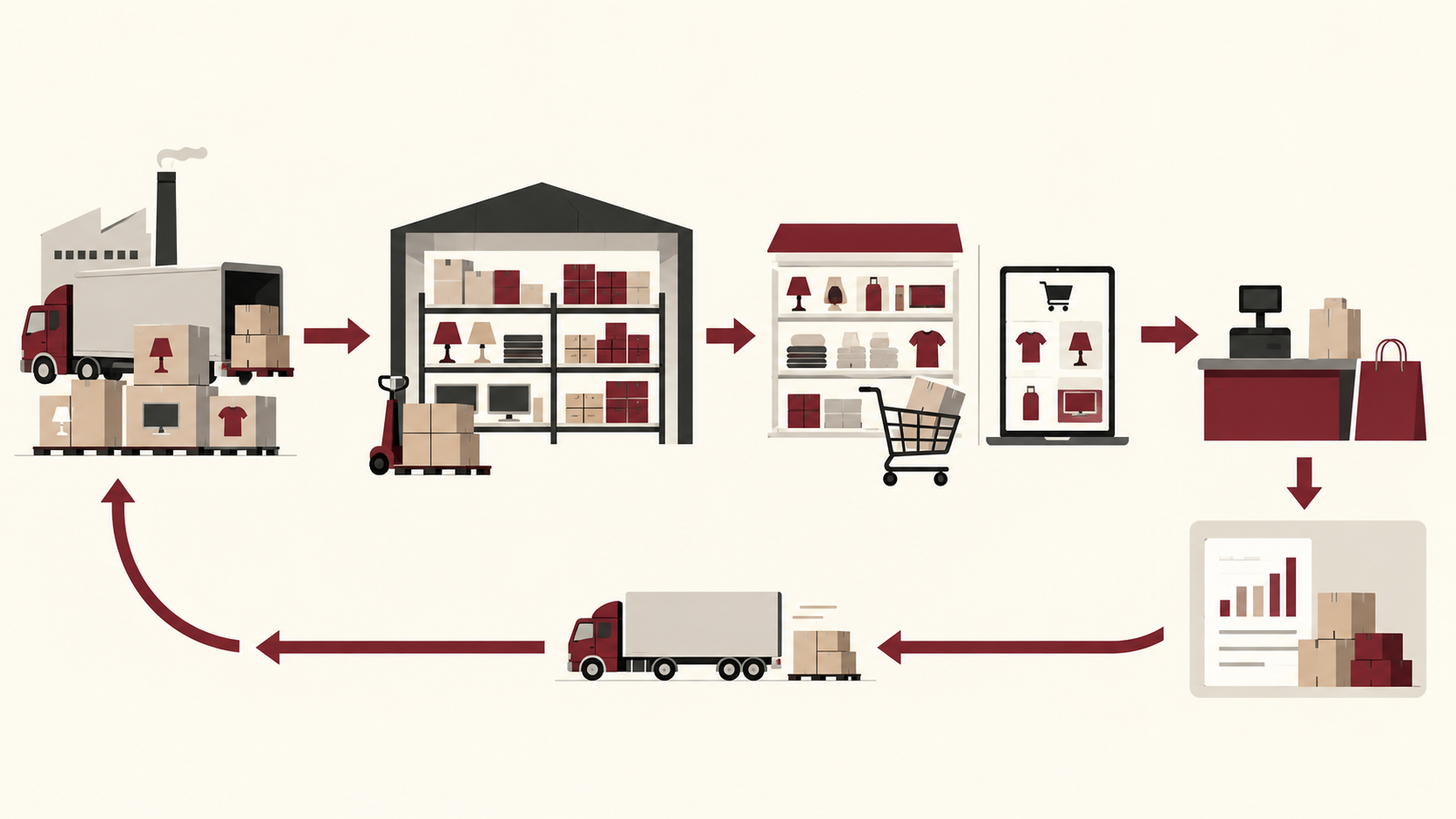
Inventory sits on the balance sheet as an asset, but retail performance depends on what happens to that inventory after it arrives. Understanding how products move from purchasing to sale helps connect accounting numbers with the supply chains, merchandising decisions and customer demand behind a retail business.
- Inventory is a current asset, but simply holding more merchandise does not by itself indicate stronger retail performance.
- Walmart ended fiscal 2026 with $58.85 billion in inventory and $535.4 billion in annual cost of sales.
- Those figures imply an approximate fiscal 2026 inventory turnover of 9.3 times, illustrating how balance-sheet inventory can be connected with merchandise flowing through COGS.
- Effective inventory management requires balancing product availability with the risk of carrying too much or too little merchandise.
Walk into a large retailer and almost everything on the shelves represents an asset.
A box of cereal, a television or a pair of shoes may eventually be sold to a customer, generating revenue for the business. Until that happens, the product generally sits on the balance sheet as inventory.
That creates a seemingly simple question: If inventory is an asset, wouldn't having more of it make a retailer better off?
Not necessarily.
For retailers, the amount of inventory matters, but so does what happens next. Products need to be available when customers want them, sold at an appropriate pace and replenished as demand continues. Too little inventory can mean missed sales. Too much can leave more capital tied up in products and increase the possibility of markdowns.
That makes inventory more than an accounting number. It is also part of the operating system behind a retail business.
Inventory Is an Asset — but It Is Supposed to Move
Inventory appears among current assets because a retailer expects to sell those products through its normal operations.
But unlike cash, inventory still has another step to complete.
A retailer first acquires merchandise. That merchandise becomes inventory. When customers buy it, the cost associated with the products sold leaves inventory and becomes cost of goods sold, or COGS, on the income statement.
The basic relationship can be expressed as:
Beginning Inventory + Purchases − COGS = Ending Inventory
It looks like an accounting equation, but it also describes a real business process.
Products enter the company through purchasing. They remain inventory while they are available for sale. Products that are sold flow into COGS, while unsold products remain in ending inventory.
Then the cycle starts again.
Inventory comes in → products become available → customers buy them → inventory is sold → the retailer replenishes
For a retailer operating thousands of stores and digital channels, managing that cycle becomes a major operational task.
Walmart Shows the Scale of the Cycle
Walmart offers a useful example.
At January 31, 2026, Walmart reported $58.85 billion of inventory, up from $56.44 billion a year earlier. During fiscal 2026, the company generated $706.4 billion in net sales and recorded $535.4 billion in cost of sales.
Those figures illustrate how much merchandise moves through a retailer of Walmart's scale.
Walmart also said its gross profit rate increased slightly in fiscal 2026, with the improvement driven in part by what the company described as disciplined inventory management, alongside growth in higher-margin businesses.
The latest results add another useful lesson. Walmart reported $61.6 billion of inventory at July 31, 2026, up 6.7% from a year earlier. The company attributed the increase to strategic initiatives and inflation. At the same time, quarterly revenue rose 5.9% to $187.9 billion and global e-commerce sales increased 23%.
In other words, an increase in inventory does not by itself tell investors whether inventory management is improving or deteriorating. The number needs context: sales, prices, product mix, expansion plans and expected customer demand can all affect how much merchandise a retailer holds.
The Metric That Connects Inventory to Sales
One way businesses and analysts examine this relationship is inventory turnover.
A common version of the calculation is:
Inventory Turnover = COGS ÷ Average Inventory
The ratio asks, in effect, how many times a company's average inventory is sold through during a period.
Using Walmart's fiscal 2026 figures provides a simple example. The company reported $56.44 billion of inventory at the beginning of the fiscal year, $58.85 billion at the end and $535.4 billion of cost of sales.
Average inventory was therefore roughly $57.64 billion.
Dividing Walmart's $535.4 billion of annual cost of sales by that average produces an inventory turnover of approximately 9.3 times for the year.
That does not mean every individual Walmart product was literally replaced 9.3 times. Walmart sells an enormous mix of merchandise with very different demand patterns. Grocery products, electronics, apparel and seasonal items can move at very different speeds.
Instead, turnover provides a company-level view of how inventory relates to the cost of merchandise flowing through the business.
Faster Is Not Automatically Better
It can be tempting to conclude that the highest possible inventory turnover is always the goal.
Retail operations are more complicated.
A retailer that keeps inventory extremely low may produce a high turnover ratio but also risk running out of popular products. A retailer carrying more inventory may be preparing for seasonal demand, expanding its assortment or responding to higher merchandise costs.
The objective is therefore not simply to minimize inventory.
It is to have the right products, in the right quantities, where customers want to buy them.
That balance becomes especially important in modern omnichannel retail. Walmart, for example, reported that global e-commerce sales increased 23% in its latest quarter, while Walmart U.S. store-fulfilled delivery continued to expand. Stores increasingly serve not only shoppers walking through the doors but also digital orders for pickup and delivery.
Inventory decisions therefore connect merchandising, supply chains, stores and e-commerce.
Inventory Is Also an Economy-Wide Signal
The same relationship appears beyond individual companies.
The U.S. Census Bureau reported that total business inventories reached $2.765 trillion in July 2026, up 0.8% from June and 3.8% from a year earlier. Business sales rose 0.3% during the month.
Economists also track the inventories-to-sales ratio, which compares the stock of inventory with the current pace of sales. The nationwide ratio stood at 1.30 in July, down from 1.37 a year earlier.
The idea is similar to what happens inside an individual retailer: inventory becomes more informative when compared with the rate at which products are moving through the economy.
The Balance Sheet Is Only the Beginning
Seeing inventory listed under current assets tells readers what a company holds at a particular point in time.
It does not tell the entire story.
Behind that single balance-sheet number is a continuous operating cycle involving purchasing, distribution, customer demand, sales and replenishment. Inventory turnover adds another layer by connecting the stock of merchandise on the balance sheet with the products flowing through the income statement as COGS.
That is why two retailers with different amounts of inventory cannot be judged simply by asking which one holds more.
The more useful question is what the inventory is doing.
For a retailer, products sitting on a shelf are assets. Products moving through a well-managed retail system are part of how those assets become sales.
Inventory is a useful example of why financial statements become more valuable when they are connected to business operations. The balance sheet shows the merchandise a retailer holds at one moment; COGS shows merchandise flowing out as products are sold. Inventory turnover connects the two. What looks like a basic accounting concept is therefore also a window into purchasing, supply chains, customer demand and the operating rhythm of retail.
- SEC filing Walmart Inc. — Form 10-K for the fiscal year ended Jan. 31, 2026, filed Mar. 13, 2026
- Company IR Walmart Inc. — Q2 FY2027 Earnings Release, Aug. 20, 2026
- Company IR Walmart Inc. — Q2 FY2027 Financial Presentation, Aug. 20, 2026
- Government data U.S. Census Bureau — Manufacturing and Trade Inventories and Sales: July 2026, Sept. 16, 2026
- News Reuters — U.S. business inventories rise more than expected in July, Sept. 16, 2026