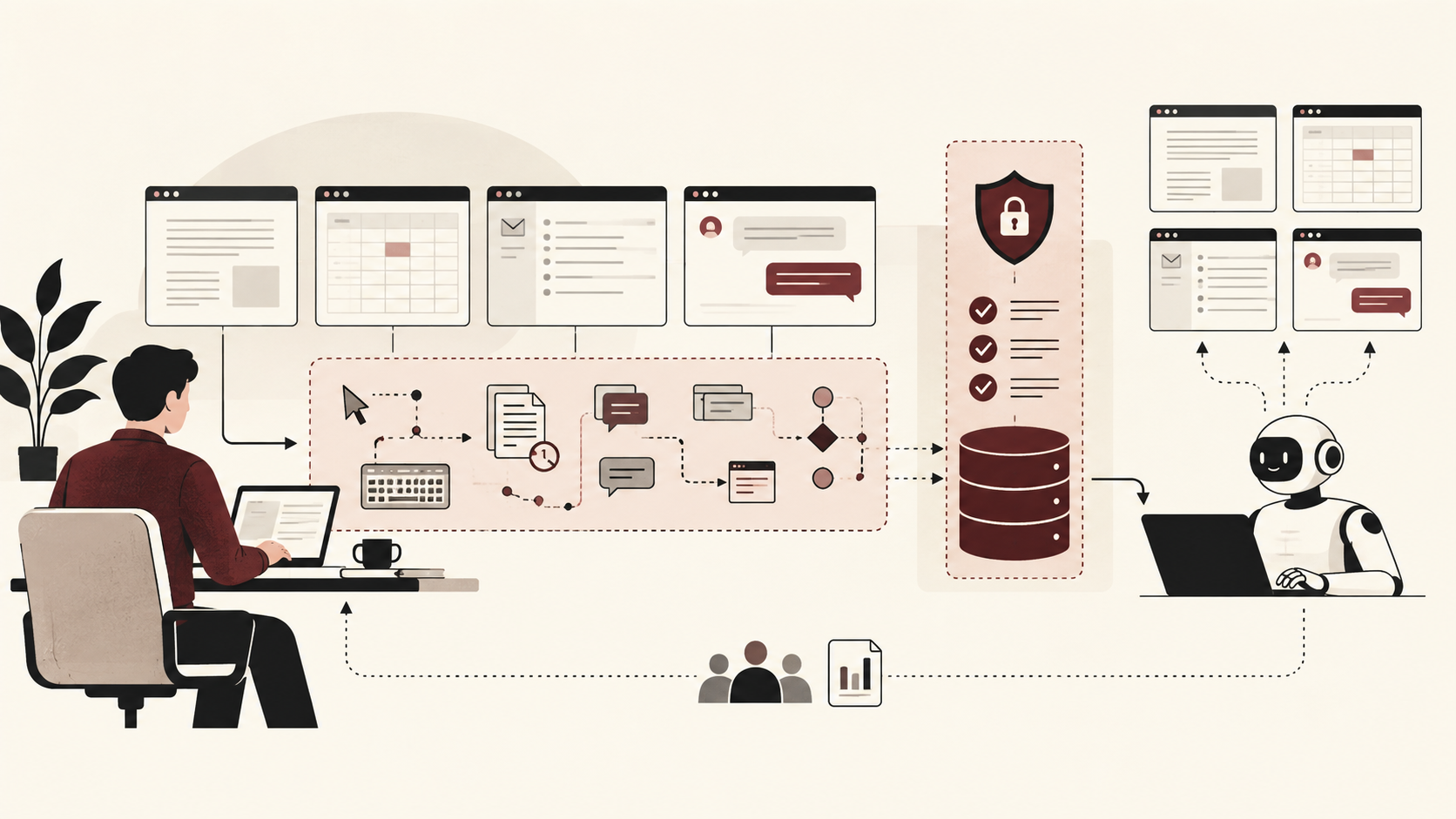
Enterprise AI is shifting the value of corporate data. Documents and databases still matter, but AI agents may also benefit from understanding the sequences, decisions and software interactions behind real work. That makes workplace data governance increasingly connected to both employee trust and AI competitiveness.
- AI agents need more than finished documents; examples of how people navigate software and complete multi-step tasks can provide useful workplace context.
- U.S. work-made-for-hire rules can give employers copyright ownership over qualifying employee-created works, but that does not create one universal ownership rule for every type of workplace data.
- Meta’s 2026 MCI initiative illustrates how employee computer-use data could be used to improve AI agents, as well as why consent, access and governance matter when collecting it.
- As companies increasingly deploy the same underlying AI models, proprietary knowledge and well-governed workflow context could become an important source of differentiation.
A workday leaves behind far more than finished documents.
An employee might write a presentation, answer emails, search through company files, revise a spreadsheet, enter prompts into an AI assistant and move information between several applications. Behind the final output is another layer of information: which tools were opened, what was clicked, what was typed and how a task moved from beginning to end.
Until recently, much of that activity could be viewed mainly as an operational record.
AI is giving it another possible use.
For companies trying to build AI agents that can perform knowledge work, the valuable information may not be only what employees produce, but how they produce it. That turns an ordinary question about workplace privacy into a broader business question:
Who controls the data created while people work — and what happens when that data can help teach AI how work gets done?
AI Needs More Than the Finished Document
Large language models became powerful partly by learning patterns from enormous collections of text, code and other information.
But reading information and performing a job are different problems.
Consider a simple workplace task: preparing an analysis for a manager.
A person might open an email, identify the request, find the relevant spreadsheet, compare several figures, search an internal database, decide which information matters, revise a chart and finally write a short explanation.
The finished document shows the result.
It does not necessarily show the process that produced it.
That distinction becomes important as AI moves from generating answers toward agents that can take actions across software.
Microsoft Research, for example, wrote in February 2026 that real workplace productivity can require managing many interdependent tasks rather than completing isolated instructions. Its CORPGEN research environment was designed around that problem and found that leading computer-using agents performed substantially worse when handling multiple tasks simultaneously than when dealing with a single task.
The implication is straightforward: knowing language is not the same as knowing how work happens.
An AI system may need context about sequences, decisions, software interactions and corrections to become better at completing complex workplace tasks.
That makes workflow data potentially valuable.
From Work Product to Work Process
This creates an important distinction between two kinds of workplace information.
The first is the work product: the report, presentation, code, design or spreadsheet an employee creates.
The second is the work process: the sequence of actions used to create it.
That process can generate data such as prompts, clicks, keyboard inputs, software interactions, revisions and task sequences.
Under U.S. copyright law, a copyrightable work created by an employee within the scope of employment can qualify as a “work made for hire.” In that situation, the employer is generally considered the author and copyright owner unless an applicable agreement provides otherwise. But copyright law does not mean that every piece of workplace-generated data has one universal owner. Copyright protects original expression, not ideas, procedures, processes or methods themselves, and other questions involving employee data can depend on contracts, privacy rules, company policies and jurisdiction.
So the question “Who owns my work data?” does not have one simple answer.
A company document, an employee’s personal information and a log of mouse movements may all be data, but they are not necessarily treated the same way.
For businesses, however, they can increasingly belong to the same strategic conversation: what information can be responsibly used to make workplace AI more useful?
Why Companies Want to Understand How Work Gets Done
Meta offered a particularly clear example in 2026.
Reuters reported in April that Meta had begun a Model Capability Initiative, or MCI, designed to capture certain activity on U.S. employees’ work computers, including mouse movements, clicks and keystrokes, as well as occasional screen snapshots. Meta said the purpose was to provide its AI models with real examples of how people interact with computers, including actions such as navigating menus and using keyboard shortcuts. The company said the information would not be used for performance assessments and that safeguards would protect sensitive content.
The program illustrates why workplace data can have a different value in the age of AI.
A company already has documents, emails, code and internal knowledge. But if it wants an AI agent to do more than retrieve that information — if it wants the agent to actually perform a task — examples of human actions may become useful as well.
Meta later paused the initiative and moved toward an opt-in approach following employee concerns, according to subsequent reporting.
That evolution is significant beyond one company.
It shows that collecting useful AI training data is not simply a technical problem. Companies also have to decide what should be collected, how it should be protected, who can access it, what it can be used for and how clearly those rules should be communicated.
In other words, data governance becomes part of AI strategy.
The Prompt Is Becoming Corporate Data Too
AI introduces another category of workplace information that barely existed a few years ago: the prompt.
A prompt can look like a simple question typed into a chatbot. In a professional environment, however, it can contain much more.
It might include a customer problem, a draft strategy, internal financial information, a piece of code or instructions explaining how an employee solves a recurring task.
Over thousands or millions of interactions, those prompts can also reveal something broader: how an organization thinks and works.
This helps explain why enterprise AI products increasingly make specific commitments about how organizational data is handled.
Microsoft says prompts, responses and organizational information accessed through Microsoft Graph in its enterprise Copilot products are not used to train foundation models. Those interactions can still be logged and governed under enterprise controls for purposes such as auditing, retention and eDiscovery.
OpenAI similarly says that data from its business offerings and API platform is not used to train its models by default.
These policies point to an emerging commercial principle: businesses increasingly want the benefits of AI without automatically turning proprietary workplace information into shared model-training data.
That makes data protection more than a compliance feature. It can become part of the product companies are buying.
Corporate Data May Become Part of the AI Advantage
For years, discussions about AI competition focused heavily on models, computing power and public training data.
Enterprise AI adds another layer: company-specific context.
Two companies can buy access to the same underlying AI model and still get very different results from it.
One may connect the model to carefully organized internal information, established workflows and well-defined permissions. Another may give it little context about how the organization actually operates.
The model may be similar.
The business environment around it is not.
OpenAI reported in August 2026 that enterprise AI use is increasingly moving from assistance toward execution, with agents being given context and tools to complete more complex tasks.
That shift makes internal knowledge and workflow context more strategically important.
The competitive question may therefore become less about simply having an AI model and more about how effectively a company can connect AI to the knowledge, processes and permissions that make its organization distinctive.
A New Kind of Business Asset
Calling workplace data an “asset” does not necessarily mean it appears as an asset on a company’s balance sheet.
In business terms, an asset can also describe a resource that helps an organization create value.
A company’s accumulated knowledge about how customers are served, how software is developed, how decisions are made or how complicated tasks move through an organization may become more useful when AI systems can learn from or operate within those processes.
But its value depends on more than volume.
A giant collection of employee activity is not automatically useful. The information has to be relevant, secure, properly governed and connected to a clear business purpose.
The same data can also carry costs and responsibilities. Workplace information may contain confidential company material, personal information or sensitive communications. Poor controls can make potentially valuable data a liability rather than an advantage.
That is why the next stage of enterprise AI may involve two developments at the same time.
Companies will try to give AI systems more context about how real work happens.
And they will need stronger rules around exactly how that context is collected and used.
The most valuable dataset inside a company, then, may not simply be a database of what employees have produced.
It could increasingly include something harder to capture:
how the organization actually gets things done.
The interesting business shift is from data about the business to data about how the business operates. AI models are becoming widely accessible, but every company has different workflows, internal knowledge and ways of making decisions. If AI agents increasingly need that context to perform useful work, the ability to organize and govern internal operational data could become as important as access to the model itself.
- Regulatory / legal U.S. Copyright Office — Copyright Act, Section 201: Ownership of Copyright
- News Reuters — Meta to start capturing employee mouse movements, keystrokes for AI training data, Apr. 21, 2026
- News Business Insider — How Meta tried, and failed, to grab its employees’ data for AI, Sept. 11, 2026
- Company research Microsoft Research — CORPGEN advances AI agents for real work, Feb. 26, 2026
- Company research OpenAI — Enterprise Signals: What frontier firms are doing differently, Aug. 12, 2026