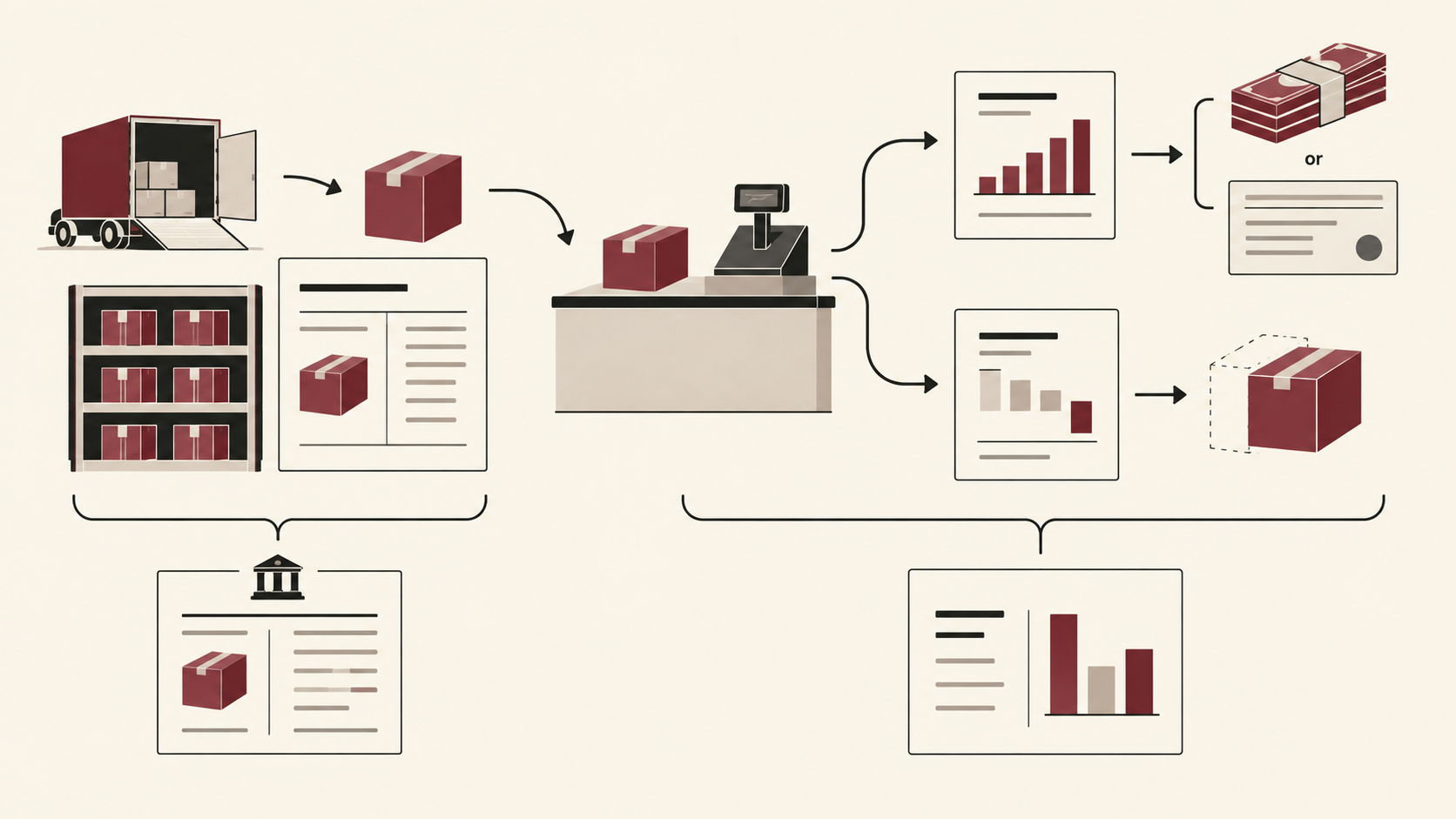
Financial statements can look like collections of separate numbers, but they are built from interconnected business transactions. Understanding what happens when one product is sold makes it easier to see why revenue is different from profit, why inventory is an asset before a sale, and why reported revenue does not necessarily mean cash has already arrived.
- A product held for sale is generally recorded as inventory rather than immediately becoming an expense.
- In the simplified example, selling a $40-cost product for $100 creates $100 of revenue and $40 of COGS, producing $60 of gross profit.
- A sale can increase cash immediately or create accounts receivable when payment will be collected later.
- Balance-sheet accounts such as inventory, cash and receivables connect directly with income-statement measures such as revenue and COGS.
A customer walks into a store, picks up a $100 product and pays at the register.
From the customer’s perspective, the transaction is simple: $100 leaves a bank account, and a product goes home.
For the retailer, much more happens.
The sale can affect cash, revenue, inventory, cost of goods sold and profit at nearly the same time. It is a useful example of how everyday business activity becomes the numbers that eventually appear in financial statements.
Before the Sale, the Product Is an Asset
Suppose a retailer acquires a product for $40 and plans to sell it to customers.
That $40 does not immediately become an expense simply because the company spent money to acquire the product. Instead, the merchandise is recorded as inventory, an asset on the balance sheet.
That distinction matters.
The SEC describes inventory as a current asset, alongside items such as cash and accounts receivable. Current assets generally include resources expected to be converted into cash within a year.
In other words, the retailer has exchanged one resource for another. If it paid cash for the product, cash declined by $40 while inventory increased by $40.
The company has not yet recorded the $40 as cost of goods sold because the product has not yet been sold.
Then the Customer Buys It for $100
Now suppose the retailer sells that product for $100.
The transaction creates two related accounting movements.
On the sales side, the company records $100 of revenue. If the customer pays immediately, cash increases by $100.
On the inventory side, the retailer removes the $40 product from inventory and recognizes its cost as cost of goods sold, or COGS.
The simplified transaction looks like this:
Sale:
Cash +$100
Revenue +$100
Cost of the product sold:
Inventory −$40
COGS +$40
This treatment reflects a fundamental connection between the balance sheet and income statement. Inventory sits on the balance sheet while the product is held for sale. Once that inventory is sold, its cost moves into the income statement as an expense associated with the sale.
The IFRS Foundation describes the same underlying mechanism: when inventory is sold, its carrying amount is recognized as an expense in the period in which the related revenue is recognized. Its educational material illustrates this with separate entries for the sale itself and the removal of the sold inventory.
$100 of Revenue Is Not $100 of Profit
This is where one of the most important distinctions in financial statements becomes visible.
The retailer generated $100 in revenue, but it did not generate $100 in profit.
The product itself cost $40.
So, in this simplified example:
Revenue: $100
COGS: $40
Gross profit: $60
That $60 is gross profit, not net profit.
The SEC explains that gross profit is calculated after subtracting the cost of sales from net revenue. Other expenses — such as employee compensation, rent, marketing and other operating costs — may still have to be deducted before reaching net income.
That is why a company's revenue alone does not tell investors how much money the business ultimately earned. Two retailers could each generate $1 billion in revenue while having very different cost structures and profits.
What If the Customer Has Not Paid Yet?
There is another important complication: revenue and cash do not always arrive at the same time.
Suppose the same $100 product is sold on credit and the customer is allowed to pay later.
The company may recognize revenue when the applicable revenue-recognition requirements have been satisfied even though it has not yet received the cash. Under FASB Topic 606, the core principle is to recognize revenue in a way that depicts the transfer of promised goods or services to the customer for the consideration the company expects to receive.
Instead of increasing cash immediately, a credit sale can create an accounts receivable balance representing an amount owed by the customer. The SEC defines accounts receivable as a balance-sheet account reflecting amounts customers owe for goods or services purchased on credit.
In simplified form:
Accounts Receivable +$100
Revenue +$100
The customer can pay later:
Cash +$100
Accounts Receivable −$100
The later collection does not create another $100 of revenue. It converts one asset — the receivable — into another asset, cash.
This is one reason cash and profit should not be treated as interchangeable concepts when reading financial statements. The SEC notes that cash-flow statements and income statements provide related but different information: one tracks cash moving through the business, while the other measures revenues and expenses over a period.
One Purchase Connects the Financial Statements
The larger lesson is not really about a $100 product.
It is about how financial statements translate business activity.
A product can begin as inventory on the balance sheet, become COGS on the income statement when it is sold, generate revenue, and create either cash or accounts receivable depending on how the customer pays.
The SEC emphasizes that financial statements should not be viewed independently. Changes in assets and liabilities on the balance sheet connect with revenues and expenses on the income statement, while the cash-flow statement provides another view of how cash actually moved.
So when a retailer reports revenue, inventory, COGS and gross profit, those figures are not isolated accounting numbers.
They are different financial representations of the same underlying business cycle: companies acquire resources, hold products for sale, sell them to customers, recognize the associated costs and ultimately collect cash.
A single item crossing a checkout counter is where that cycle becomes visible.
Accounting becomes more intuitive when financial statements are viewed as translations of real business activity rather than separate sets of numbers. Revenue, inventory, COGS and gross profit all trace back to products moving through a business — from acquisition, to sale, to collection. That connection is useful far beyond the classroom: it is the foundation for understanding how retailers turn inventory into earnings and cash.
- Government / Investor Education U.S. Securities and Exchange Commission — Beginners' Guide to Financial Statements, Feb. 4, 2007
- Government / Regulatory Reference U.S. Securities and Exchange Commission — Glossary: Accounts Receivable, Current Assets and Financial Statements
- Accounting Standard Financial Accounting Standards Board — Revenue Recognition: Topic 606
- Accounting Standard IFRS Foundation — IAS 2 Inventories