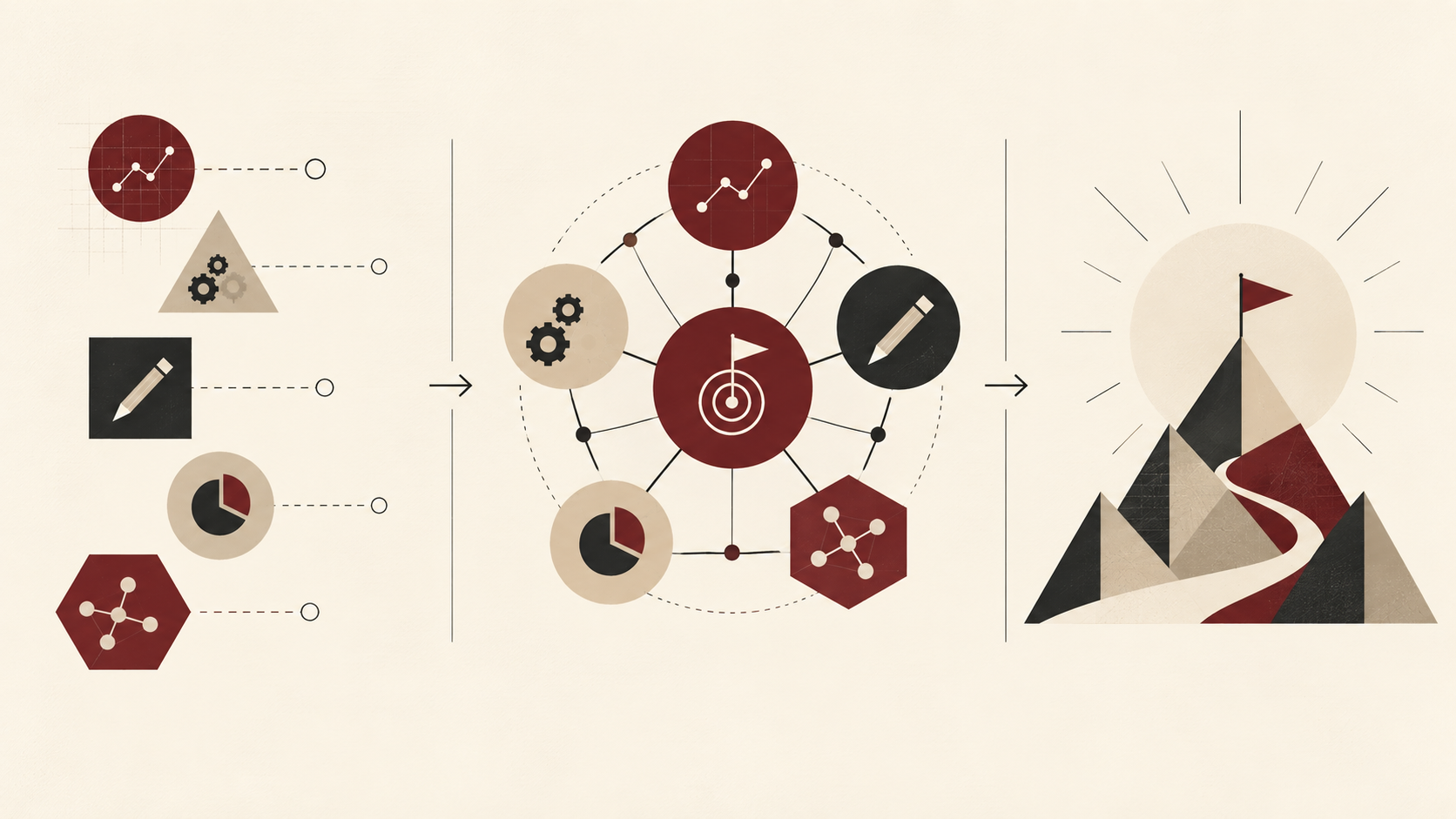
Companies invest heavily in finding skilled employees, but hiring determines only part of what an organization can produce. Team design determines whether different knowledge is shared, responsibilities are clear and individual work can be converted into coordinated execution. Research on team effectiveness suggests that managing the connections between talented people can be as important as assembling the talent itself.
- Google's Project Aristotle found that, among the teams it studied, how members worked together mattered more for effectiveness than simply who was on the team.
- Research on diversity suggests different perspectives can broaden a team's informational resources, but diversity does not automatically improve performance; teams need processes that allow members to exchange and integrate what they know.
- Psychological safety can support learning by making it easier for team members to raise problems, ask questions, admit mistakes and contribute ideas.
- Clear responsibilities, dependable execution, team norms and shared goals help turn individual capabilities into coordinated work.
Companies spend enormous amounts of time trying to hire talented people. The logic seems straightforward: put enough capable people in one room, and the result should be a capable team.
But teams do not work like simple addition.
A group can have strong individual performers and still struggle with unclear responsibilities, weak communication or decisions that never fully use the knowledge available around the table. Conversely, people with different expertise and perspectives can produce strong results when the team gives them a structure for combining what they know.
That distinction matters because much of modern business is organized around teams. Product launches can involve engineers, designers, marketers and finance teams. Consulting projects combine different specialties. Startups may require a small group to move between product development, customer research and fundraising.
The business question, then, is not simply how companies find great people. It is how they turn individual talent into collective performance.
A Team Is More Than a Collection of Employees
There is an important difference between a group and a team.
Google's research on team effectiveness defined work groups as relatively independent collections of people who may exchange information, while teams involve greater interdependence: members plan, solve problems, make decisions and review progress around shared work.
That interdependence changes the performance equation.
If five people perform five unrelated tasks, each person's individual ability can largely determine the quality of their own output. But when five people must produce one result together, performance also depends on what happens between them.
Does information reach the right person? Does everyone understand who makes the final decision? Can someone challenge an assumption? Will people admit that something is going wrong before it becomes expensive to fix?
These questions are less visible on a résumé, but they can shape what a team actually produces.
What Google Found When It Studied Its Own Teams
Google explored this question through Project Aristotle, an internal research effort examining what made teams effective inside the company.
Researchers considered both team composition — including characteristics such as skills, personality and demographics — and team dynamics, or how members actually worked together. They analyzed hundreds of variables using more than 35 statistical models.
The company's conclusion was notable: within the teams it studied, effectiveness depended less on who was on the teamthan on how the team worked together.
Google identified five dynamics associated with effective teams: psychological safety, dependability, structure and clarity, meaning, and impact.
This does not mean talent is irrelevant. Teams still need people with the knowledge and skills required for the work. Instead, the findings point to a second layer of performance: companies need mechanisms that allow those individual capabilities to work together.
That is where team design begins.
Different Perspectives Are Resources — If Teams Can Use Them
One reason companies build teams rather than assigning every problem to one person is that complex decisions often require different information.
A marketer may understand customers. An engineer may understand technical constraints. A finance employee may see costs and returns differently. Someone closer to operations may notice implementation problems that others miss.
Research on work-group diversity, however, shows that simply assembling different people does not guarantee better performance.
A widely cited model developed by Daan van Knippenberg, Carsten De Dreu and Astrid Homan found that research linking diversity and group performance had produced inconsistent results. Their framework helps explain why: different perspectives can expand the information available to a group, but social categorization and other group processes can interfere with whether that information is actually examined and integrated.
In other words, having different perspectives and using different perspectives are two separate things.
Research on functionally diverse teams similarly emphasizes information elaboration: members need to exchange relevant knowledge, explain their reasoning, consider other perspectives and integrate that information into the group's decisions.
That makes diversity partly a team-design question. A company can assemble people with different expertise, but the potential business value appears only when the team's working process allows those differences to enter the decision.
Good Teams Need Room for Disagreement
That leads to another important concept: psychological safety.
Harvard Business School professor Amy Edmondson defined team psychological safety as a shared belief that a team is safe for interpersonal risk-taking. Her 1999 study of 51 work teams found psychological safety was associated with learning behavior, which in turn was linked to team performance.
The idea can sound softer than it actually is.
Psychological safety does not mean that everyone agrees or that performance standards disappear. Its business relevance is almost the opposite: people need to be able to surface information that the rest of the team may not want to hear.
An employee might notice that a project is falling behind. A junior team member might see a flaw in a manager's assumption. Someone may need to admit a mistake, ask for help or challenge the direction of a meeting.
If speaking up carries too much interpersonal risk, that information can remain unused.
Google's Project Aristotle similarly identified psychological safety as the most important of the five team dynamics in its research. Its description focused on whether employees could ask questions, admit mistakes and offer ideas without expecting embarrassment or punishment from teammates.
For businesses, the value is not simply that employees feel comfortable. It is that information can move through the organization more effectively.
Structure Matters Too
Good collaboration also needs something less abstract: clarity.
Teams make countless small decisions about how work gets done. Who owns each task? Who has authority to make a decision? When should another person be consulted? What happens when a deadline is missed?
If those answers are unclear, even talented people can duplicate work, wait for decisions or assume someone else is responsible.
Google's research identified both dependability and structure and clarity as important team dynamics. Dependability meant that members reliably completed quality work on time, while structure and clarity included understanding job expectations, processes and performance consequences.
Earlier team-effectiveness research reached a related conclusion. Harvard Business School's summary of Richard Hackman's work describes effective team design as involving clear goals, tasks suited to teamwork, an appropriate mix of skills and experience, adequate resources, and access to coaching and support.
This is why team design is a business issue rather than simply an interpersonal one.
Companies design financial systems so money reaches the right projects. They design supply chains so products reach the right places. Teams require architecture too: responsibilities, information flows, decision rights and accountability.
Teams Also Develop Their Own Rules
Not every part of that architecture appears in an organizational chart.
Teams gradually develop norms — informal expectations about how members behave around one another. Meetings might encourage disagreement, or quietly discourage it. Deadlines might be treated as commitments, or as suggestions. One person might dominate decisions even though everyone technically has an equal voice.
These patterns can become the team's operating system.
That is why useful norms need to become concrete behaviors. A norm such as encouraging participation, for example, matters only if the team's actual process gives people opportunities to contribute. Teams also need ways to hold members accountable when agreed working norms are ignored.
Shared goals provide another layer. Members need to understand not only their individual assignments but how those assignments contribute to a common result. Google identified both meaning and perceived impact as relevant dynamics: employees benefited from understanding why their work mattered and how it contributed to broader organizational goals.
That is what begins to turn individual responsibility into collective responsibility.
The Business of Building a Team
Hiring still matters. A software company needs engineers who can build software; an investment bank needs people who understand finance; a retailer needs employees who understand merchandising, operations and customers.
But talent is an input, not the finished product.
The broader lesson from team-effectiveness research is that companies also have to design the system connecting those people.
Different perspectives expand the information available to a team. Psychological safety can make it easier to surface that information. Clear roles and norms help determine how it moves. Dependability turns assigned work into completed work. Shared goals give individual contributions a common direction.
The result is a different way of thinking about organizational performance.
Companies do not only compete for talent. They also compete through their ability to organize talent.
And that means one of the most important questions after hiring great people may be what happens once they start working together.
Talent is often treated as something a company either has or does not have. Team research points to a more useful distinction: human capital has to be organized before it becomes organizational capability. Hiring can bring knowledge into a company, but team design influences whether that knowledge reaches decisions, combines with other expertise and ultimately becomes useful output. The competitive advantage, therefore, may lie not only in attracting strong individuals but in building systems that allow them to work well together.
- Company research Google re:Work — Understand Team Effectiveness, Project Aristotle
- Academic research Amy C. Edmondson — Psychological Safety and Learning Behavior in Work Teams, Administrative Science Quarterly, June 1999
- Academic research Daan van Knippenberg, Carsten K. W. De Dreu and Astrid C. Homan — Work Group Diversity and Group Performance: An Integrative Model and Research Agenda, Journal of Applied Psychology, December 2004
- Academic research Elizabeth H. Homan et al. — Information Elaboration and Team Performance: Examining the Psychological Origins and Environmental Contingencies, Organizational Behavior and Human Decision Processes, 2014
- Academic research Harvard Business School Working Knowledge — The Importance of Teaming, Apr. 25, 2012