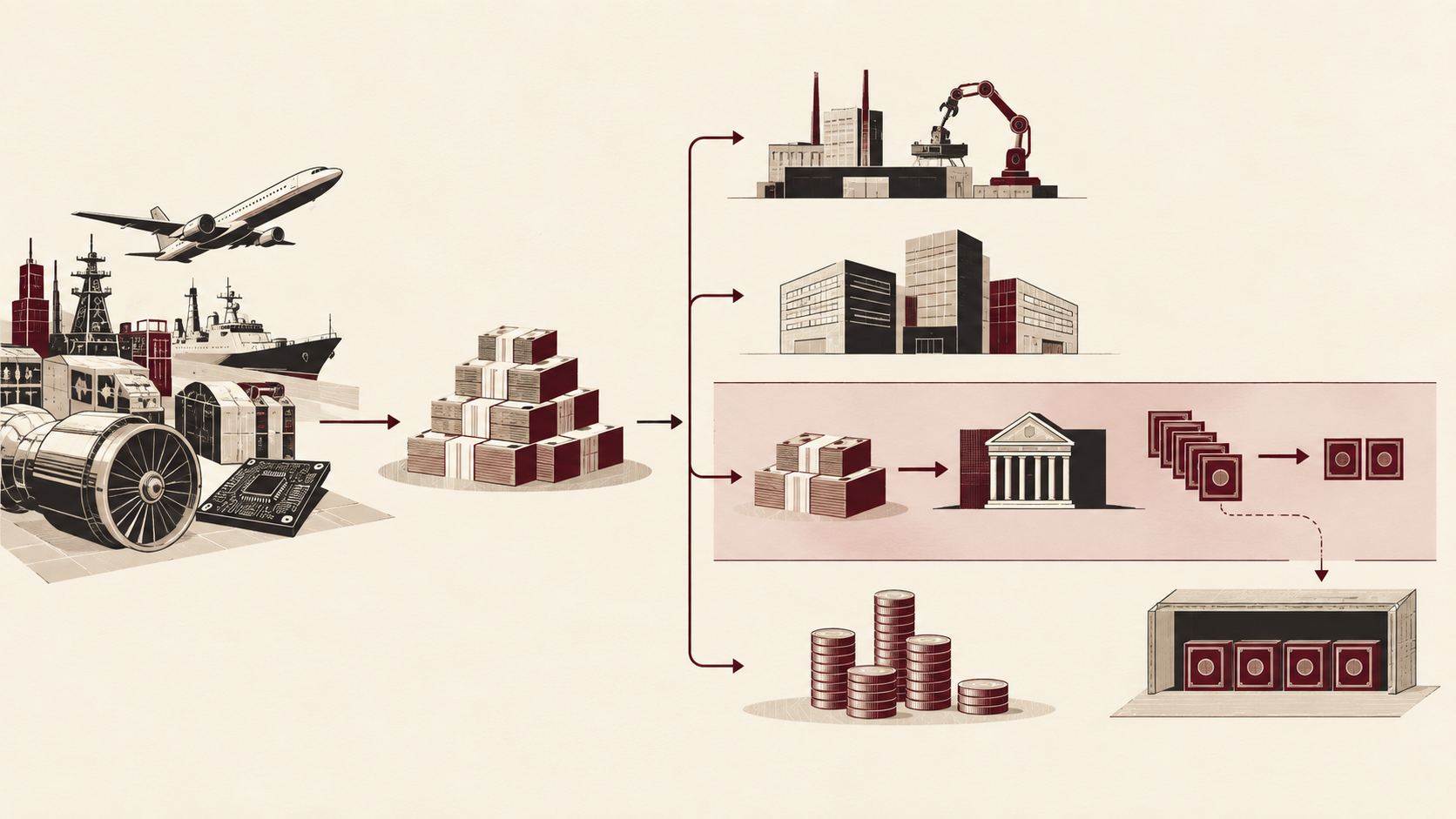
Share buybacks are often discussed through their effect on a company’s stock, but the transaction begins with a more fundamental business decision: how to use corporate cash. Curtiss-Wright’s expanded authorization shows how free cash flow can be divided among reinvestment, acquisitions, dividends and share repurchases—and how those choices eventually appear on the balance sheet.
- Curtiss-Wright added $510 million of repurchase authorization on Sept. 10, bringing its total available authorization to $700 million.
- The company plans to execute an additional $100 million of repurchases through a 10b5-1 plan running through the end of October 2026.
- Curtiss-Wright raised its 2026 free cash flow outlook to $585 million to $605 million after generating $160 million in the second quarter.
- A share repurchase uses corporate cash to reacquire shares and is recorded through treasury stock, reducing shareholders’ equity rather than operating profit.
Curtiss-Wright is giving itself significantly more room to buy back its own stock.
On Sept. 10, the aerospace and defense technology company said its board authorized an additional $510 million for future share repurchases, bringing its total available authorization to $700 million. Of that amount, Curtiss-Wright plans to use $100 million immediately through a Rule 10b5-1 trading plan.
The announcement is more than a change in the number of shares the company may repurchase. It offers a useful look at a broader corporate finance question: What actually happens when a company uses its cash to buy back its own stock?
A Bigger Buyback Program
Curtiss-Wright provides highly engineered products and services across aerospace and defense as well as commercial power, process and industrial markets. In 2025, the company generated $3.50 billion in sales and $484 million in net earnings. Aerospace and defense markets accounted for about $2.45 billion of those sales.
Its latest repurchase authorization builds on a series of buyback actions.
Before the Sept. 10 decision, Curtiss-Wright had $190 million remaining under existing authorizations. The board added another $510 million, bringing the available total to $700 million. The company then established a 10b5-1 plan to purchase $100 million of shares through the end of October. After that plan is completed, it expects to retain $600 million of repurchase authorization.
An authorization, however, is not the same as an obligation to spend the entire amount. Curtiss-Wright’s SEC filing says the broader authorization has no expiration date and can be changed or terminated by the board. Future purchases can also depend on market conditions and other corporate, regulatory and tax considerations.
That distinction matters. The $700 million figure represents capacity to repurchase shares, not $700 million of stock that has already been purchased.
What Actually Happens in a Share Buyback?
A share buyback occurs when a company purchases shares of its own stock from the market.
The transaction changes both sides of the company’s financial position. Cash, an asset, falls because the company spends money on the shares. The repurchased stock is generally recorded within shareholders’ equity as treasury stock, a contra-equity account that reduces total equity.
Curtiss-Wright’s own plan also illustrates another effect: reducing or offsetting the number of shares held by outside investors. The company said it expects to use repurchases partly to offset dilution from employee equity-based compensation, while retaining the ability to make additional opportunistic repurchases.
That makes a buyback different from an ordinary operating expense. The company is not purchasing inventory or paying employees. It is deciding how to deploy capital that is available after funding its operations and other priorities.
In accounting terms, treasury stock provides the bridge between a headline about a buyback and the shareholders’ equity section of the balance sheet. In the AC221 framework, treasury stock is a contra-equity account created when a company reacquires its own shares.
The Cash Behind the Decision
Curtiss-Wright’s latest move comes alongside stronger operating results.
In the second quarter of 2026, the company reported $924 million in sales, up 5% from a year earlier, and $179 million in operating income. New orders reached $1.1 billion, while backlog stood at $4.5 billion, up 10% from the end of 2025.
Cash generation also increased. Second-quarter free cash flow was $160 million, compared with $117 million a year earlier. Curtiss-Wright subsequently raised its full-year 2026 free cash flow outlook to between $585 million and $605 million.
Free cash flow is particularly relevant to capital allocation because it represents cash remaining after operating cash flow and capital expenditures under Curtiss-Wright’s definition. The company identifies uses for that cash including investing in the business, acquisitions, debt repayment and returning capital to shareholders.
The buyback therefore sits within a larger decision about where corporate cash goes.
Curtiss-Wright has also been investing in its operations and pursuing acquisitions. Its 2026 free cash flow guidance incorporates roughly $25 million more capital expenditures than in 2025 to support growth and efficiency. The company has described its capital allocation approach as balancing investment in core operations, strategic acquisitions and shareholder returns.
Buybacks Are One Part of Capital Allocation
Curtiss-Wright was already an active buyer of its shares before this month’s authorization.
The company repurchased approximately 934,000 shares in 2025 and reported $465 million in total share repurchases for the year. That same year, it generated a record $554 million in free cash flow.
The latest authorization extends that pattern while leaving the company flexibility over when and how much stock it ultimately purchases.
Curtiss-Wright also continues to return capital through dividends. Alongside the September buyback announcement, its board declared a quarterly dividend of $0.26 per share, payable Oct. 9 to shareholders of record as of Sept. 25. Earlier this year, the company raised its quarterly dividend from $0.24 to $0.26, marking its tenth consecutive annual dividend increase.
For investors, buybacks and dividends are both ways companies can return capital. But the mechanics differ. A dividend distributes cash directly to shareholders. A buyback uses corporate cash to reacquire shares, changing the company’s cash balance, treasury stock and potentially the number of shares outstanding.
Why the Balance Sheet Matters
The headline number in a buyback announcement can make the transaction appear simple: a company plans to purchase hundreds of millions of dollars of its own stock.
The underlying business decision is broader.
Companies generate cash and then have to decide how to deploy it. They can reinvest in existing operations, acquire another business, repay debt, retain cash, pay dividends or repurchase shares. Those choices together form a company’s capital allocation strategy.
Curtiss-Wright’s expanded authorization shows how share repurchases fit into that system. The $700 million authorization does not simply represent money leaving the company. It represents additional flexibility over how Curtiss-Wright can allocate future capital while continuing to invest in its businesses.
And on the balance sheet, the mechanism becomes visible: cash used for repurchases declines, treasury stock increases as a contra-equity account, and total shareholders’ equity is reduced.
That is what turns a share-buyback headline into a corporate finance story.
The interesting part of Curtiss-Wright’s announcement is not simply the size of the authorization. It is the sequence behind it: operating businesses generate cash, management decides where that capital can be deployed, and those choices eventually reshape the balance sheet. A buyback is one possible destination for that cash alongside reinvestment, acquisitions, debt management and dividends. Understanding that chain makes capital allocation easier to see as an operating business decision rather than simply a stock-market event.
- SEC filing Curtiss-Wright Corporation — Form 8-K, Share Repurchase Authorization, Sept. 10, 2026
- Official release Curtiss-Wright Corporation — Curtiss-Wright Raises Total Share Repurchase Authorization to $700 Million and Announces an Additional $100 Million Expansion of 2026 Share Repurchase Program, Sept. 10, 2026
- Company IR Curtiss-Wright Corporation — Second Quarter 2026 Financial Results and Raised Full-Year Guidance, Aug. 5, 2026
- Company filing Curtiss-Wright Corporation — 2025 Annual Report, Form 10-K