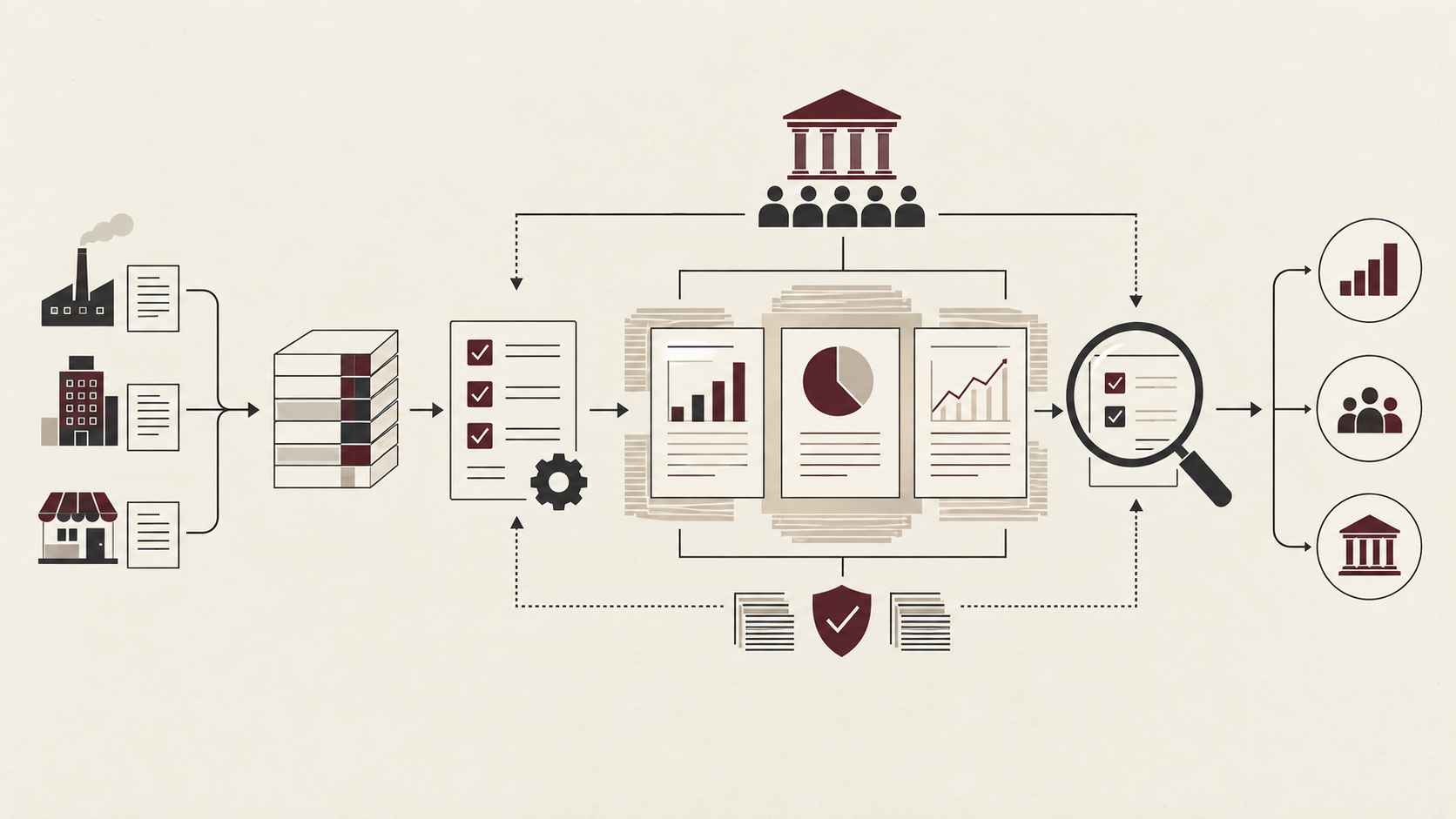
Financial statements are one of the main ways investors understand a business they do not directly operate. Their usefulness depends not simply on companies publishing numbers, but on a reporting system that makes those numbers comparable, transparent and subject to independent oversight. Reliable information, in turn, gives capital markets a stronger basis for deciding where resources should go.
- U.S. public-company financial reporting relies on GAAP to provide a common framework for recognizing, measuring and presenting financial information.
- Management—not the external auditor—is responsible for preparing a company’s financial statements and related disclosures.
- Audit committees provide independent oversight, while external auditors seek reasonable assurance that financial statements are free of material misstatement.
- Reliable historical financial information matters because investors use it to evaluate future performance and make capital-allocation decisions.
A company can report billions of dollars in revenue, profit or assets. But before investors use those numbers to judge the business, there is a more basic question: Why should they trust them?
Financial statements are prepared by companies themselves. Management records transactions, makes accounting estimates and ultimately produces the statements investors see. Yet corporate financial reporting is not designed to depend on management’s word alone.
For U.S. public companies, reliability comes from a broader reporting system. Accounting standards establish common rules for measuring and presenting financial information. Management is responsible for the statements and the controls behind them. Disclosures add context. Boards and audit committees provide oversight. Independent auditors examine the financial statements and supporting evidence.
Together, those layers make reported numbers more useful for one of their most important purposes: helping investors make decisions about where to allocate capital.
The Numbers Start With a Common Accounting Language
The first layer is Generally Accepted Accounting Principles, or GAAP.
Without common accounting standards, companies could have much more freedom to decide when revenue should be recognized, how assets should be measured or how certain expenses should be reported. Comparing two companies—or even the same company across different years—would become much harder.
GAAP provides the framework that U.S. public companies use to prepare financial statements. The Financial Accounting Standards Board, or FASB, develops accounting standards and maintains a conceptual framework for financial reporting. That framework identifies relevance and faithful representation as fundamental characteristics of useful financial information.
That does not mean every accounting number is perfectly objective. Financial statements can include estimates and judgments. A company may need to estimate how much of its receivables will ultimately be collected, for example, or determine the useful life of an asset.
The value of accounting standards is that these decisions take place within an established framework rather than being invented independently by each company.
Management Is Responsible for the Financial Statements
Another important distinction is easy to miss: auditors do not create a company’s financial statements. Management does.
The SEC states that management is responsible for preparing a company’s financial statements and related disclosures. For public companies, senior executives also carry formal responsibilities for financial reporting. SEC rules implementing the Sarbanes-Oxley Act require principal executive and financial officers to make certifications regarding information in annual and quarterly reports and the company’s disclosure controls and procedures.
This matters because reliable reporting begins inside the company.
A business needs systems capable of recording transactions correctly, determining who can approve them, reconciling accounts and moving accurate information into its financial statements. These processes form part of the company’s internal control over financial reporting.
In other words, reliability is not something added only after the financial statements have been produced. It starts with the way financial information is created and controlled.
Why Disclosure Matters Beyond the Headline Number
A financial number rarely tells the entire story by itself.
Suppose a company reports higher revenue. Investors may also need to know how that revenue was recognized, whether an acquisition affected the comparison, which accounting estimates were important and what risks could materially affect the business.
That is why financial reporting includes more than an income statement or balance sheet. Notes to the financial statements and other required disclosures provide information that helps readers understand what sits behind the headline figures.
The distinction matters because the same numerical result can carry different economic meaning depending on how it was generated.
Reliable financial reporting therefore depends not only on measurement, but also on transparency.
Corporate Governance Adds Another Layer
There is also a governance structure between management and the market.
For listed U.S. companies, the audit committee, typically composed of independent members of the board, plays a central role in overseeing financial reporting and the external audit. SEC rules make the audit committee directly responsible for the appointment, compensation, retention and oversight of the independent auditor.
This creates an important separation.
Management runs the company and prepares its financial information. The audit committee provides oversight on behalf of the board. The external auditor independently examines the financial statements.
The SEC has described these roles as interconnected parts of a financial reporting system intended to provide investors with high-quality, reliable information.
What Does an Independent Auditor Actually Do?
An audit is one of the most visible checks on corporate financial reporting, but its purpose is sometimes misunderstood.
An independent auditor does not simply look at a company’s final profit number and decide whether it seems reasonable.
Auditors assess risks of material misstatement and gather evidence related to amounts and disclosures in the financial statements. That work can involve examining records, testing transactions, evaluating accounting policies and significant estimates, understanding internal controls and considering whether the overall financial statements are fairly presented.
The objective is to obtain reasonable assurance that the financial statements are free of material misstatement, whether caused by error or fraud, and to express an opinion on whether the statements are fairly presented, in all material respects, under the applicable reporting framework.
The word reasonable is important.
An audit does not provide absolute certainty that every number is correct. PCAOB standards explicitly distinguish reasonable assurance—a high level of assurance—from absolute assurance. Auditing instead focuses on whether errors or omissions could be material, meaning significant enough to matter to users of the financial statements.
That makes an audit less like a guarantee and more like an independent verification layer designed to increase confidence in the information investors receive.
Reliable Numbers Make Capital Markets Work Better
All of these mechanisms ultimately connect to a larger economic function.
Investors use historical financial information to form expectations about a company’s future. Revenue can help reveal demand and growth. Margins can show how efficiently a business converts sales into profit. Assets and liabilities provide information about the resources a company controls and the obligations it must meet. Cash flows show how money actually moves through the business.
Those historical numbers then become inputs into decisions about future earnings, risk and value.
FASB’s conceptual framework explicitly connects useful financial reporting to investment, credit and other resource-allocation decisions. The SEC has similarly emphasized that investors benefit from high-quality financial information when making capital-allocation decisions.
That is why financial reporting reliability matters beyond accounting departments.
Capital markets continuously decide which businesses receive investment, at what price and under what conditions. Those decisions become more difficult when investors cannot have reasonable confidence in the information they are using.
The financial reporting system cannot eliminate uncertainty about a company’s future. That is not its job. Instead, accounting standards, management responsibility, internal controls, disclosure, corporate governance and independent auditing work together to make the information about the past more dependable.
And that gives investors a stronger foundation for making decisions about what may come next.
The important idea is not that an auditor makes a company’s numbers trustworthy on its own. Financial reporting works more like a chain: accounting rules shape how economic activity becomes numbers, company controls protect the reporting process, management takes responsibility, disclosures provide context, governance adds oversight and auditors independently test the result. The reliability investors depend on comes from the system working together.
- Accounting standards Financial Accounting Standards Board — Conceptual Framework for Financial Reporting, September 2024
- Regulatory guidance U.S. Securities and Exchange Commission — All About Auditors: What Investors Need to Know
- Regulatory guidance U.S. Securities and Exchange Commission — Statement on Role of Audit Committees in Financial Reporting and Key Reminders Regarding Oversight Responsibilities, Dec. 30, 2019
- Auditing standard Public Company Accounting Oversight Board — AS 1000: General Responsibilities of the Auditor in Conducting an Audit
- Auditing standard Public Company Accounting Oversight Board — AS 2810: Evaluating Audit Results