Total assets are easy to compare, but the number can hide more than it reveals. Asset composition connects financial accounting to business strategy: factories, inventory, servers and financial assets each show where a company must put resources to operate and grow.
- ExxonMobil's latest balance sheet is dominated by property, plant and equipment, reflecting the physical infrastructure required by the energy business.
- Home Depot held $26.8 billion of merchandise inventory against $109.4 billion of total assets as of Aug. 2, 2026, showing how inventory is central to large-scale retail.
- Meta held $225.7 billion of net property and equipment by June 2026, showing that a digital platform can also operate an increasingly capital-intensive infrastructure base.
- Comparing the composition of assets can reveal more about a business model than comparing total assets alone.
A company with $100 billion in assets sounds large.
But that number alone tells surprisingly little about what kind of business it is.
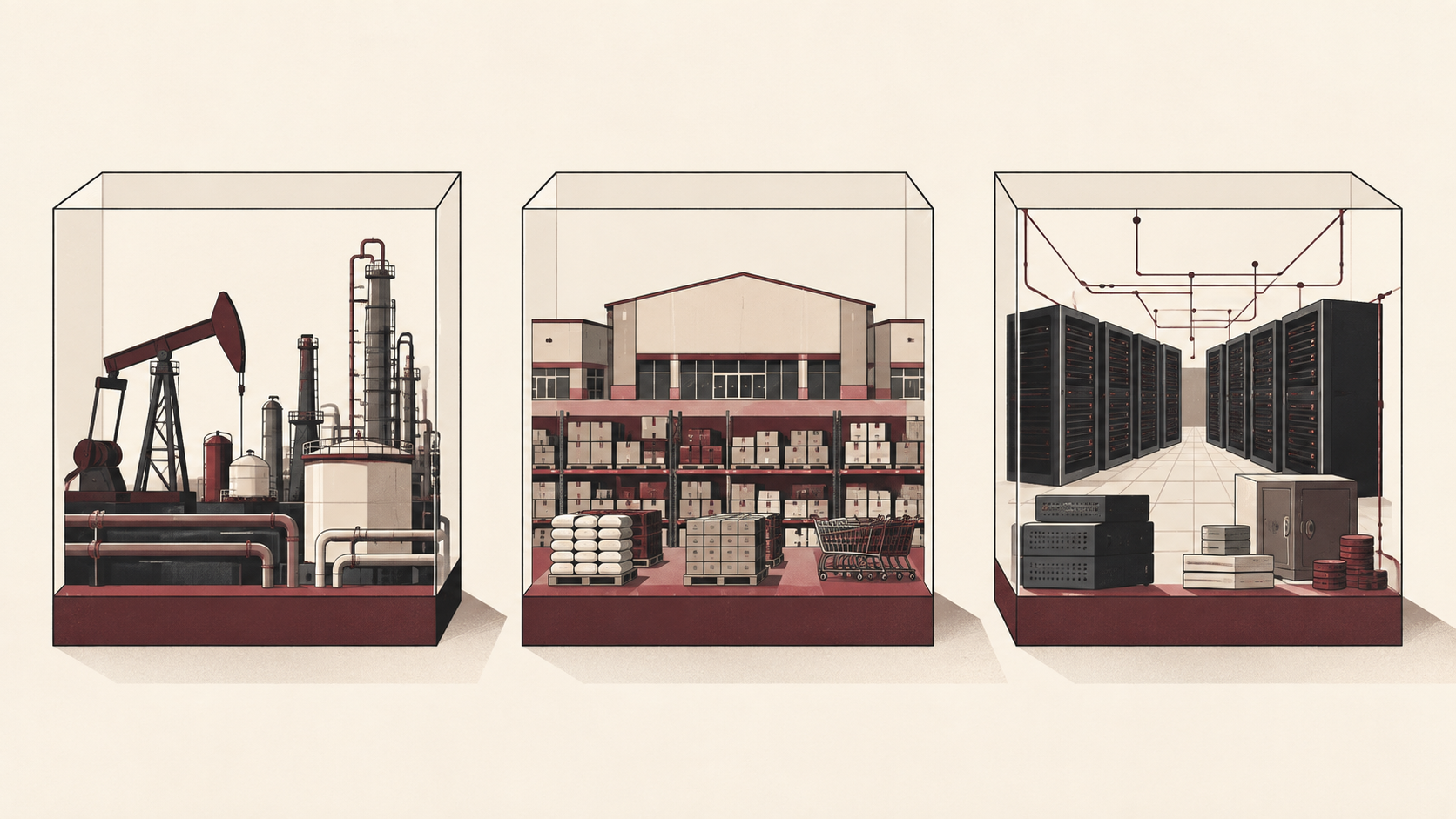
Imagine three companies, each with exactly $100 billion in assets. One could own oil fields, processing facilities and industrial equipment. Another could hold billions of dollars of merchandise alongside a large network of stores. A third could own servers, data centers and financial investments.
The total is identical. The businesses are not.
That is one of the most useful ways to read a balance sheet. Instead of stopping at total assets, look at what those assets actually are.
ExxonMobil, Home Depot and Meta offer three very different examples.
A Balance Sheet Is Also a Map of the Business
Accounting defines an asset as an economic resource controlled by a company. On a balance sheet, that can include cash, inventory, receivables, property, equipment, investments, goodwill and other items.
But different business models require very different combinations of those resources.
As of June 30, 2026, ExxonMobil reported about $464.5 billion in total assets. Roughly $296.3 billion was net property, plant and equipment.
That means close to 64 cents of every dollar of ExxonMobil's assets was tied to property, plant and equipment.
That makes sense for an energy company. Producing and processing energy requires physical infrastructure: wells, production facilities, refineries, chemical plants, pipelines and other equipment. ExxonMobil's balance sheet reflects a business that requires large amounts of long-lived physical capital.
Now compare that with Home Depot.
Home Depot reported approximately $109.4 billion in assets as of Aug. 2, 2026. Its balance sheet included $26.8 billion of merchandise inventory and $28.1 billion of net property and equipment.
Inventory alone represented roughly one-quarter of the company's assets.
That tells a different business story. Home Depot needs stores and distribution infrastructure, but it also needs enormous quantities of products available for customers to buy. Lumber, appliances, tools, building materials and thousands of other items sitting within its retail system are not simply accounting entries. They are part of the mechanism through which the company generates sales.
Then there is Meta.
As of June 30, 2026, Meta reported nearly $450.0 billion in total assets. It held $15.5 billion in cash and cash equivalents, $74.8 billion in marketable securities and $225.7 billion in net property and equipment.
The composition is particularly interesting because Meta is usually thought of as a digital company.
Its products — including Facebook, Instagram and WhatsApp — are digital, but the infrastructure supporting its business is increasingly physical. At the end of 2025, Meta's property and equipment included $98.0 billion of servers and network assets on a gross basis, along with $50.5 billion of construction in progress, much of it related to data centers, network infrastructure and servers.
A digital business can still have a very physical balance sheet.
What Would Each $100 of Assets Look Like?
The differences become easier to see if the companies are scaled to the same size.
Imagine that each balance sheet contains exactly $100 of assets.
Based on their latest reported figures, ExxonMobil would have about $64 of net property, plant and equipment for every $100 of assets.
Home Depot would have about $25 of merchandise inventory and $26 of net property and equipment.
Meta would have roughly $50 of net property and equipment, while another $20 would sit in cash and marketable securities.
These are simplified comparisons, but they reveal something that total assets cannot.
The composition of the balance sheet reflects what a company needs to operate.
For ExxonMobil, much of the economic engine is long-lived industrial infrastructure.
For Home Depot, the system depends heavily on stores, distribution infrastructure and merchandise ready for sale.
For Meta, the balance sheet increasingly reflects the computing infrastructure required to operate and expand a technology platform at global scale.
The same hypothetical $100 billion, distributed in these three ways, would represent three fundamentally different businesses.
More Assets Does Not Automatically Mean a Better Business
This is also why comparing companies only by total assets can be misleading.
A larger asset base does not automatically mean a company is more successful, more efficient or more valuable.
Some businesses naturally require enormous amounts of capital to generate revenue. Others can produce substantial sales with relatively fewer assets. Even companies within technology can become more asset-intensive as their strategies change.
The useful question is therefore not simply:
How many assets does the company have?
It is:
What assets does the company need to make its business model work?
Inventory matters differently to a retailer than it does to an energy producer. Servers have a different economic role from merchandise sitting on store shelves. Cash and marketable securities provide flexibility, while factories and data centers represent long-term operating capacity.
Each asset category tells part of the company's operating story.
Meta Shows How a Business Model Can Change the Balance Sheet
Meta also illustrates another important point: balance sheets are not static descriptions of companies.
They can reveal how strategies are changing.
At the end of 2024, Meta reported $121.3 billion of net property and equipment. By the end of 2025, that figure had risen to $176.4 billion. By June 30, 2026, it had reached $225.7 billion.
The increase corresponds with Meta's continued investment in computing infrastructure. Its balance sheet is therefore becoming more capital-intensive even though its core consumer products remain digital.
That is an important distinction.
A company's product can be intangible while the infrastructure required to deliver it becomes increasingly physical.
The balance sheet can make that shift visible before a reader ever reaches a detailed discussion of strategy.
Read the Mix, Not Just the Total
Financial statements can initially look like collections of numbers. But the categories matter because they connect accounting to the way a company actually operates.
Revenue tells us what a company sold during a period.
Net income tells us what remained after expenses.
The balance sheet answers a different question: What economic resources does this company control in order to operate and grow?
That is why $100 billion in assets does not have one universal meaning.
It could represent industrial infrastructure. It could represent merchandise moving through a retail network. It could represent servers and data centers supporting billions of digital interactions.
The number tells you the size of the balance sheet.
The mix of assets starts to tell you what kind of business is behind it.
A balance sheet becomes more useful when it is read as a business document rather than only an accounting statement. The interesting question is not whether ExxonMobil, Home Depot or Meta has “more assets.” It is where each company has to place capital to make its model work. That connection — business model → required resources → asset mix → balance sheet — is what turns financial statement analysis into business analysis.
- SEC filing Exxon Mobil Corp. — Form 10-Q for quarter ended June 30, 2026
- SEC filing The Home Depot, Inc. — Form 10-Q, balance sheet as of Aug. 2, 2026
- SEC filing Meta Platforms, Inc. — Form 10-Q for quarter ended June 30, 2026
- Company IR Meta Platforms — Second Quarter 2026 financial results and balance sheet
- SEC filing Meta Platforms, Inc. — 2025 Form 10-K, property and equipment detail