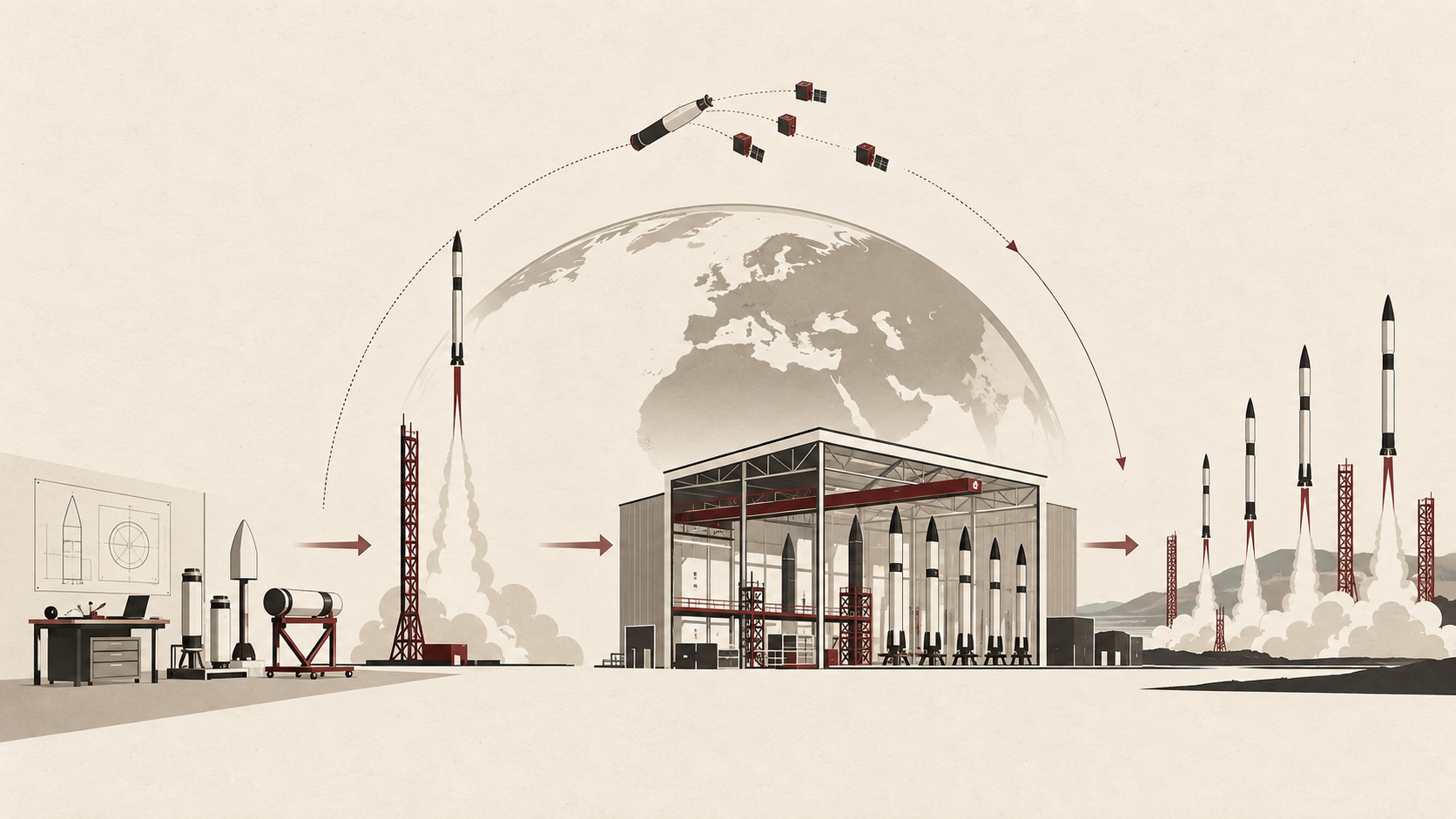
A successful launch changes what a rocket startup can sell. Isar has moved from demonstrating components and prototypes to showing that its system can actually deliver customer payloads into orbit. The larger business opportunity now lies in converting that proof into repeatable production and launch capacity.
- Isar Aerospace’s Spectrum rocket reached orbit from Norway on September 5 and successfully deployed five small satellites and one experiment.
- The mission made Isar the first commercial European space company to successfully deliver satellites into orbit and marked the first orbital launch from continental Europe.
- The startup raised €270 million in June, while Germany Trade & Invest said the financing brought its valuation to about €2 billion.
- Isar is preparing production capacity for as many as 40 Spectrum rockets annually, showing that the next phase of the business is about repeatable launch volume rather than a single successful flight.
A startup founded less than a decade ago has reached one of the hardest milestones in aerospace: putting customers’ hardware into orbit.
Germany’s Isar Aerospace successfully launched its Spectrum rocket from Andøya Spaceport in northern Norway on September 5, delivering five small satellites and a technology experiment to their target orbits. It was only Spectrum’s second flight.
The mission made Isar the first commercial space company from Europe to successfully deliver satellites into orbit and marked the first orbital launch from continental Europe, according to Isar Aerospace and the European Space Agency.
That makes the launch more than a technical achievement. For Isar, it represents the transition from building a rocket company to demonstrating the core service behind its business: transporting satellites from Earth into space.
The next challenge is equally important from a business perspective. A rocket company does not scale by launching once. It has to turn a successful mission into repeatable launch capacity.
From Startup to Launch Provider
Isar Aerospace was founded near Munich in 2018 and now employs more than 400 people across five international locations. Its main product is Spectrum, a two-stage orbital rocket designed to carry small and medium-sized satellites.
Spectrum is 28 meters tall and two meters in diameter. In regular operation, the rocket is expected to carry payloads of as much as 1,000 kilograms into low Earth orbit.
That payload capacity gives Isar a relatively clear place in the launch business.
Satellites do not reach orbit on their own. Satellite operators need a launch provider to transport them, and the availability, timing and destination of those launches can influence how quickly a satellite business can begin operating.
Isar is building around that demand. Rather than simply manufacturing rockets as products, the company sells launch services: customers purchase access to orbit for satellites and other payloads.
That distinction matters. The rocket is the infrastructure that makes the service possible.
Why One Successful Flight Changes the Business
Spectrum’s first test flight in March 2025 ended about 30 seconds after liftoff. Isar later identified an unintended vent-valve opening and subsequent loss of attitude control as the initiating events behind the failed flight. The company completed its investigation and implemented corrective measures before returning to the launch pad.
The second flight went much further.
Spectrum completed the mission and delivered its payloads into orbit. For a young aerospace company, that creates something capital alone cannot provide: evidence that the underlying system can perform its intended job.
The progression illustrates an important feature of deep-tech businesses.
Funding allows a company to build technology. Testing produces engineering knowledge. A successful demonstration turns that technology into a more credible commercial capability.
Isar has also built a customer pipeline beyond this qualification mission. Its current launch manifest extends through 2028, and agreements include missions for the European Space Agency and other customers.
The company raised €270 million in a Series D funding round announced in June to expand operations, increase serial production of Spectrum and develop additional launch infrastructure. Germany Trade & Invest later said the round put Isar’s valuation at about €2 billion.
The company is still privately held. CEO Daniel Metzler told Reuters following the launch that an IPO was not currently on the table.
The Bigger Business Is Repetition
One successful rocket can prove engineering capability. A commercial launch company, however, ultimately depends on how often it can do it.
That is why Isar’s manufacturing strategy may be as important as Saturday’s flight.
The company is preparing a new production facility in Parsdorf, near Munich, designed for future serial production of as many as 40 Spectrum vehicles per year. Isar says five additional rockets are already in production.
That points toward a different way of thinking about the rocket business.
Instead of treating every launch vehicle as an isolated engineering project, Isar is trying to move toward a repeatable industrial model:
engineering → production → launch → customer payload → repeat
The economics become more attractive when the same underlying rocket platform, manufacturing process and launch infrastructure can support many missions.
It is similar to the transition other capital-intensive industries face when moving from prototype to production. Building the first working product proves that something is possible. Building many of them reliably is what creates commercial capacity.
A Startup Becomes Infrastructure
Isar is also expanding beyond its first launch complex.
The company plans a second launch site in Nova Scotia, Canada, which it says could begin operations in 2028. The expansion would give Isar another location from which to provide launch services as its customer base and production capacity grow.
The company has also received institutional support. ESA backed Spectrum through its Boost! commercial space transportation program, while Isar recently signed an agreement under the European Launcher Challenge. ESA says the September flight means Isar has already achieved the challenge’s orbital-launch milestone, which participating launch providers were required to reach by 2027.
Those programs illustrate a broader feature of the emerging space economy: private companies can develop the technology and operate the service while governments and institutions become customers, partners and early supporters.
For a startup, that can create a pathway from research and engineering toward an infrastructure business serving commercial and institutional demand.
What Comes After Orbit
Isar has now cleared an important technical threshold. But the next stage will be measured less by a single launch and more by frequency.
Can Spectrum launch repeatedly? Can production increase without sacrificing reliability? Can Isar convert its launch manifest into a steady cadence of customer missions?
Those questions will determine how quickly Isar moves from successful rocket startup to scaled launch provider.
The September mission nevertheless changes where that process begins. Isar is no longer working only toward reaching orbit.
It has done it.
Now the business is about doing it again.
The most interesting part of Isar’s launch may be what happens after the rocket disappears from view. Space startups eventually have to become manufacturing and logistics businesses: building standardized vehicles, securing launch sites, scheduling customers and repeating missions reliably. Spectrum reaching orbit validates one end of that chain. Isar’s factories, launch manifest and future launch sites show where the company is trying to build the rest.
- Official release Isar Aerospace — History for European spaceflight: Isar Aerospace reaches orbit and deploys payloads on second flight, Sept. 5, 2026
- Government / Space agency German Aerospace Center (DLR) — First orbital flight of the Spectrum commercial launch vehicle from Germany, Sept. 6, 2026
- Official release European Space Agency — Isar Aerospace achieves first launch to orbit from continental Europe, Sept. 5, 2026
- Official release Isar Aerospace — Secures €270 million to expand sovereign space capabilities globally, June 9, 2026
- News Reuters — German space rocket reaches orbit in Europe’s first commercial launch, Sept. 5, 2026