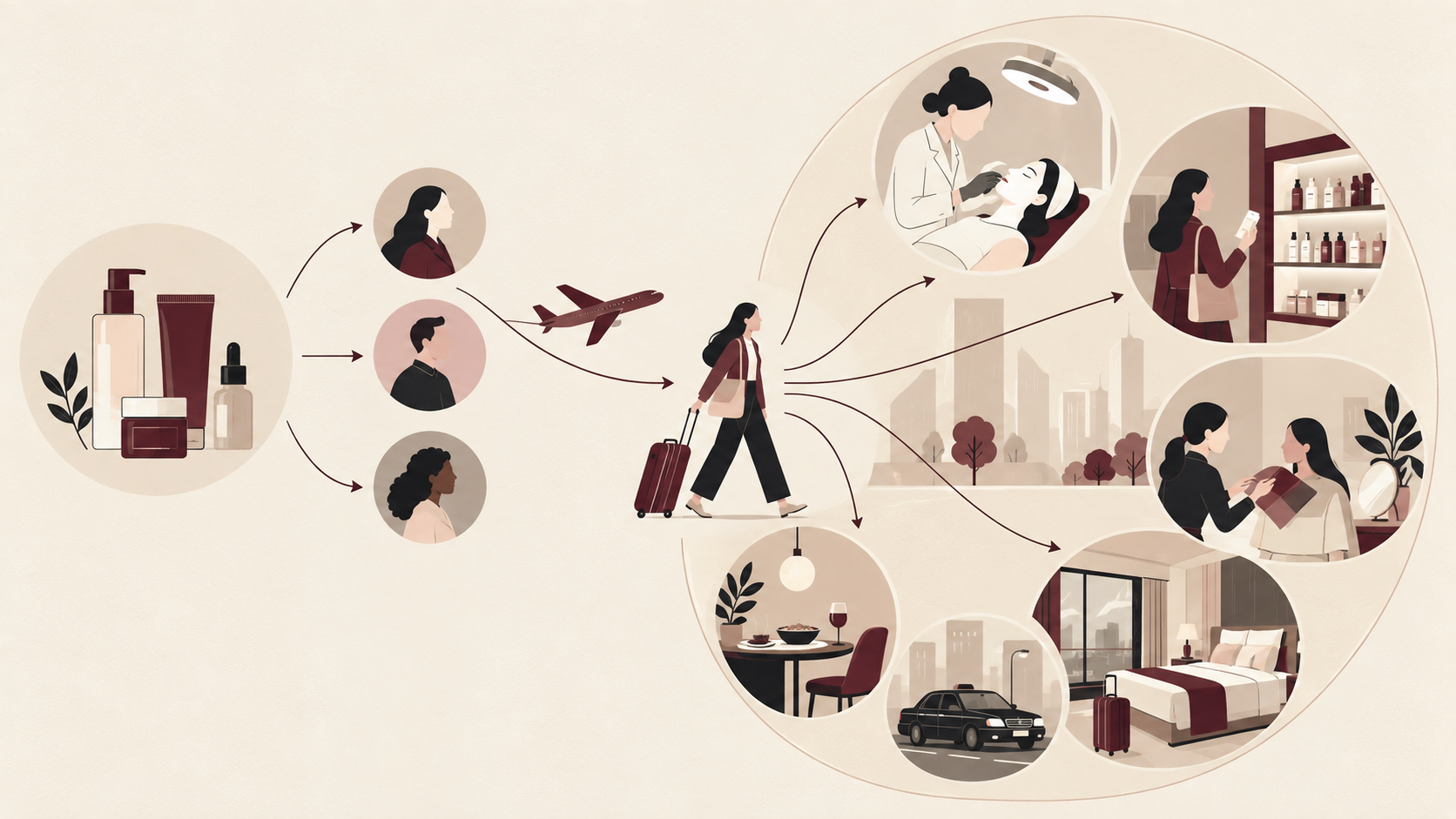
K-beauty’s global growth is beginning to create value beyond cosmetics manufacturing and exports. When international consumers travel to Korea for beauty-related experiences, the same demand can generate revenue across clinics, retailers, hotels, restaurants and other tourism services—turning a consumer-products industry into part of a broader visitor economy.
- South Korea received 2.01 million foreign patients in 2025, up 71.9% from the previous year.
- Dermatology accounted for 62.9% of foreign patients, or about 1.31 million people.
- International visitors spent KRW 5.62 trillion by card in Seoul in the first half of 2026, with medical and wellness accounting for 24.4% of spending.
- Seoul beauty-sector spending rose 40% year over year, showing how global interest in K-beauty is increasingly translating into local service and tourism spending.
K-beauty has spent years traveling around the world in bottles, tubes and sheet-mask packets. Increasingly, consumers are traveling in the opposite direction.
A growing number of international visitors are coming to South Korea not simply to buy Korean skincare, but to experience the beauty ecosystem at its source. A trip can include a dermatology appointment, a personal color consultation, scalp or hair care, visits to beauty retailers and pop-ups, and the discovery of products that may not yet be widely available overseas.
The trend has acquired a fitting name: the “glowcation.”
But behind the catchy label is a larger business story. K-beauty is beginning to show how a successful consumer export can generate demand for an entire ecosystem of services around the place where it was created.
From Selling Products to Attracting Visitors
For years, the international growth story of K-beauty was largely measured through exports.
That business is still expanding. South Korea exported a record $11.4 billion of cosmetics in 2025, according to the Ministry of Food and Drug Safety. That was up 11.8% from 2024 and helped make Korea the world’s second-largest cosmetics exporter that year.
Those exports do more than generate sales. Every Korean sunscreen, serum or cushion foundation sold abroad can also introduce consumers to a broader Korean approach to beauty.
Social media has accelerated that process. Consumers can now see what is being sold in Seoul, which treatments are popular and which products Korean shoppers are buying long before those products reach stores in their own countries.
That changes the relationship between destination and consumer.
Instead of waiting for the next Korean beauty product to arrive abroad, some consumers are choosing to visit the market itself.
Vogue recently highlighted this behavior as the rise of the “glowcation,” describing trips to Seoul that combine cosmetic treatments, beauty shopping and other Korean cultural experiences.
The important business shift is not the term itself. It is what happens when international demand for a product category becomes strong enough to influence travel.
Beauty Is Becoming Part of the Tourism Economy
The scale of Korea’s medical tourism market makes that connection easier to see.
South Korea received 2.01 million foreign patients in 2025, according to the Ministry of Health and Welfare, up 71.9% from the previous year and the first time the figure exceeded two million.
Dermatology was by far the largest category. About 1.31 million foreign patients received dermatological care, representing 62.9% of the total. Plastic surgery accounted for another 11.2%.
Seoul captured 87.2% of foreign patients.
Those numbers do not mean every international dermatology patient traveled to Korea solely for beauty. “Foreign patient” statistics cover medical care and are not identical to tourism statistics. But the concentration in dermatology shows how significant aesthetic and skin-related services have become within Korea’s international healthcare economy.
More importantly, the economic activity does not stop at the clinic door.
A visitor traveling to Seoul for a treatment may also need a hotel, transportation and restaurants. The same visitor can shop at beauty retailers, visit brand flagships and pop-ups, purchase products after a consultation and spend money elsewhere in the city.
That turns one category of demand into several.
One Beauty Customer Can Support Several Businesses
This is what makes beauty tourism different from a conventional cosmetics export.
When a Korean skincare product is exported, most of the immediate economic value comes from manufacturing, distribution and retail.
When a consumer travels to Korea because of an interest in beauty, the spending can spread across a much wider network.
A dermatology clinic sells a service. A beauty retailer sells products. A hotel sells nights. Restaurants capture dining spending. Transportation providers move the visitor around the city. Beauty brands gain another opportunity to introduce products directly to consumers.
Specialized businesses can emerge between those industries as well. Beauty and medical-tourism concierge companies, interpreters and itinerary planners can help foreign visitors navigate appointments and services.
In other words, K-beauty can function not only as something Korea exports, but also as a reason for consumers to enter the Korean economy.
Recent spending data from Seoul points in that direction.
International visitors spent about KRW 5.62 trillion by card in Seoul during the first half of 2026, according to the Seoul Metropolitan Government. Shopping represented 46.4% of that spending, while medical and wellness services accounted for 24.4%.
Medical-tourism spending increased 63.3% from a year earlier. Spending in the beauty sector rose 40%, reaching KRW 463.7 billion.
The numbers suggest that beauty, wellness and shopping are becoming increasingly connected parts of the visitor economy rather than isolated categories.
Seoul Is Building Around the Opportunity
The public sector is beginning to treat that ecosystem as a tourism product in its own right.
Seoul has been expanding programs that connect beauty, wellness, shopping and local experiences. The city has also announced plans to expand medical-tourism infrastructure, including increasing its pool of medical interpretation coordinators and developing services that connect medical care with accommodation and tourism.
In August, the city launched Beautiful Life in Seoul, a lifestyle festival combining beauty, fashion, wellness, design, entertainment and local commerce. The initiative was designed not only for visitors to experience Korean lifestyle industries, but also as a platform connecting Korean companies with international buyers.
The strategy reflects a broader change in what a destination can export.
A country can export physical products overseas. But it can also build enough global interest around those products that consumers want to visit the place where the industry operates.
K-beauty is increasingly doing both.
The Experience Can Strengthen the Product Business
Beauty tourism does not replace cosmetics exports. It may reinforce them.
Someone who discovers a Korean brand while traveling can continue purchasing it after returning home. A treatment can introduce consumers to ingredients, devices or skincare routines they had not encountered before. Visits to retailers and pop-ups can give smaller brands exposure to international consumers without requiring those brands to have extensive overseas distribution.
That creates a potential cycle.
Korean beauty products build awareness overseas. That awareness encourages some consumers to visit Korea. While in Korea, those visitors spend on treatments, retail and other services. They discover additional products and brands, which can then generate demand after they return home.
The economic value of K-beauty therefore becomes larger than the value of the cosmetics themselves.
For brands, clinics, retailers and tourism businesses, the opportunity is increasingly connected. The same consumer can move through several parts of the beauty economy during a single trip.
K-beauty’s next stage of international growth may therefore be measured not only by how many Korean products leave the country, but also by how many consumers the industry brings in.
The interesting part of the K-beauty boom may no longer be just how much Korea can export. A globally recognizable consumer industry can also become an economic magnet: products build awareness abroad, awareness creates reasons to travel, and those visitors then spend across businesses that never manufactured a cosmetic product. K-beauty shows how an export industry can gradually become an ecosystem.
- Government data Ministry of Health and Welfare — Foreign Patients Surpass 2 Million in 2025, Positioning Korea as Asia’s Medical Tourism Hub, Apr. 24, 2026
- Government data Ministry of Food and Drug Safety — 2025 K-Beauty Exports Reach Record $11.4 Billion, Jan. 9, 2026
- Government data Seoul Metropolitan Government — International Arrivals to Seoul Rise 21%, Spending Jumps 57%—Visitor Spending Reaches KRW 5.6 Trillion in H1 2026, Aug. 5, 2026
- Official release Seoul Metropolitan Government — Beautiful Life in Seoul to Showcase Seoul’s Trendy Lifestyle, Aug. 12, 2026
- News Vogue — Would You Go on a Glowcation? K-Beauty Is Betting So, Sept. 4, 2026