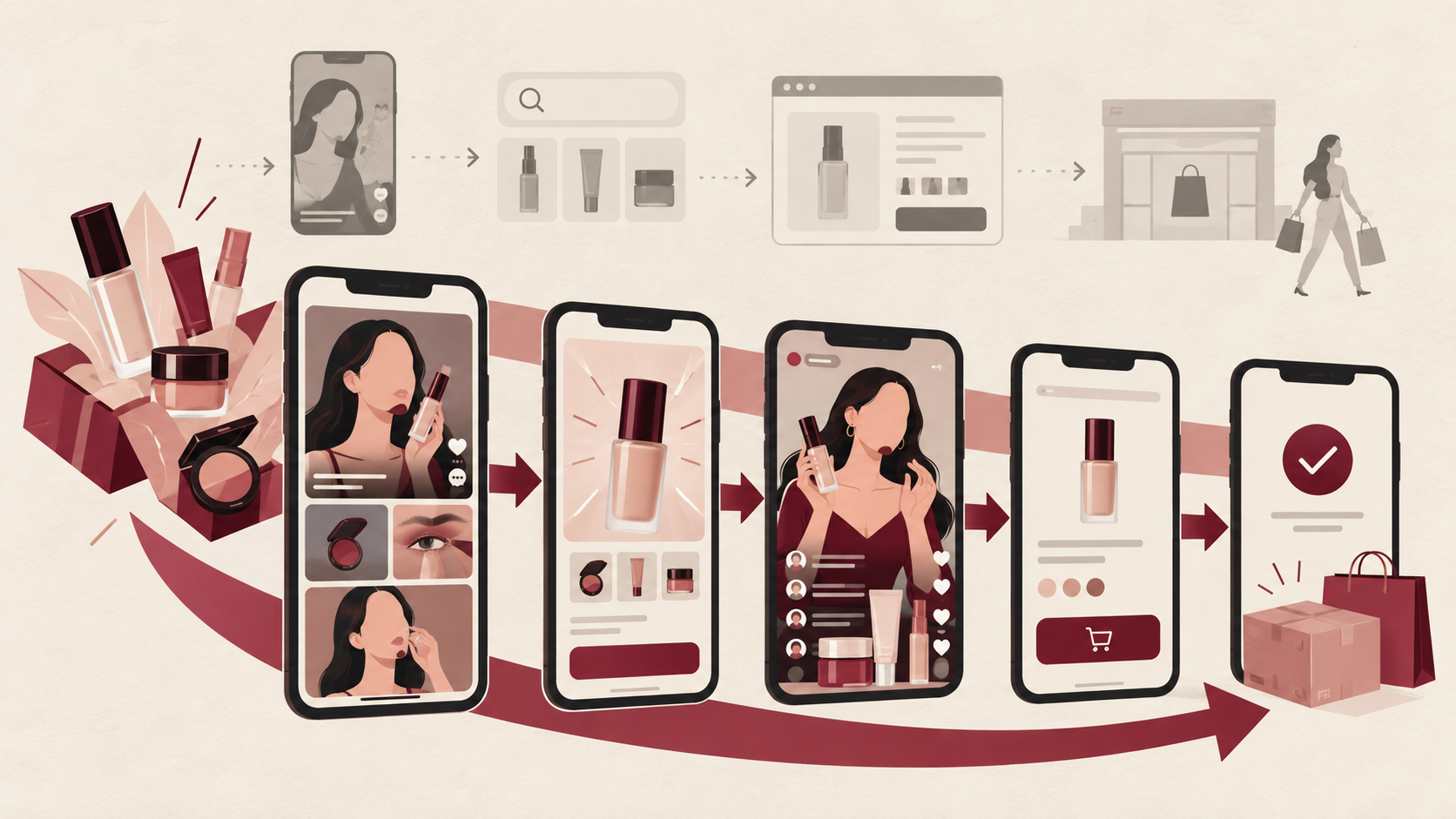
Social platforms have traditionally helped retailers create demand while stores and e-commerce sites captured the transaction. TikTok Shop compresses those roles into one environment, allowing discovery, product education and checkout to happen together. Sephora’s experiment shows how that shift could change not only where beauty products are sold, but how new products are launched.
- Sephora began piloting its U.S. Drop Shop on TikTok Shop on Sept. 19, 2026, using exclusive monthly product drops rather than simply replicating its full online catalog.
- TikTok generates more than 1 billion beauty-related searches each month, according to Sephora, giving the retailer access to consumers where beauty discovery is already happening.
- Each drop connects teasers, creator content and TikTok LIVE with direct purchasing, reducing the number of steps between discovering a product and buying it.
- The model shows how social platforms are moving beyond advertising and product discovery to become part of retail distribution itself.
Sephora has spent years benefiting from a familiar shopping habit: someone sees a beauty product on TikTok, searches for it, then heads to Sephora to buy it.
Now, Sephora is trying to bring the store closer to where that discovery happens.
The beauty retailer launched a U.S. pilot called Sephora Drop Shop on TikTok Shop on Sept. 19. Instead of simply uploading its full assortment to another online marketplace, Sephora is using the platform for monthly product drops built around creators, livestreams and limited periods of exclusivity.
The idea is straightforward. A customer can discover a product, learn about it from creators, watch it demonstrated live and buy it without leaving TikTok.
That shortens a shopping journey that once moved across several different platforms — and shows why social media is becoming more important to retailers not just as a place to advertise products, but as a place to sell them.
A Product Launch Built Inside TikTok
Each Sephora Drop Shop activation is designed as a sequence rather than a conventional online product listing.
Sephora will first tease an upcoming brand and use creator-led content and interactive experiences to build interest. The campaign then leads to an official TikTok LIVE featuring a celebrity host, brand founders and creators, where viewers can see products, ask questions and purchase featured items through TikTok Shop.
The products in each monthly drop initially launch exclusively through Sephora’s TikTok Shop. Select products can later move to Sephora.com, Sephora stores or other retail partners. Customers can still preview the products on Sephora’s website before their broader release.
The format is also deliberately narrower than a traditional digital storefront. Sephora Collection remains available on the TikTok Shop page, while partner brands appear through limited-time drops rather than a permanently stocked catalog, according to Business of Fashion.
That distinction matters.
Sephora is not simply creating another version of Sephora.com. It is experimenting with a different kind of retail format built around the way people already use TikTok.
From Advertising Channel to Retail Channel
For years, social media occupied a relatively clear position in the shopping funnel.
A brand could pay for an advertisement, work with an influencer or hope that a product went viral. The social platform generated attention, while the transaction usually happened somewhere else.
TikTok Shop changes that structure.
Shoppable videos and livestreams allow discovery and checkout to happen inside the same platform. TikTok says its U.S. Shop sales increased 120% year over year during the first part of 2025. It also reported that 83% of shoppers surveyed for research conducted with GlobalData had discovered a new product on TikTok Shop, while 70% had discovered a new brand.
For beauty, that connection is particularly relevant.
Beauty is TikTok’s most-searched category, generating more than 1 billion beauty-related searches each month, according to Sephora’s announcement.
Beauty products also fit naturally into content. A lipstick can be applied on camera. A foundation can be compared across shades. A skincare routine can be demonstrated step by step. Questions that might once have been answered by a beauty advisor in a store can increasingly be addressed by creators or brand founders during a livestream.
TikTok Shop effectively places the checkout button next to that content.
For Sephora, the opportunity is to participate in the transaction at the same moment that interest in a product is being created.
Why Exclusivity Matters
The most interesting part of Drop Shop may be Sephora’s decision to give TikTok first access to selected launches.
Exclusivity changes the role of the platform.
If the same product is already widely available everywhere else, TikTok is simply another place to purchase it. But when a product appears there first, content and distribution become connected.
A teaser can create curiosity. Creator videos can explain the product. A livestream can turn the launch into an event. And the product sitting next to that content gives viewers an immediate way to act on their interest.
In that sense, the launch resembles a digital version of a limited retail drop more than a conventional social-media campaign.
It also gives Sephora and its brand partners another way to observe how consumers respond to launches. Sephora Global Chief Digital Officer Anca Marola described the U.S. program as a “test-and-learn” initiative intended to generate insights that could inform future digital expansion across Sephora’s global network.
The pilot therefore tests more than whether consumers will buy beauty products on TikTok. It tests whether a retailer can use a social platform as part of the product-launch process itself.
Sephora Is Not Alone
The move is part of a broader shift in beauty retail.
Ulta Beauty announced its own TikTok Shop launch earlier in 2026 with a curated assortment, becoming another major U.S. beauty retailer to move commerce directly onto the platform.
TikTok Shop itself has been building toward this model since its full U.S. launch in September 2023. The platform integrated shoppable videos and livestreams into the TikTok experience so merchants and creators could sell products directly through content.
That creates a different competitive environment for retailers.
Traditional retailers have historically controlled valuable parts of the shopping journey: product assortment, merchandising, advice and checkout. Social platforms controlled attention and discovery.
Those roles are becoming less separate.
TikTok can now host discovery, product education and the transaction. Retailers such as Sephora, meanwhile, can bring their curation and brand relationships onto the platform rather than waiting for customers to leave TikTok and visit their own stores or websites.
The Store Is Moving Closer to Discovery
Sephora is not abandoning its stores or its own digital channels. Drop Shop is a pilot, and products can eventually move into Sephora’s broader retail network.
But the experiment illustrates a larger change in commerce.
Online shopping once largely assumed that consumers knew what they wanted and visited a retailer to find it. Social commerce starts earlier. A consumer may open TikTok with no intention of shopping, encounter a creator discussing a product and end up purchasing it minutes later.
The path can increasingly look like this:
content → discovery → recommendation → product education → purchase
All without leaving the platform.
For retailers, that means the place where consumers spend their attention can also become part of the store.
Sephora’s Drop Shop is one attempt to adapt beauty retail to that reality.
The bigger shift is not that Sephora has opened another digital storefront. It is that the boundary between marketing and distribution is becoming harder to see. When the same platform can create interest through creators, explain a product through video and process the purchase, attention itself becomes part of retail infrastructure. For beauty companies, the next important sales channel may not look much like a traditional store at all.
- Official release Sephora — “Sephora launches on TikTok Shop, bringing a new beauty shopping experience to U.S. customers with its Sephora Drop Shop,” Sept. 2, 2026
- Official release TikTok — “TikTok Shop is where shoppers come to discover,” June 13, 2025
- Official release TikTok — “Introducing TikTok Shop,” Sept. 12, 2023
- News Business of Fashion — “What Sephora’s TikTok Shop Launch Means for Beauty,” Sept. 2, 2026
- News Retail Dive — “Ulta to launch on TikTok Shop with curated assortment,” Mar. 13, 2026