Universities already concentrate research, technical talent and intellectual property. Accelerators can connect those assets with market validation, entrepreneurial training and outside capital, potentially shortening the distance between a campus idea and a commercial company. The shift also changes entrepreneurship education: students can increasingly build companies as part of the university experience rather than waiting until after graduation.
- Ohio State is forming an inaugural BuildX cohort of 20 student startups ahead of a summer 2027 accelerator and plans to use a $1 million fund to support student ventures.
- UC Davis launched the Aggie Venture Accelerator in 2026, combining mentorship, structured programming, industry connections and potential investment for early-stage life-science companies.
- AUTM reported that licenses involving startups at participating U.S. institutions increased 15% in fiscal 2025, showing a growing connection between academic technology and startup commercialization.
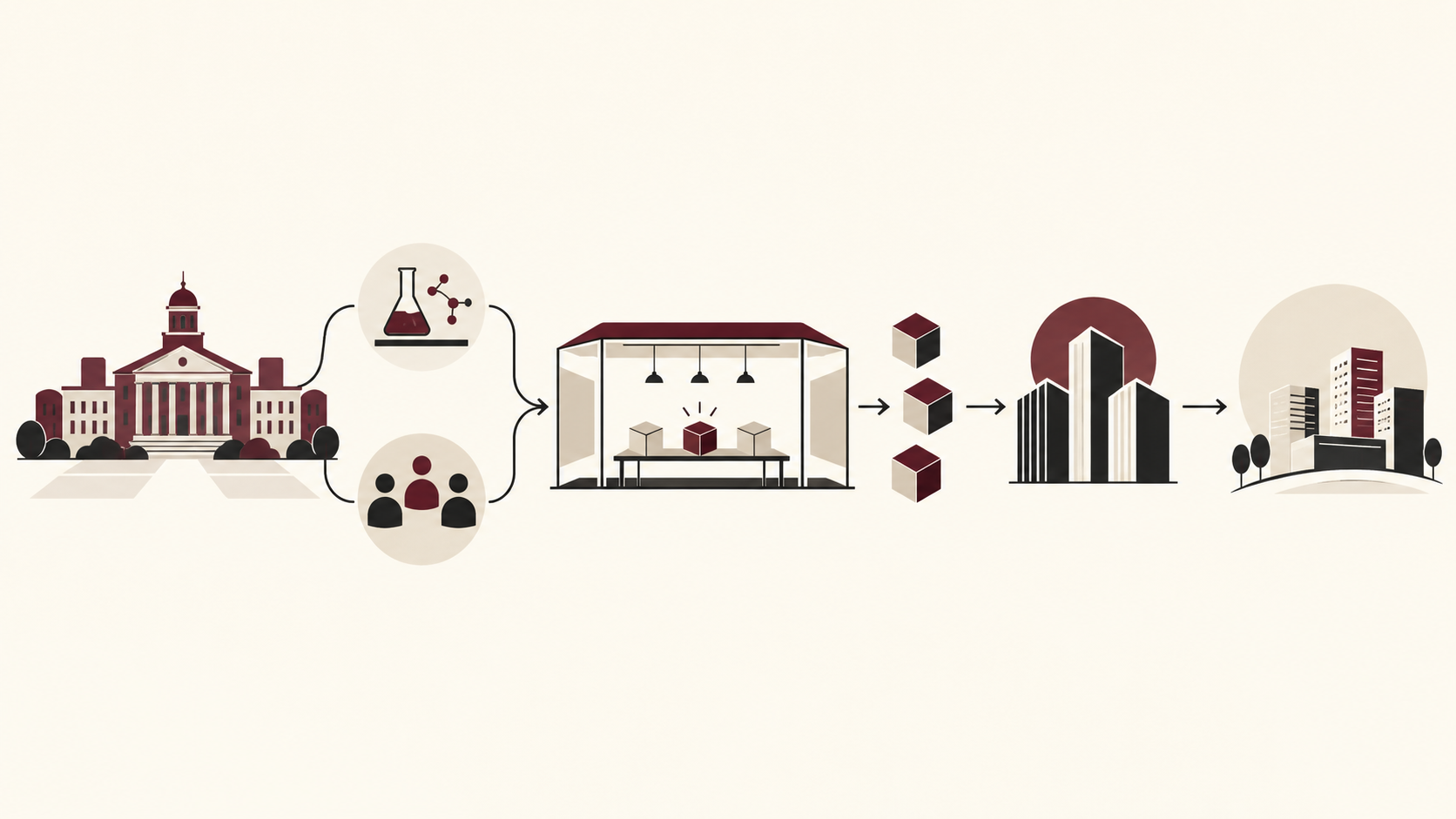
- University accelerators can act as the bridge in a broader pipeline: research and talent → startup formation → market validation → outside capital → commercialization.
For decades, universities have been places where new technologies are researched, tested and taught. Increasingly, they are also trying to build the companies that can take those ideas into the market.
Ohio State is preparing to launch BuildX, a new program for student startups. The university expects an inaugural group of 20 startups to enter the program this academic year before participating in a summer accelerator in 2027. Ohio State President Walter “Ted” Carter Jr. said the university plans to use a $1 million fund to support students and their ideas, with a longer-term goal of producing 100 investable student startups. The initiative will also include academic courses for credit.
Ohio State is not alone.
Earlier this year, UC Davis launched the Aggie Venture Accelerator, focused on early-stage startups in life sciences, food and health. Its first cohort includes three companies, while the program combines entrepreneurial training, mentorship, industry connections and potential investment.
Together, the programs illustrate a broader shift in what universities can provide entrepreneurs. Instead of stopping at education, research or a campus pitch competition, some institutions are building infrastructure designed to move ideas further toward commercialization.
The Gap Between an Idea and a Company
A promising technology is not automatically a business.
A university laboratory might produce a new medical technology, material or software system. A student might identify a market opportunity and build an early prototype. But neither has necessarily answered the questions that investors and customers eventually ask.
Who will buy it? How large is the market? What problem does it solve? Can the technology be produced at scale? Who owns the intellectual property? And what evidence would convince an investor to provide capital?
That gap between invention and commercialization is where accelerators can become useful.
Instead of simply providing classroom instruction, an accelerator typically puts founders through a concentrated period of customer discovery, business-model development, mentorship and investor preparation. The goal is not simply to make an idea sound better. It is to determine whether the idea can become a viable company.
The U.S. National Science Foundation has built a similar model through its I-Corps program, which trains scientists and engineers to evaluate the commercial potential of technologies developed from research. Its seven-week program emphasizes customer discovery and moving research beyond the laboratory.
That creates a relatively simple pipeline:
research and talent → startup formation → accelerator → market validation → outside capital → commercialization
The accelerator sits in the middle, helping turn something technically possible into something that could potentially attract customers and investors.
Universities Have Something Most Accelerators Do Not
Universities enter this market with an unusual collection of resources already under one roof.
They have researchers developing intellectual property, students looking to build companies, laboratories and technical infrastructure, alumni networks, industry relationships and faculty expertise across fields ranging from engineering to medicine and business.
A university accelerator can connect those resources.
UC Davis provides a useful example. Its Aggie Venture Accelerator is based at Aggie Square and operated with The March Group, an early-stage venture investor. Participating companies receive structured programming and mentorship while gaining connections to investors and industry partners. Select companies can also receive investment through an accelerator fund managed by The March Group.
The accelerator is therefore not an isolated entrepreneurship course. It can become one part of a larger commercialization system.
UC Davis says more than 300 startups have been launched with support from the university over the past decade, collectively raising more than $4 billion. Its Venture Catalyst operation also runs programs for customer discovery, startup development and research translation.
For universities with large research operations, that matters because producing knowledge and commercializing it are two different activities.
Research Is Increasingly Connected to Startup Formation
The numbers suggest that the connection between academic research and startup formation is already substantial.
AUTM, which tracks technology transfer among universities and research institutions, reported that participating U.S. institutions spent more than $112 billion on research in fiscal 2025 and produced more than 28,000 invention disclosures. Licenses involving startups increased 15% from the previous year, while agreements that included equity increased 16%.
Those figures help explain why commercialization infrastructure matters.
Universities can generate thousands of inventions, but research spending alone does not determine whether those inventions reach customers. Technologies may need patents, licenses, founders, market testing and capital before they can become commercial products.
The accelerator can help organize part of that process.
Federal policy has been moving in the same direction. NSF's I-Corps network now connects universities, researchers, entrepreneurs and federal agencies around commercialization. Its 2025 biennial report said 52% of participating National I-Corps teams since the program began had been linked to startup launches, while those teams had raised $7.01 billion in follow-on funding.
That does not mean an accelerator guarantees a successful startup. Most early-stage companies still face substantial technical, financial and market uncertainty.
But it shows why universities increasingly see entrepreneurship infrastructure as something that can sit alongside research infrastructure.
The Student Experience Is Changing Too
Ohio State's BuildX adds another dimension: the accelerator is explicitly centered on student-owned startups.
The university plans to connect the program with courses for academic credit while providing capital and a structured accelerator experience. That begins to blur a traditional boundary between studying entrepreneurship and actually practicing it.
A finance student can learn how venture funding works. An engineering student can learn product development. A marketing student can learn customer research.
Inside an accelerator, those skills can be applied to the same company at the same time.
That makes entrepreneurship less dependent on students independently finding mentors, investors and technical collaborators outside campus. The university can instead become the platform connecting those pieces.
There is also a feedback loop.
Successful university startups can attract investors and experienced founders back toward the campus ecosystem. Those connections can provide future founders with mentors, customers and capital, while commercialization can create new industry relationships around university research.
The result can look less like a traditional sequence of university → graduation → company and more like a network in which education, research and company creation happen simultaneously.
From Research Institution to Startup Platform
Universities are unlikely to become venture capital firms, nor does every research project need to become a company.
But programs such as BuildX and the Aggie Venture Accelerator show institutions becoming more deliberate about what happens between invention and the market.
The underlying business logic is straightforward.
Universities already produce two of the hardest inputs to replicate: specialized knowledge and concentrated talent. Accelerators add another layer by connecting those resources with entrepreneurial training, market validation, industry networks and capital.
If that model continues to expand, one of the more important questions for universities may no longer be simply how much research they produce.
It may also be how effectively they build the infrastructure that allows promising ideas to leave campus.
The interesting shift is not simply that universities are teaching more entrepreneurship. They are beginning to build the infrastructure around entrepreneurship. Research, students and intellectual property have long existed on campus; accelerators add a mechanism for organizing those assets into companies that investors and customers can evaluate. That could make the strength of a university's startup ecosystem increasingly important alongside its traditional measures of research and education.
- Official release The Ohio State University — Ohio State welcomes class of 2030, Aug. 25, 2026
- Official release The Ohio State University — Students return to Ohio State campus as massive move-in week concludes, Aug. 2026
- Official release UC Davis — UC Davis Launches Aggie Venture Accelerator to Advance Early-Stage Life Science Innovation, Apr. 8, 2026
- Industry data AUTM — FY2025 Licensing Activity Survey
- Government research U.S. National Science Foundation — 2025 NSF Innovation Corps Biennial Report