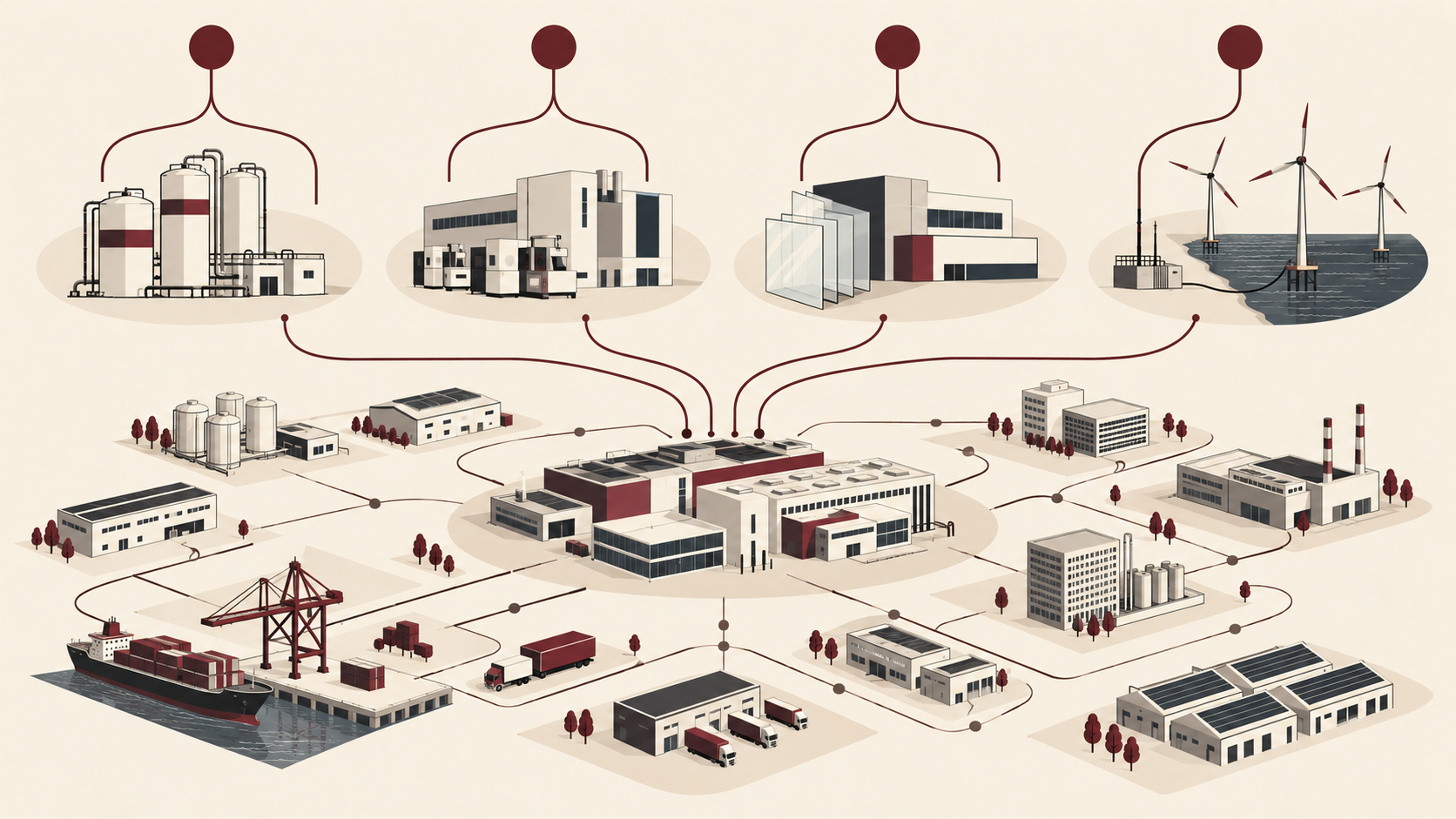
Foreign investment can do more than add new factories. When capital enters specialized manufacturing and infrastructure, it can increase demand for suppliers, engineering, logistics and energy around those facilities. South Korea’s existing technology base gives these investments the potential to reinforce a broader industrial network.
- Air Products, Axcelis Technologies, Corning and Pacifico Energy have committed a combined $2 billion of investment in South Korea.
- The projects span semiconductor gases, chip equipment, advanced materials and offshore wind, rather than concentrating on a single industry segment.
- Pacifico Energy is developing a 3.2 GW offshore wind cluster off Jindo, comprising three separate projects.
- The larger business mechanism is foreign capital → capacity → supplier demand → infrastructure → industrial ecosystem, showing why the economic effect of FDI can extend beyond its headline value.
Four U.S. companies are preparing a combined $2 billion in investments in South Korea, spanning some of the infrastructure behind semiconductors, advanced displays and clean energy.
Air Products, Axcelis Technologies, Corning and Pacifico Energy outlined the investments at a September 3 event in Washington, D.C., according to South Korea’s Ministry of Trade, Industry and Resources. The projects range from semiconductor gases and manufacturing equipment to advanced glass and a 3.2-gigawatt offshore wind development.
The $2 billion figure is significant. But the more interesting part is where the money is going.
Rather than concentrating on one finished product, the investments reach several layers of the industrial system that makes advanced manufacturing possible. That helps explain why foreign direct investment can matter beyond the companies making it: new facilities can create demand for suppliers, infrastructure, engineering and specialized production around them.
Four Companies, Four Parts of the Industrial Base
Air Products plans to expand semiconductor gas supply facilities in Pyeongtaek, one of South Korea’s major semiconductor manufacturing centers.
Industrial gases rarely receive the same attention as the chips themselves, but they are essential inputs in semiconductor fabrication. Air Products’ project includes infrastructure for ultra-high-purity gases as well as rare gases used in advanced chip processes.
The investment also builds on an existing commercial relationship. Earlier in 2026, Air Products said Samsung had selected it to build, own and operate multiple production facilities and a bulk specialty-gas supply system for a new advanced semiconductor fab in South Korea.
Axcelis Technologies is expanding another part of the semiconductor chain: equipment.
The Massachusetts-based company specializes in ion implantation systems, machines used to introduce controlled amounts of material into semiconductor wafers during chip manufacturing. Axcelis has produced ion implantation equipment in South Korea since 2021, according to the Korean government, and its latest expansion is intended to increase production capacity and strengthen the Korean operation as a base serving the Asia-Pacific market.
Corning adds the materials layer.
The company has operated in South Korea for decades, beginning its investment relationship with the country in 1973. More recently, Corning has expanded advanced glass capabilities in Asan, including a supply chain for ultra-thin bendable glass. Its new investment is expected to strengthen manufacturing capabilities for advanced materials used in areas including next-generation devices and semiconductors.
Together, those three projects illustrate how semiconductor manufacturing extends well beyond a chipmaker.
A fabrication plant needs specialized gases. It needs highly precise manufacturing equipment. It depends on advanced materials and a network of companies capable of supplying and servicing those inputs.
Investment in one layer can therefore create business opportunities in another.
The Fourth Investment Is About Power
Pacifico Energy’s project looks different, but it belongs to the same broader industrial story.
The U.S.-based renewable-energy developer is advancing a 3.2 GW offshore wind cluster off Jindo County in South Jeolla Province. The cluster consists of three projects: the 420 MW Myeong Ryang project, the 990 MW Manho project and the 1.8 GW Jindo Baram project.
Pacifico said its latest declared investment exceeds $1 billion and will be allocated to the Manho and Jindo Baram projects. The company connects the development to growing electricity requirements from advanced industries, including semiconductor manufacturing and AI data centers.
The project is also beginning to create connections beyond electricity generation itself.
In July, Pacifico signed agreements with Korean companies involved in offshore wind foundations, components and marine logistics as part of an effort to establish a local supply chain around the Jindo development. The company has separately been working with Hana Bank and Hana Securities on potential financing structures for development, construction and operation of the wind cluster.
That makes the investment a useful example of how a large infrastructure project can spread through an economy.
A wind farm requires financing, turbines, foundations, cables, vessels, engineering, construction and long-term operations. Capital committed to the original project can therefore generate demand across a much wider group of businesses.
What Foreign Investment Actually Builds
Foreign direct investment is often discussed as a single number: a company commits a certain amount of capital to another country.
But the economic mechanism can be more important than the headline figure.
When a company builds or expands production locally, it needs inputs. Some come from its own global network, while others can come from domestic manufacturers, contractors and service providers. As production expands, suppliers have more reason to invest in capacity of their own.
The basic chain can look like this:
foreign investment → new production capacity → supplier demand → supporting infrastructure → larger industrial ecosystem
South Korea already has a large semiconductor and advanced-manufacturing base. That changes the economics of new investment. A company entering or expanding in the country is not starting from zero; it can operate near customers, suppliers, engineers and existing production infrastructure.
That concentration can become self-reinforcing. Customers attract suppliers. Suppliers make a location more useful for manufacturers. More manufacturing can then justify additional investment in logistics, materials, equipment and energy.
Economists often describe these benefits as agglomeration effects: businesses gain advantages from locating near other businesses, workers and infrastructure connected to the same industry.
The latest U.S. investments provide a practical version of that idea.
Why the $2 Billion Matters Beyond Four Companies
The four projects do not represent one coordinated production line. They involve different companies making independent investment decisions.
But together, they point toward the same economic structure.
South Korea is attracting capital not only for final manufacturing, but also for the systems surrounding it: industrial gases, semiconductor equipment, advanced materials and large-scale electricity generation.
That distinction matters.
An industrial ecosystem becomes harder to replicate when more of its supporting capabilities exist in the same place. A semiconductor economy, for example, is stronger when chip fabrication sits alongside equipment suppliers, materials specialists, infrastructure providers and technical talent.
For the companies, South Korea offers access to an established customer and manufacturing base. For South Korea, additional foreign investment can expand capacity and strengthen connections between domestic industry and global suppliers.
The result is a form of investment that can reach further than the original $2 billion.
The capital builds facilities first. What develops around those facilities — suppliers, infrastructure, technical capabilities and additional investment — may ultimately be the more important business story.
The interesting part of this investment is not simply that American companies are putting $2 billion into South Korea. It is where the capital is landing. Gases, equipment, materials and electricity sit behind the products consumers eventually see. Investment flowing into these less-visible layers suggests that competition for advanced manufacturing increasingly depends on building the entire system around production, not simply attracting one major factory.
- Government data South Korea Ministry of Trade, Industry and Resources — “U.S. companies to invest $2 billion in semiconductors and advanced materials,” Sept. 4, 2026
- News Reuters — “South Korea says US companies to invest $2 billion in chip, energy sectors,” Sept. 4, 2026
- Official release Air Products — Fiscal 2026 Q2 results; Samsung selected Air Products for advanced semiconductor fab gas facilities in South Korea, Mar. 31, 2026
- Company information Corning — History and manufacturing investment in South Korea\
- Official release Pacifico Energy Korea — Investment of more than $1 billion in offshore wind projects, Sept. 2026