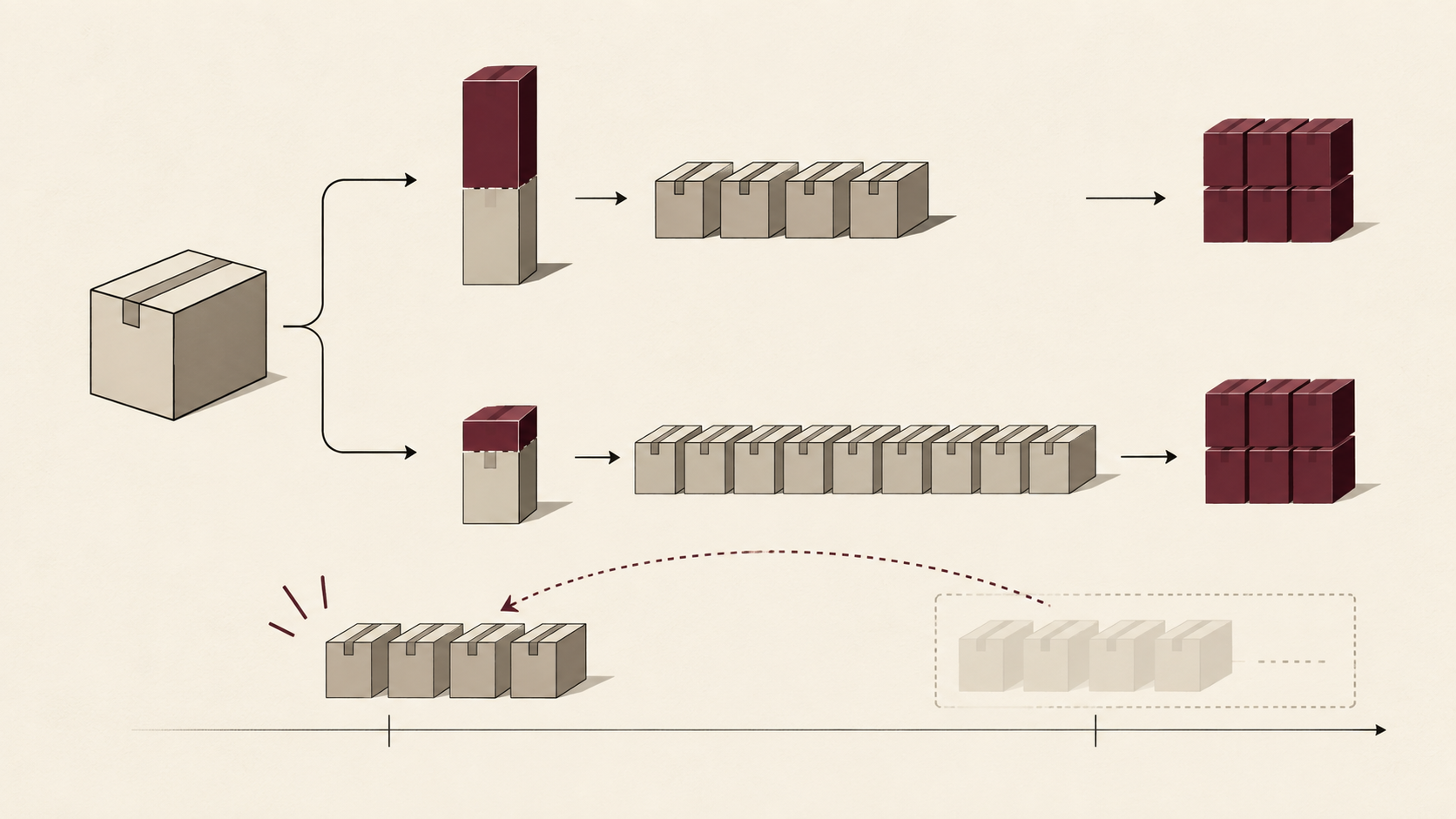
Promotions are easy to judge by sales volume, but volume alone says little about whether the decision created economic value. Because discounts reduce contribution per unit, even a modest price cut can require a much larger increase in demand to preserve profitability. Understanding that relationship turns a familiar sale sign into a basic lesson in pricing strategy.
- A 20% price discount does not necessarily require only 20% more sales because the discount is taken from price, not directly from profit.
- A $100 product with $60 in variable cost sees contribution per unit fall from $40 to $20 after a 20% discount, requiring twice as many units for the same total contribution.
- Price elasticity helps estimate how demand may respond to a lower price, but profitability also depends on costs and contribution margin.
- Promotional sales can come from new demand, brand switching, stockpiling or purchases pulled forward from the future, making the source of the sales lift important.
A 20% discount sounds simple. Lower the price by 20%, sell more products, and make up the difference through higher volume.
The math is often much less forgiving.
Imagine a product that normally sells for $100 and costs $60 per unit to produce or acquire. At the regular price, each sale contributes $40 before fixed costs.
Now put that product on sale for $80.
The customer sees a 20% discount. But the company sees something much larger: its contribution per unit has fallen from $40 to $20.
That is a 50% decline.
To generate the same $800 of contribution that came from selling 20 units at the original price, the company now has to sell 40 units.
In other words, a 20% discount requires a 100% increase in unit sales just to get back to the same contribution level.
That gap is what makes promotions a pricing decision rather than simply a marketing tactic.
The Discount Is 20%. The Margin Loss Is 50%.
The easiest mistake is to compare the percentage discount directly with the percentage increase in sales.
If price falls 20%, it might seem reasonable that selling 20% more units would compensate for the reduction.
But businesses do not keep the entire selling price.
The U.S. Small Business Administration describes contribution margin in terms of the difference between selling price and variable cost, and uses that relationship in break-even analysis. As price moves closer to variable cost, each additional sale contributes less toward fixed costs and profit.
Consider the same simplified example:
| Regular Price | 20% Discount | |
|---|---|---|
| Selling price | $100 | $80 |
| Variable cost | $60 | $60 |
| Contribution per unit | $40 | $20 |
| Units needed for $800 contribution | 20 | 40 |
Selling 24 units after the discount—a 20% increase in volume—would produce only $480 of contribution.
Revenue would rise from $2,000 to $1,920? Actually, even revenue would be slightly lower. More importantly, contribution would fall from $800 to $480.
The promotion would have generated more transactions while producing substantially less contribution.
That distinction matters because sales growth is not the same thing as profit growth.
How Much More Does a Company Actually Need to Sell?
The required increase depends on the product's margin before the promotion.
Suppose the original price is , variable cost is , and the discounted price is .
Before the promotion, the contribution per unit is:
P − C
After the promotion:
P_d − C
A simple way to find the required sales volume is:
Required new volume = Original volume × (Original contribution per unit ÷ New contribution per unit)
In the $100-to-$80 example:
20 × ($40 ÷ $20) = 40 units
This also explains why identical discounts can have very different consequences across businesses.
Imagine another $100 product that costs only $20 per unit. Its contribution falls from $80 to $60 after the same 20% discount. The company would need to sell about 33% more units—not 100% more—to maintain the same total contribution.
The promotion is identical from the customer's perspective.
Its economics are completely different for the business.
This Is Where Price Elasticity Enters the Decision
Once a company knows how much additional volume it needs, another question follows:
Will customers actually buy that much more because the price is lower?
That is where price elasticity of demand becomes useful.
Price elasticity measures how responsive quantity demanded is to a change in price. When demand is relatively elastic, a percentage change in price produces a larger percentage response in quantity. When demand is relatively inelastic, quantity changes by less.
For revenue alone, the logic is relatively straightforward. When demand is elastic, lowering price can increase total revenue because the increase in quantity can outweigh the lower price.
But a company trying to maximize profit has another variable to consider: cost.
A price cut can increase revenue and still fail to improve profit if the additional units carry too little contribution or create additional costs.
That is why elasticity answers only part of the promotion question.
Not Every Extra Sale Is Really an Extra Sale
There is another complication.
Suppose a supermarket discounts a product and sales double that week. At first glance, the promotion looks successful.
But where did those additional purchases come from?
Marketing research has long shown that promotional sales increases can come through several different mechanisms: customers may switch from another brand, buy earlier than they otherwise would have, stockpile more of the product, or change how much they consume.
Those outcomes have different economic value.
A shopper who tries the product because of the promotion and continues buying it later may represent genuinely incremental demand.
A loyal customer who normally buys one unit every month but buys three discounted units today may be different. Some of today's apparent sales growth may simply have pulled future full-price purchases forward.
Research published in the Journal of Marketing Research has specifically examined this stockpiling effect, noting that promotions can shift purchases that might otherwise have occurred later while also potentially increasing consumption or affecting brand switching.
More recent research reinforces the point that the type of promotion matters. A 2026 Journal of Retailing study using household-panel data found different promotional formats produced different kinds of sales increases: temporary price reductions and coupons were more associated with current-period brand switching in the categories studied, while volume and multi-item deals were more associated with consumption effects.
So the important question is not simply:
Did sales increase?
It is:
What caused them to increase?
Promotions Can Still Be Valuable Beyond the Immediate Sale
None of this means discounts are inherently bad for profitability.
A promotion can attract customers who otherwise would not have purchased the product. It can encourage consumers to switch from a competing brand, move inventory, generate store traffic, or introduce buyers to a product they may purchase again.
For retailers, the economics can extend beyond the discounted item itself. Research on price promotions notes that a promotion can encourage store visits and potentially contribute to purchases of other planned, unplanned or complementary products—the broader shopping basket matters, not just the margin on the promoted item.
That changes the calculation.
A grocery store might accept a low margin on one promoted product if customers arriving for that deal also buy higher-margin products. A company launching a new product might accept lower profit on the first purchase if the promotion brings in customers who later return at regular prices.
In those cases, evaluating the promotion requires looking beyond immediate unit economics toward customer acquisition, repeat purchases and total basket economics.
The Real Question Is What the Discount Changes
A promotion therefore creates a trade-off:
Lower price → lower contribution per unit → potentially higher demand
Whether that trade-off improves profit depends on what happens next.
How much additional volume appears? How price-sensitive are customers? Are the purchases genuinely incremental? Would those customers have bought anyway? Do they return after the promotion? Does the promotion increase the rest of the shopping basket? And what happens when competitors respond?
A large jump in sales can look impressive on a dashboard while still being economically disappointing.
A smaller sales increase can sometimes be more valuable if it attracts new customers, produces repeat purchases or supports higher-margin sales elsewhere.
That is why the profit-maximizing promotion is not necessarily the promotion that generates the most sales.
The better question is whether the incremental value created by changing customer behavior exceeds the margin the company gives up to create that behavior.
The most useful way to think about a promotion is not “How many more units did it sell?” but “What behavior did the lower price actually change?” Margin determines how much additional demand a company needs; elasticity helps explain whether that demand might appear; customer behavior determines how valuable the resulting sales really are. Together, those concepts explain why pricing is ultimately an allocation decision: a company gives up some value on every discounted unit in exchange for the possibility of changing what customers buy, when they buy it and what they buy next.
- Academic research OpenStax — Principles of Economics 3e: Price Elasticity of Demand and Price Elasticity of Supply
- Academic research OpenStax — Principles of Economics 2e: Elasticity and Pricing
- Government guidance U.S. Small Business Administration — Break-even point analysis
- Academic research Chan, Narasimhan & Zhang — Decomposing Promotional Effects with a Dynamic Structural Model of Flexible Consumption, Journal of Marketing Research, 2008
- Academic research Van Oest et al. — Not all sales bumps are created equal: Examining the sales bump decomposition of different types of price promotions, Journal of Retailing, 2026