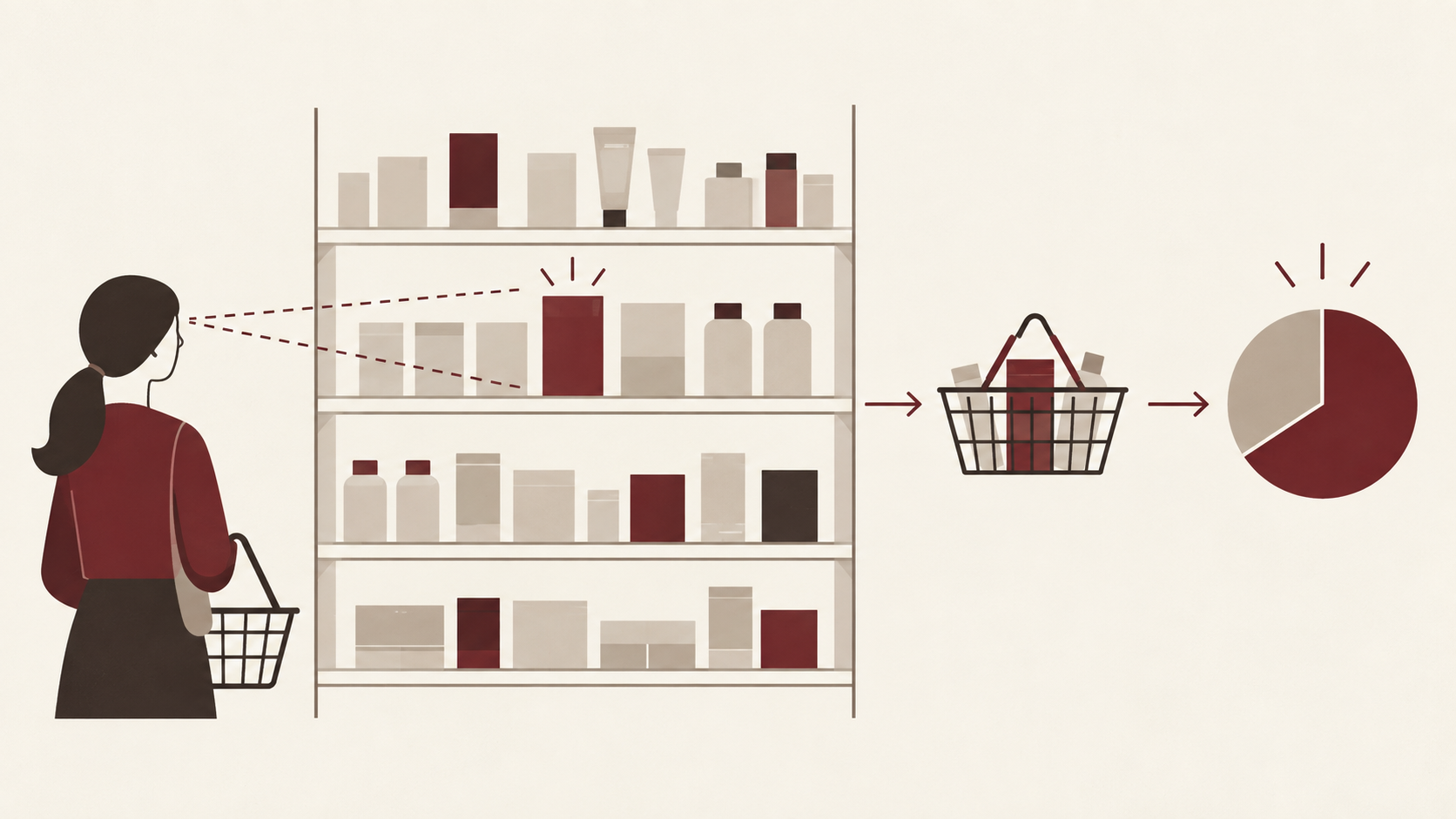
Shelf space shows how distribution can become a competitive advantage even when competing products are available in the same store. Brands are not only competing to make better products or charge better prices; they are competing to be seen at the moment a consumer makes a decision. As retailers combine stores, pickup and delivery into one system, strong placement and retailer relationships can remain valuable even as more purchases begin digitally.
- Haleon has worked with Walmart and Target on improved U.S. shelf placement while using pricing, promotions, innovation and selected exclusivity as part of its broader retailer strategy.
- Haleon's U.S. consumer-health market share rose from 11.4% in February to 12% by August 2026, according to NielsenIQ data cited by Reuters.
- Shelf placement matters because visibility can affect which products consumers notice and consider before making a purchase.
- E-commerce has not eliminated the strategic importance of stores; major retailers increasingly use physical locations as both shopping destinations and fulfillment infrastructure.
Walk into a supermarket or drugstore and the shelves can look almost accidental: dozens of toothpaste boxes, pain relievers and vitamin bottles arranged side by side.
They are not.
For consumer brands, the exact position of a product inside a store can be valuable commercial territory. A spot at eye level, a larger block of shelf space or placement next to the right products can make an item easier to notice — and potentially easier to sell.
That old retail principle is getting a fresh demonstration from Haleon, the consumer-health company behind Sensodyne, Advil and Centrum.
Haleon has negotiated improved shelf positions with major U.S. retailers including Walmart and Target, according to Reuters. The company said it has worked with retailers on commercial terms including pricing, promotions, new products and some exclusivity while seeking better placement.
The strategy helps explain something that can seem surprising in an economy increasingly built around e-commerce: physical shelf space still matters.
A Few Inches Can Change What Shoppers See
Shelf placement is ultimately a competition for attention.
A shopper standing in front of a wall of toothpaste may have dozens of options available. But availability is not the same as visibility. Products that are easier to see and reach have an advantage before shoppers begin comparing ingredients, prices or packaging.
Research has long supported the importance of placement. One in-store experiment examining potato-chip purchases found that products positioned on the middle shelf generated the highest percentage of purchases among the shelf positions tested. The researchers concluded that placement itself can influence consumer buying behavior.
That helps explain why brands care about something as specific as eye-level positioning.
Haleon said its research found that shoppers first looked for the brand, then expected premium and newer products to be easy to find within that brand's section. The company used those findings when working with retailers on shelf layouts. In some cases, Centrum products were moved to eye level and supported with promotions.
The basic mechanism is simple:
Visibility → attention → consideration → purchase.
A better shelf position does not guarantee a sale. Price, brand recognition, packaging, promotions and consumer preference all matter. But shelf placement determines which products shoppers encounter most easily in the first place.
Shelf Space Is Something Brands Have to Earn
Retail shelves are finite.
A Walmart or Target store cannot give every toothpaste, vitamin or pain reliever the most visible position. Retailers therefore have an incentive to allocate space to products and arrangements they believe can generate sales, improve the shopping experience or differentiate their assortment.
That turns shelf space into part of the commercial relationship between retailers and suppliers.
In Haleon's case, the company told Reuters that its discussions included lower prices, stronger promotions, new products and exclusivity alongside improved shelf positions. Haleon also shared forecasts with retailers showing the potential sales benefit of moving certain products.
This is why competing for shelf space is more complicated than simply paying for a better location.
A consumer-goods company needs to convince the retailer that giving its products more visibility can also benefit the store. A successful product generates revenue for the manufacturer, but it also generates sales for the retailer occupying that limited square footage.
The incentives can therefore align: the brand wants visibility, while the retailer wants productive shelves.
Haleon's U.S. Gains Show Why the Strategy Matters
The recent numbers make the Haleon example especially interesting.
According to NielsenIQ data cited by Reuters, Haleon's share of the U.S. consumer-health market increased from 11.4% in February to 12% by August 2026, rising each month over that period. Haleon said improved shelf visibility contributed to gains in oral health and adult vitamins.
That improvement follows a stronger second quarter in North America.
Haleon reported that North American organic revenue growth accelerated to 3.1% in the second quarter of 2026, compared with 1.0% in the first quarter. Oral Health grew 6.2% organically in Q2, supported by brands including Sensodyne and parodontax. Across the company, 73% of the business gained or maintained market share during the first half.
Promotions are another part of the equation. More than 21% of Haleon's U.S. second-quarter sales came from products sold with promotions, according to NielsenIQ data analyzed by Bernstein and reported by Reuters.
None of those figures proves that shelf placement alone produced the gains. Haleon has also been investing in advertising, innovation and broader commercial execution. Its first-half advertising and promotion spending increased 3.2% at constant currency.
Instead, the results illustrate how several familiar retail tools can work together: product, price, promotion and place.
The shelf is the “place” part of that equation.
But Isn't Shopping Moving Online?
Yes — but the distinction between physical and digital retail is becoming less clean.
Target reported that digitally originated merchandise sales reached 20.6% of merchandise sales in 2025, up from 18.3% two years earlier. Yet stores still fulfilled 97.6% of its merchandise sales, a figure that includes traditional in-store purchases as well as online orders fulfilled through stores, pickup, Drive Up and same-day delivery.
Walmart is following a similar omnichannel model. Its latest annual report describes stores and e-commerce as an integrated system, while its fiscal 2027 second-quarter results showed Walmart U.S. e-commerce sales rising 24%, including strong growth in store-fulfilled delivery.
Physical stores, in other words, have not simply been replaced by websites.
They have become both shopping environments and pieces of fulfillment infrastructure.
For brands, that means winning inside a major retailer can have effects beyond the shopper physically walking through an aisle. Strong retail relationships can influence assortment, product availability, promotions and how products participate in a retailer's broader omnichannel system.
The Shelf Is Really a Distribution Asset
The bigger lesson is that consumer businesses do not compete only through the products they manufacture.
They compete over distribution.
A company can develop a strong product and spend heavily on advertising, but consumers still need to encounter that product somewhere. In physical retail, shelf position determines part of that encounter. Online, the equivalent battle happens through search rankings, recommendations, sponsored listings and digital storefront placement.
The interface changes. The business problem does not.
Brands are always trying to reduce the distance between a consumer's attention and their product.
That is why a few inches of shelf space inside Walmart or Target can still matter in 2026. The physical shelf may be one of retail's oldest technologies, but the competition behind it remains remarkably modern.
Shelf space is an unusually visible example of a much bigger business idea: distribution is not passive. Making a product is only one part of selling it. Companies also compete to control the routes through which consumers discover, access and eventually buy that product. The eye-level shelf at a supermarket and the first page of an online search result may look completely different, but economically they solve much the same problem — getting a product into the consumer's field of attention before a competitor does.
- News Reuters — “Haleon secures better shelf space at Walmart, Target in bid to boost market share,” Sept. 3, 2026
- Company IR Haleon — “2026 Half Year Results,” July 30, 2026
- Company filing Target Corporation — 2025 Annual Report, Item 1: Business
- Company filing Walmart Inc. — 2026 Annual Report
- Academic research Sigurdsson, Saevarsson & Foxall — “Brand Placement and Consumer Choice: An In-Store Experiment,” Journal of Applied Behavior Analysis