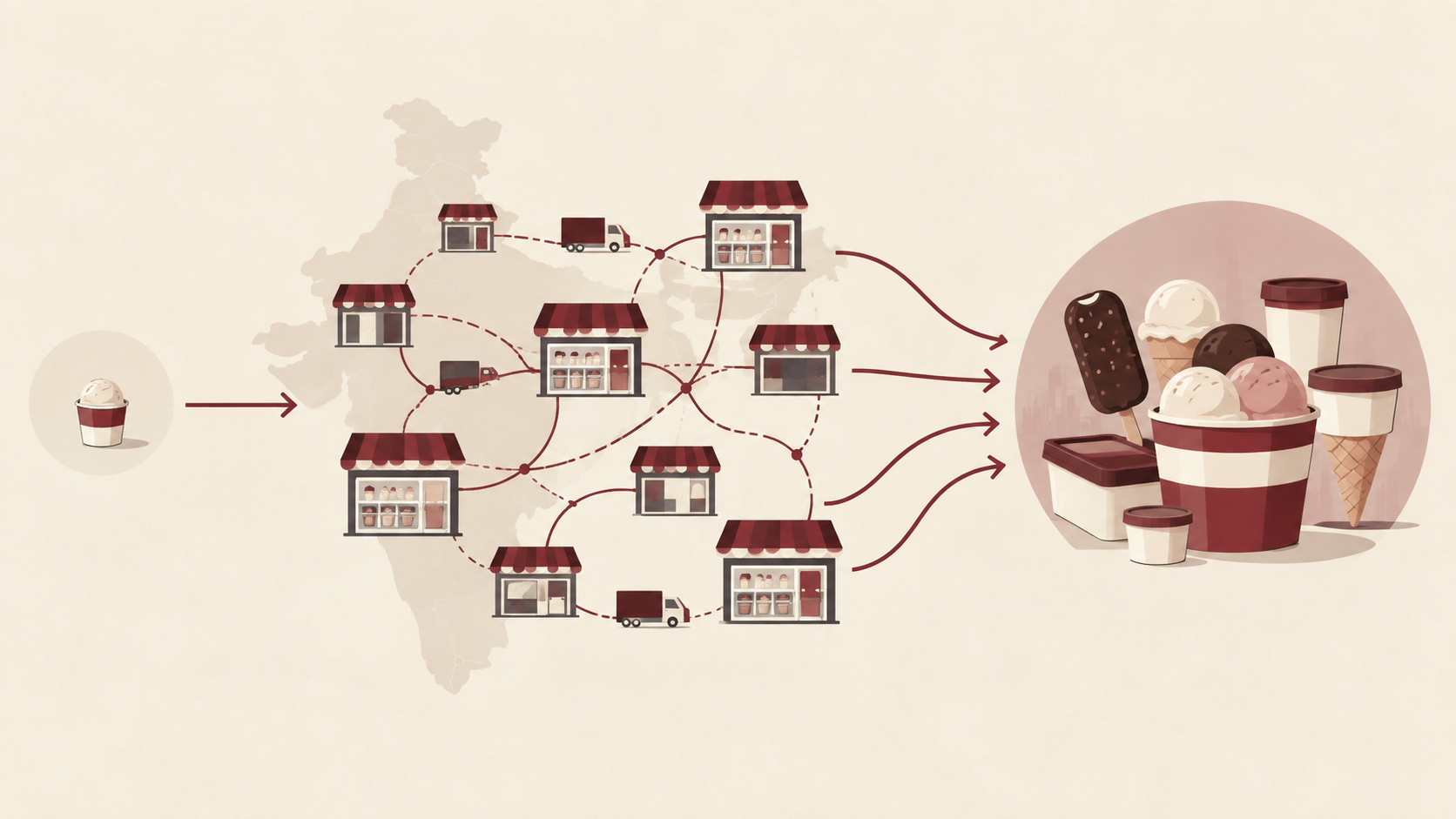
Bombay Creamery shows why market entry in consumer goods is not simply a pricing decision. Reliance can pair an accessible ₹10 starting price with an existing distribution system reaching nearly 3 million retail outlets, potentially making availability as important as advertising in building the new brand.
- Reliance Consumer Products launched Bombay Creamery on September 1, with products starting at ₹10 and a nationwide rollout planned after its western India debut.
- RCPL has access to nearly 3 million retail outlets across India and reported ₹22,000 crore in FY2026 gross revenue.
- ₹10 is not unique in India's ice cream market; the more significant advantage may be combining accessible pricing with distribution and freezer placement.
- The launch illustrates a broader consumer-goods mechanism: low-cost trial can attract customers, while availability and repeat purchases are what turn trial into scale.
Reliance is moving into one of India’s most familiar consumer categories: ice cream.
On September 1, Reliance Consumer Products Limited, or RCPL, launched Bombay Creamery, a new dairy ice cream brand offering cones, cups, tubs, bars and sticks. Prices start at ₹10, or roughly 10.5 U.S. cents. The initial rollout is focused on western India, with a nationwide expansion planned.
The low starting price immediately stands out. But the more interesting business story is not simply that Reliance can sell an inexpensive ice cream.
It is what can happen after someone buys the first one.
For a new consumer brand, a low entry price can make trial easier. Distribution determines how often consumers encounter the product afterward. Repeat purchases can then turn those individual trials into scale.
For Reliance, Bombay Creamery enters the market with much of that distribution infrastructure already in place.
A ₹10 Product Makes Trying the Brand Easy
Entering an established consumer category creates a basic problem: customers already know what they buy.
India's ice cream market includes established names such as Amul, Mother Dairy, Vadilal, Kwality Wall’s and Arun. A new brand therefore needs to persuade shoppers to choose something unfamiliar instead.
One way to lower that barrier is to make the first purchase inexpensive.
At ₹10, buying a Bombay Creamery product requires little commitment from a consumer. That matters especially for an impulse category like ice cream, where purchases can be decided quickly at a store rather than researched in advance.
But ₹10 should not be mistaken for a price point unique to Reliance. Other ice cream companies in India already sell products at that level. The strategy is therefore less about inventing a new low price than about combining an accessible price with Reliance's ability to distribute a new product at scale.
RCPL is also positioning Bombay Creamery as an “accessible premium” product made with real dairy cream. That creates a straightforward proposition: keep the entry price low while trying to give consumers a reason to associate the brand with a higher-quality product.
Distribution May Matter More Than Price
A ₹10 ice cream does not accomplish much if shoppers cannot find it.
That is where Reliance enters the category differently from a typical new food startup.
RCPL already has access to nearly 3 million retail outlets across India, according to a company announcement from March. Its consumer business has expanded across beverages, staples, packaged foods and other everyday categories.
The company has already demonstrated how quickly that infrastructure can support a consumer brand. RCPL reported ₹22,000 crore in gross revenue for FY2026, double the previous year, while its Campa beverage business generated more than ₹4,700 crore in gross sales.
That existing network changes the economics of launching another product.
A startup entering ice cream would have to build brand awareness while simultaneously persuading distributors and retailers to carry its products. Reliance can introduce Bombay Creamery through a consumer-products operation that already sells other goods to retailers.
In simple terms, the pathway can look like this:
low entry price → trial → wide availability → repeat purchase → scale
Price gets a consumer to try the product. Distribution gives the brand more chances to be purchased again.
Ice Cream Adds Another Complication: The Freezer
Ice cream also demonstrates why consumer distribution is about more than getting a product onto a store's inventory list.
It needs cold storage.
Retail freezer space is limited, which makes placement itself valuable. Reuters reported that Reliance has already placed freezers in stores for its products and could use that infrastructure as it expands in ice cream.
That creates another layer to the strategy.
If Bombay Creamery gains freezer placement across a large retail network, Reliance is not simply increasing the number of stores that technically carry the product. It is securing physical space where consumers actually make ice cream purchases.
For inexpensive consumer goods, that visibility can be especially important. A product costing ₹10 does not need a customer to plan a shopping trip around it. It needs to be available when the customer wants one.
That makes distribution infrastructure part of the product strategy itself.
Reliance Is Building a Larger Consumer Business
Bombay Creamery also makes more sense when viewed as one piece of RCPL rather than as a standalone ice cream venture.
Reliance has been expanding its consumer portfolio across beverages, staples, packaged foods and home and personal care products. Its annual report describes India's FMCG market as increasingly driven by rising incomes, branded consumption and consumers looking for a combination of quality and value.
The strategy gives Reliance opportunities to use the same distribution system across more categories.
A distributor that already carries Campa beverages or other RCPL products can potentially carry additional Reliance brands. Retail relationships, logistics infrastructure and consumer insights can therefore support more than one product line.
That is one reason scale can become such an advantage in consumer goods.
The value of a distribution network grows when a company can send more products through it.
The Real Test Comes After the First Scoop
Bombay Creamery still has to win consumers.
Low prices and distribution can make a product easier to discover, but neither guarantees repeat purchases. Taste, product quality, retailer adoption and consistent availability will ultimately determine whether the brand becomes part of consumers' regular choices.
There is also substantial competition. Reliance is entering a category where established brands already have distribution networks, consumer recognition and inexpensive products of their own.
That makes the planned nationwide rollout worth watching.
Bombay Creamery is starting in western India before expanding across the country. If Reliance can turn its existing retail reach into freezer availability and repeat purchases, the launch could demonstrate something broader about modern consumer businesses.
Sometimes the hardest part of launching a new brand is not making the product.
It is getting that product everywhere consumers might want to buy it.
The most useful lesson from Bombay Creamery is not simply that low prices win markets. Price can reduce the cost of trying something new, but infrastructure determines whether that trial can become a habit. Reliance already owns much of the machinery needed for the second step—retailer relationships, distribution reach and an expanding portfolio of everyday products. In consumer goods, that infrastructure can be as strategically valuable as the brand itself.
- Company IR Reliance Industries — FY2025-26 Retail Business Overview; RCPL gross revenue of ₹22,000 crore and Campa gross sales above ₹4,700 crore
- Official release Reliance Consumer Products — RCPL signs MoU with Fazer; company states access to nearly 3 million retail outlets, Mar. 6, 2026
- Company filing Reliance Industries — Chairman’s Statement, FY2025-26; RCPL gross revenue and consumer-products strategy
- Independent reporting: Independent reporting:
- News Reuters — Ambani's Reliance enters India's crowded ice cream market with 10-cent products, Sept. 1, 2026
- News Business Standard — Reliance Consumer Products enters ice-cream market with Bombay Creamery, Sept. 1, 2026