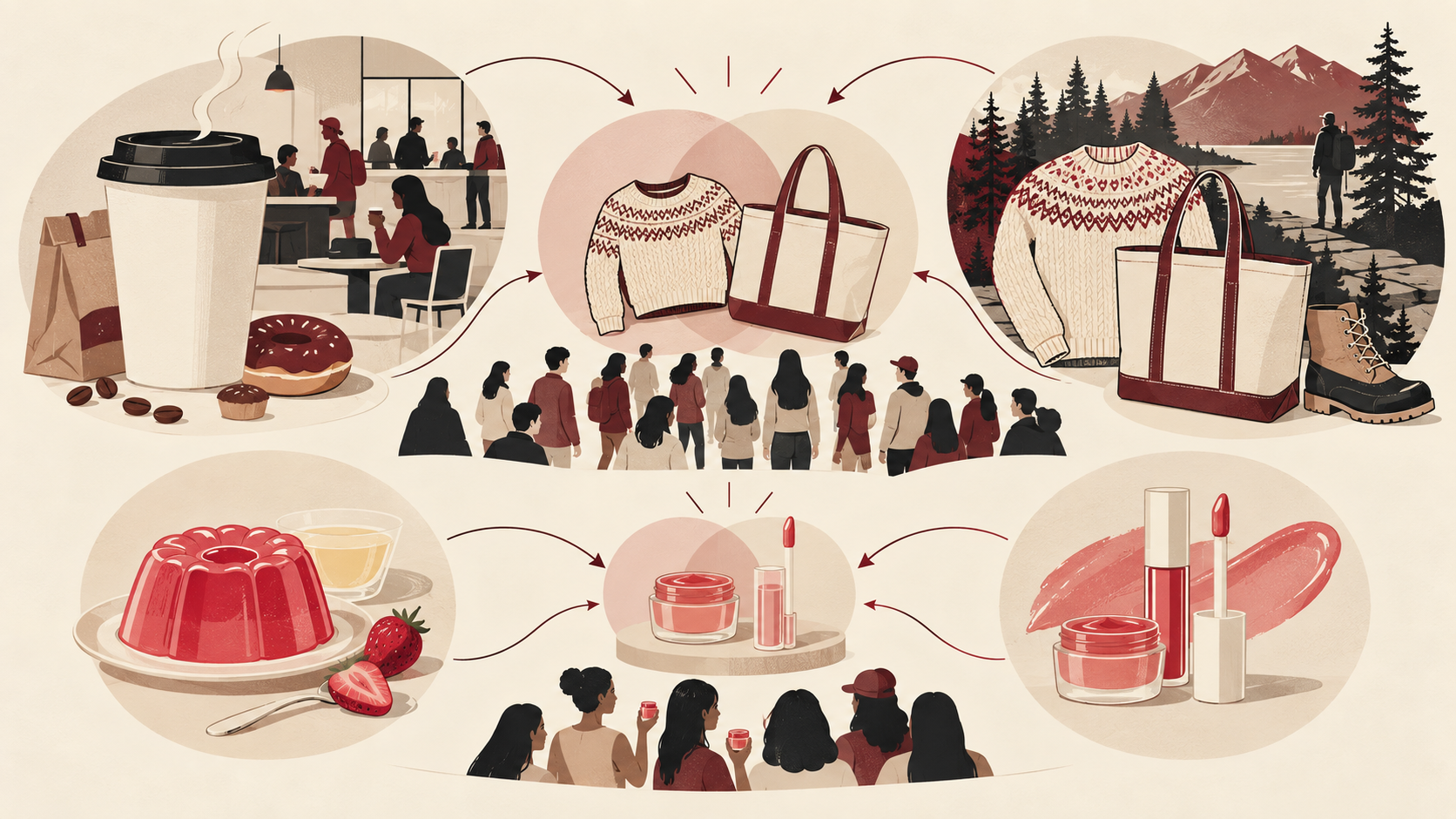
Brand collaborations can give companies access to something that is difficult to build through ordinary advertising: another brand’s existing relationship with consumers. The strongest partnerships use surprise to attract attention while giving both companies a credible way to enter a new part of customers’ lives.
- Dunkin’ and L.L.Bean launched their first collaboration with a Birdseye Sweater and Boat and Tote, extending Dunkin’s identity from coffee into apparel.
- JELL-O and Tower 28 applied the same cross-category idea to beauty, turning familiar dessert flavors into limited-edition lip products sold through Sephora.
- Research published in 2026 suggests unexpected collaborations can generate consumer curiosity and encourage people to seek more information about the partnership.
- The business value extends beyond merchandise sales: each company can gain exposure to the other brand’s audience, associations and consumer context.
Why would a coffee company want its name on a sweater?
On Sept. 29, Dunkin’ and outdoor retailer L.L.Bean released their first product collaboration: a $79.95 Birdseye Sweater and a $59.95 version of L.L.Bean’s Boat and Tote in Dunkin’s orange and pink. The launch was part of a broader campaign that included coffee-cup sleeves designed like miniature sweaters, a traveling L.L.Bean Bootmobile and an event at the retailer’s Boston Seaport store.
Dunkin’ is still selling coffee. L.L.Bean is still selling outdoor clothing and gear. But for a limited time, each brand became part of the other’s world.
That increasingly describes how consumer brands are approaching collaboration. JELL-O, the Kraft Heinz dessert brand, entered the beauty aisle in September through a partnership with cosmetics company Tower 28. Their limited-edition collection turned JELL-O and pudding flavors including Strawberry, Lemon Lime, Banana Cream and Pistachio into lip glosses and treatments sold through Sephora.
The combinations can look random. From a business perspective, they often are not.
A Collaboration Can Borrow What Advertising Has to Build
Traditional advertising puts a brand in front of an audience. A well-designed collaboration can do something more: put the brand inside another company’s product, customer base and cultural identity.
Dunkin’ does not need to become an apparel company to enter someone’s closet. L.L.Bean already knows how to make and sell the sweater. What Dunkin’ contributes is a recognizable visual identity, a large consumer following and an everyday coffee ritual.
L.L.Bean brings something different. Founded in Maine in 1912, the company has spent more than a century building an identity around the outdoors and New England.
That makes the pairing less strange than “coffee meets outdoor clothing” initially suggests. Both brands are closely associated with New England, and the campaign was built around fall — a season that naturally connects hot coffee, sweaters and the outdoors. Dunkin’ Chief Marketing Officer Jill Nelson said the companies had been part of many of the same routines and traditions for decades.
In other words, the product categories do not have to match perfectly if the meanings of the brands do.
That is one reason the sweater matters more than another Dunkin’ advertisement. Someone wearing it is not simply seeing the brand. The customer is choosing to carry Dunkin’ into another part of daily life.
The same mechanism works in reverse. Dunkin’ customers who may not have been shopping for L.L.Bean are introduced to one of the retailer’s signature designs through something they already recognize.
Why Make the Combination Unexpected?
There is another advantage to putting two seemingly unrelated brands together: people notice.
A 2026 study published in the Journal of Retailing and Consumer Services found that unexpected brand collaborations can generate stronger information-seeking intentions than conventional pairings. The researchers linked the effect to the mental mismatch consumers experience when two brands they would not normally group together suddenly appear side by side.
That helps explain the basic appeal of a JELL-O lip gloss.
JELL-O does not need to convince consumers that it has suddenly become a cosmetics manufacturer. Tower 28 already has the product. JELL-O supplies something else: familiar flavors, colors and more than a century of consumer recognition.
The resulting product gives people a reason to look twice.
Tower 28 and JELL-O launched two limited-edition sets in September: a $24 Lip Jelly Duo and a $20 Lil’ Pudding Snack Set. The products were sold through Sephora online and in stores. Kraft Heinz described the collaboration as sitting at the intersection of food, beauty, nostalgia and pop culture.
The collaboration therefore creates value from assets that already exist. Tower 28 has beauty products and distribution. JELL-O has flavors and cultural familiarity. Combining them produces something neither brand would offer in its normal category.
The Product Is Also a Customer-Acquisition Tool
That makes collaborations useful beyond merchandise sales.
Every brand already has a group of people who recognize it, shop from it or follow it. When two brands collaborate, those audiences partially overlap.
A Dunkin’ customer encounters L.L.Bean. An L.L.Bean shopper encounters Dunkin’. A Tower 28 customer encounters JELL-O in Sephora rather than the grocery aisle. And a consumer who recognizes JELL-O but has never purchased Tower 28 now has a familiar reason to look at the beauty brand.
This is one of the basic economic attractions of co-branding: companies can use an existing brand relationship instead of building every customer connection from zero.
Academic research has long found that those associations can move between partners. A classic study of brand alliances found that consumers’ attitudes toward an alliance can affect their subsequent impressions of the individual brands involved. More recently, a 2025 meta-analysis of brand-alliance research found a statistically significant positive average influence from an allied brand on the focal brand, although the size of the effect varies by situation.
For marketers, that means the partner itself can become part of the message.
The strategy also helps explain why many collaborations are limited editions. A short release creates a clear moment around the partnership and gives consumers a reason to discover something outside the brands’ usual categories. It also gives companies a flexible way to explore new products and audiences without permanently changing what the core business sells.
The Dunkin’ collaboration offers a small real-world example. L.L.Bean’s online page for the limited-edition Dunkin’ Boat and Tote currently lists the product as sold out. That does not reveal the collection’s total sales volume or financial impact, but it shows how a crossover product can turn an unusual pairing into something consumers can actually buy and use.
What Makes an Unexpected Collaboration Work?
The strongest collaborations do not need two companies to sell similar products. They need consumers to understand why the brands belong together once the connection is revealed.
Research on co-branding has found that consumers’ existing attitudes toward participating brands and their perception of how well the brands fit together can influence how they evaluate the resulting collaboration.
But fit can come from more than product category.
Dunkin’ and L.L.Bean sell different things, yet both can credibly occupy a New England fall morning. Coffee, sweaters and the outdoors fit into the same consumer moment.
JELL-O and Tower 28 operate in completely different aisles, but flavors, colors and playful packaging create another kind of connection. The collaboration translates something consumers already recognize about JELL-O into a format Tower 28 already knows how to make.
That creates a useful formula: unexpected enough to attract attention, familiar enough to make sense.
The surprise gets someone to look. The connection between the brands gives the collaboration a reason to exist.
Brands Are Competing for More Than Shelf Space
That is why these collaborations are more than novelty merchandise.
Consumer brands have traditionally expanded by selling more products, entering more stores or advertising to more people. Cross-category collaboration adds another route: temporarily entering another brand’s world.
The partner provides the category expertise. Its audience provides a new point of discovery. Its identity provides associations that would take time — and marketing dollars — to build independently.
Dunkin’ does not have to become L.L.Bean, and JELL-O does not have to become Tower 28. That is precisely the advantage.
In a crowded consumer market, a brand may not need to own every new category it enters. Sometimes it only needs the right partner to open the door.
The interesting shift is not that brands are becoming more random. It is that the boundaries of what a brand can sell are becoming less important than the boundaries of what a brand can mean. Dunkin’ does not need expertise in knitwear if consumers already associate it with the same New England fall morning that L.L.Bean represents. That turns collaboration into a flexible form of market entry: combine existing brand equity, borrow the partner’s category capabilities and give consumers a new way to experience both brands.
- Official release Dunkin’ — “Dunkin’ and L.L.Bean Debut the Ultimate Fall Blend, a First-Ever Collab Between the Two New England Icons,” Sept. 21, 2026
- Official product page L.L.Bean — “L.L.Bean x Dunkin’ Boat and Tote”
- Official release Kraft Heinz — “JELL-O and Tower 28 Team Up to Launch the Limited Edition Lip Collection You’ve Been Craving,” Sept. 9, 2026
- Academic research Journal of Retailing and Consumer Services — “The impact of collaboration unexpectedness on consumer curiosity through schema incongruity,” 2026
- News Business Insider — “The latest ploy to get you to spend more money: Bizarre cross-brand collabs,” Oct. 1, 2026