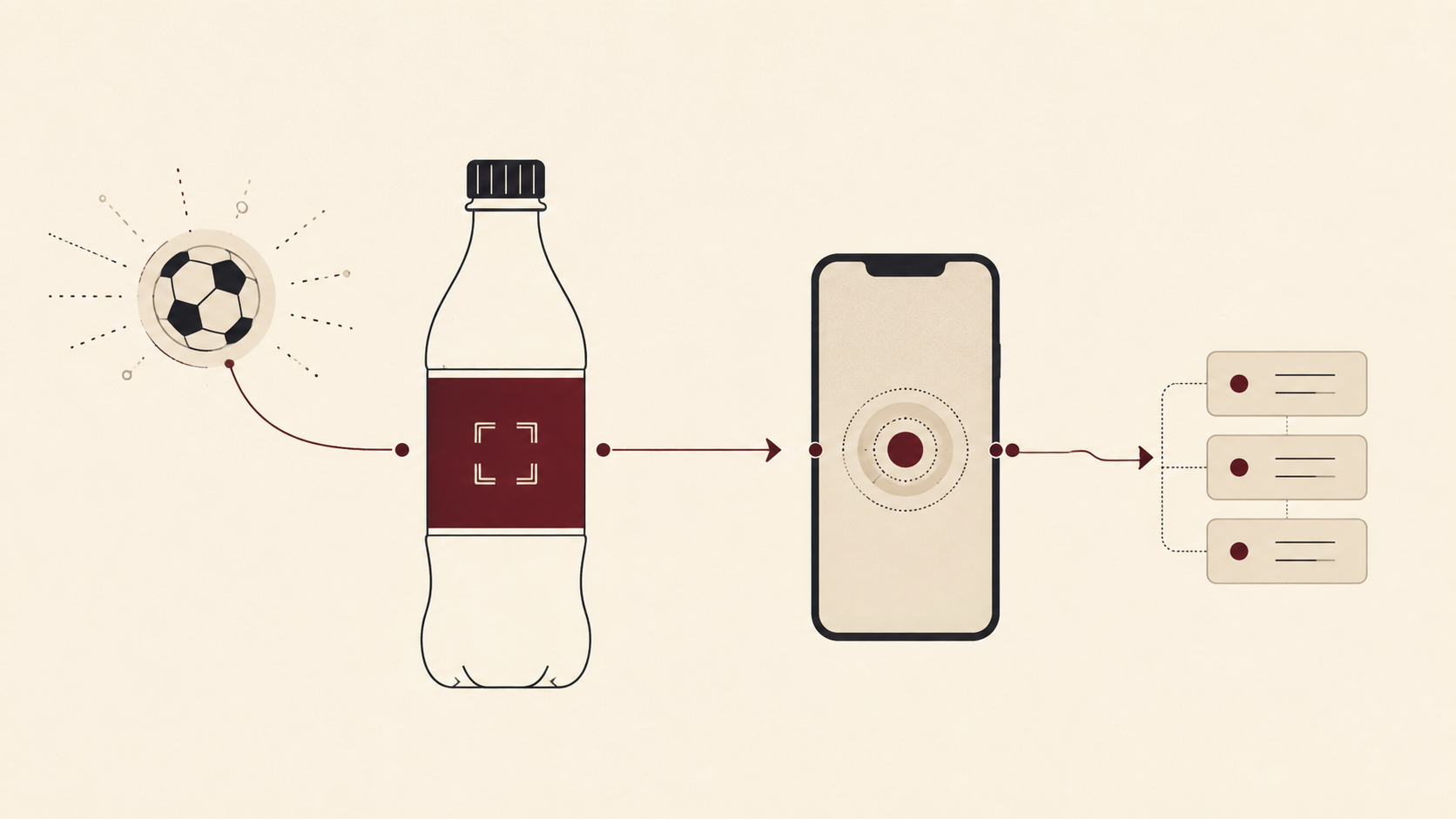
Coca-Cola’s campaign shows that sponsorship is becoming more measurable than simple logo exposure. By connecting a global event to physical packaging and then to digital interactions, consumer brands can turn temporary attention into first-party relationships that may remain useful after the event ends. The package itself is increasingly becoming part of the media strategy.
- Coca-Cola activated its 2026 FIFA World Cup campaign across more than 180 markets and retail programs spanning more than 20 million outlets.
- Connected packaging engaged more than 80 million consumers and generated more than 25 million first-party data records, according to Coca-Cola.
- Digital and social activations generated more than 60 billion impressions and over 9 billion views.
- The strategy creates a new sponsorship funnel: attention → packaging interaction → digital engagement → first-party data → future marketing.
The FIFA World Cup has always offered Coca-Cola something few marketing platforms can match: global attention.
In 2026, the company tried to make that attention more useful.
Coca-Cola activated its World Cup campaign across more than 180 markets, combining advertising, retail promotions, creator content, the FIFA World Cup Trophy Tour and interactive packaging. The campaign generated more than 60 billion digital and social impressions and over 9 billion views, according to the company.
But reach was only part of the strategy.
Coca-Cola says its connected packaging engaged more than 80 million consumers and generated more than 25 million first-party data records that can be used to tailor future marketing campaigns.
That points to a different way of thinking about sports sponsorship. Instead of simply paying to be seen during one of the world’s biggest sporting events, Coca-Cola built a path from mass attention to direct consumer interaction.
From Sponsorship to Consumer Interaction
Traditional sponsorship is largely an attention business.
A company pays for association with an event, places its brand in front of a large audience and tries to convert that visibility into awareness and sales.
Coca-Cola still did all of that. Its World Cup activation reached more than 20 million retail outlets, involved more than 2,500 content creators and included a trophy tour that reached roughly 700,000 fans before the tournament.
But Coca-Cola also connected that enormous media presence to the product itself.
Its 2026 World Cup strategy included connected packaging and scan-to-engage experiences. In North America, for example, select Coca-Cola and Coca-Cola Zero Sugar bottles carried Panini World Cup stickers inside their labels. Across its wider World Cup programs, physical packaging could become an entry point into digital experiences rather than simply a container carrying the Coca-Cola brand.
That creates a new marketing funnel:
brand attention → packaging interaction → digital engagement → first-party data
The World Cup attracts the consumer. The package gives that consumer something to interact with. The digital experience then gives Coca-Cola an opportunity to establish a measurable relationship.
That last step is what makes the strategy more interesting than a conventional sponsorship campaign.
Why First-Party Data Changes the Equation
Coca-Cola has enormous global distribution, but distribution does not necessarily mean a direct relationship with the person buying the drink.
A bottle might be purchased from Walmart, a convenience store, a restaurant or a stadium concession stand. In those transactions, the retailer or operator often controls much of the direct customer relationship.
That creates a challenge for packaged-goods companies: they can sell billions of products without necessarily knowing much about the individual consumers buying them.
First-party data can help close that gap.
It refers to information collected through a company’s own interactions with consumers. For Coca-Cola, a consumer who chooses to interact with a connected package can move from an anonymous buyer in a retail channel into a participant in a Coca-Cola-operated digital experience.
Coca-Cola says more than 25 million first-party data records were collected through its connected packaging during the World Cup campaign. That does not necessarily mean 25 million unique consumers, and the company has not publicly detailed every field contained in those records. But it does show the scale at which Coca-Cola is attempting to connect physical consumption with its digital marketing infrastructure.
The value is not simply having more data. It is having a way to learn from consumer interactions and potentially make future campaigns more relevant.
The Bottle Is Becoming a Media Channel
This also changes the role of packaging.
Consumer brands have traditionally treated packaging as a combination of product container, branding surface and point-of-sale marketing. Connected packaging adds another function: it can become a gateway to a digital relationship.
That is particularly valuable for a company like Coca-Cola because its products already have enormous physical reach.
Instead of building every digital interaction from scratch, the company can use something it already distributes at scale — bottles and cans — as the connection point.
The World Cup makes that mechanism more powerful because it gives consumers a reason to interact.
Coca-Cola’s partnership with Panini is one example. The company incorporated official World Cup stickers into select bottle labels in the United States and Canada, linking an established football collecting ritual with the purchase of a beverage.
The product is no longer only something to drink. During the campaign, it can also become part of the fan experience.
That matters because a QR code or interactive label has little value if nobody wants to use it. The sponsorship supplies the cultural moment; packaging turns that moment into an action.
A New Way to Measure Sponsorship
For brands, one of the longstanding problems with sponsorship is measurement.
Billions of impressions can demonstrate reach, but they do not necessarily show whether consumers did anything after seeing the brand.
Connected packaging creates another layer of measurement.
Coca-Cola can still count impressions, views and retail reach. But it can also measure how many consumers moved from exposure to interaction.
The company’s reported numbers illustrate the difference. Its digital and social campaign produced more than 60 billion impressions, while connected packaging engaged more than 80 million consumers and generated more than 25 million first-party data records.
Those figures represent different stages of the marketing funnel.
An impression measures exposure. An interaction signals participation. A first-party data record can potentially support another marketing interaction later.
That means some of the value created by the World Cup campaign does not have to disappear when the final match ends.
What Coca-Cola Is Really Building
Coca-Cola has been associated with the FIFA World Cup for decades. It has sponsored every tournament since 1978.
What is changing is what the company can build around that sponsorship.
The 2026 campaign connected one of the largest attention events in the world with Coca-Cola’s retail distribution, physical packaging and digital marketing systems. The result is a model in which each part strengthens the next.
The World Cup creates attention. Retail distribution puts the product within reach. Packaging creates an interaction. Digital experiences turn some of those interactions into data. That data can then inform future marketing.
For Coca-Cola, that makes sponsorship more than a temporary media purchase.
And for other consumer brands, the lesson is broader: the most valuable marketing campaigns may increasingly be the ones that do not stop at getting consumers to look.
They give them a reason to interact — and create a way for the brand to continue the relationship afterward.
The most interesting part of Coca-Cola’s World Cup strategy is not that a huge sporting event generated huge reach. That is what global sponsorships are supposed to do. The more important shift is that Coca-Cola built a mechanism for moving consumers from rented attention — a match, social feed or sponsorship placement — toward an interaction the company can measure directly. For consumer brands, packaging may increasingly function as the bridge between mass advertising and owned consumer relationships.
- Official release The Coca-Cola Company — Coca-Cola Reports Second Quarter 2026 Results and Raises Full Year Guidance, July 28, 2026
- News Reuters — Coca-Cola lifts annual forecasts on sodas demand after FIFA World Cup powers sales, July 28, 2026
- News Financial Times — Coca-Cola and Unilever sales surge after World Cup marketing blitz, July 28, 2026
- News The Atlanta Journal-Constitution — World Cup boosts Coca-Cola's second quarter results, July 2026