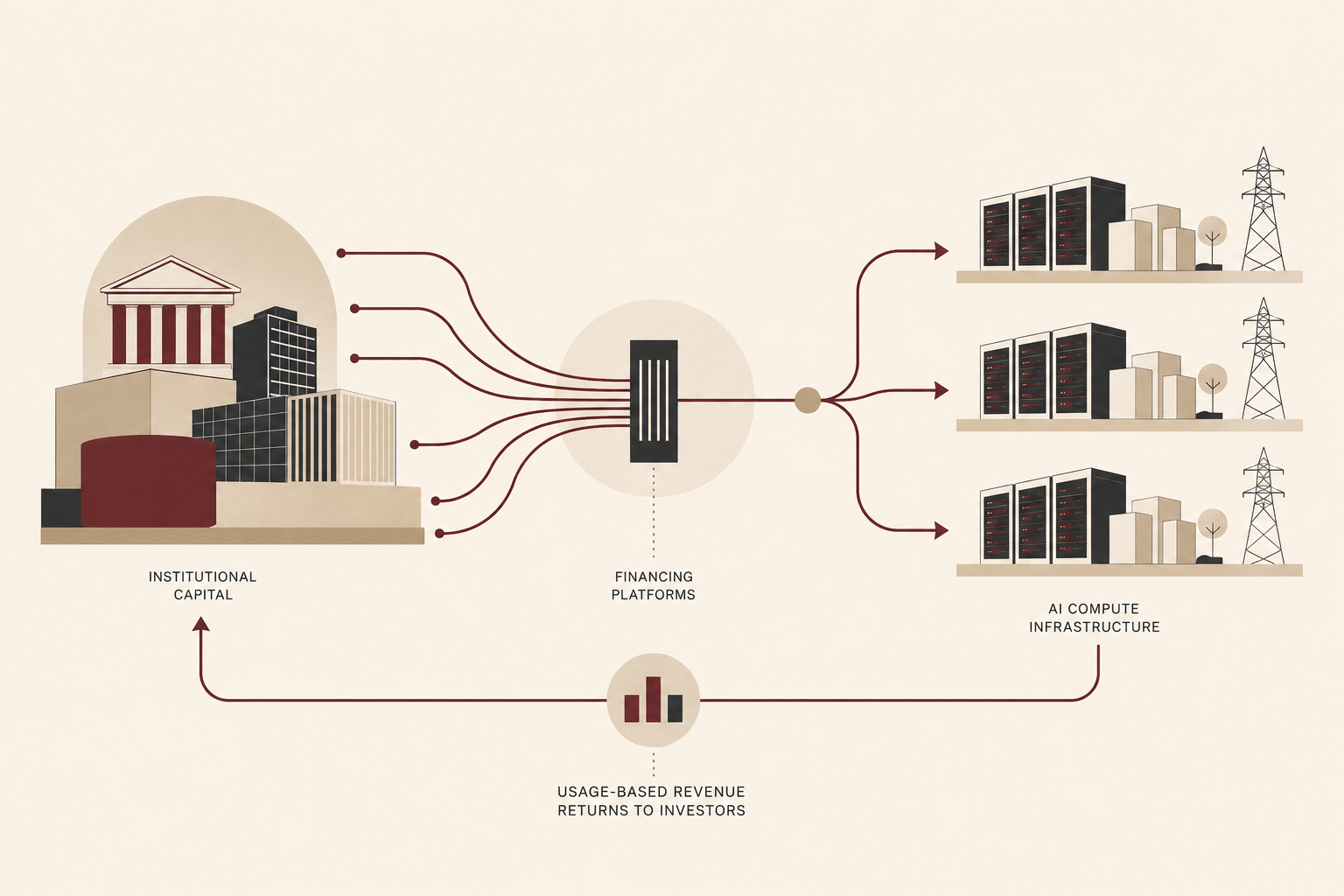
AI infrastructure is becoming too capital-intensive to remain purely a technology-sector spending story. Nvidia’s proposed financing platforms show how private credit, infrastructure funds and capital markets could become essential links between demand for AI and the physical compute needed to serve it. McKinsey estimates AI-related data centers alone could require about $5.2 trillion of investment through 2030.
- Nvidia is partnering with six major financial institutions to establish platforms designed to mobilize more than $500 billion in third-party capital for AI infrastructure.
- The $500 billion is a financing target over time—not cash already committed to Nvidia—and the partnerships remain subject to final agreements.
- The model aims to make AI compute financeable infrastructure, allowing institutional capital to fund assets that customers use to generate revenue.
- The AI race is increasingly expanding from chips and models into credit, project finance, private capital and the ability to fund massive physical infrastructure.
Nvidia spent years solving one of artificial intelligence’s biggest constraints: computing power.
Now it is turning to another one—money.
On Aug. 10, Nvidia announced partnerships with Apollo Global Management, BlackRock, Blackstone, Brookfield, Goldman Sachs and KKR to establish financing platforms intended to mobilize more than $500 billion of third-party capital for AI infrastructure over time.
The announcement does not mean Nvidia has received $500 billion, nor that the six financial firms have committed that amount today. The partnerships are based on memorandums of understanding and remain subject to final agreements. The goal is to create large pools of outside capital that can finance Nvidia-based computing infrastructure for AI labs, cloud providers, enterprises and other customers.
That distinction matters. Nvidia is trying to change not just how AI infrastructure is built, but how it is financed.
AI Is Becoming a Capital-Intensive Business
The first phase of the generative AI boom was largely framed as a technology race.
Companies competed for advanced GPUs. Cloud providers raced to secure chips. AI labs trained increasingly large models.
But buying the chip is only part of the cost.
Running AI at scale requires servers, networking equipment, data centers, cooling systems, enormous amounts of electricity and the infrastructure needed to connect all of it. Those costs arrive before the facility has generated much revenue.
McKinsey estimates that meeting global demand for AI computing could require about $5.2 trillion of data-center investment through 2030.
That changes the economics of the industry.
A company may have customers willing to pay for AI computing but still lack the balance sheet to spend billions of dollars building the infrastructure required to serve them. In that situation, the constraint is no longer access to technology alone.
It is access to capital.
Nvidia Wants Compute to Become Financeable Infrastructure
The financing model Nvidia is proposing addresses that problem by bringing institutional capital into the equation.
Instead of requiring an AI company or cloud provider to finance an entire computing facility itself, outside investors could provide capital for the infrastructure. Customers would then use that computing capacity to generate revenue over time.
The concept resembles infrastructure finance more than a traditional technology purchase.
A toll road costs billions of dollars to build before drivers begin paying tolls. A power plant requires substantial upfront investment before electricity sales generate cash flow. Investors are willing to finance those assets because future usage can produce relatively predictable revenue.
Nvidia wants AI compute to move toward a similar model.
The company describes its computing infrastructure as an investable asset capable of generating usage-linked revenue. Goldman Sachs CEO David Solomon went further, pointing to the opportunity to develop a market for credit backed by Nvidia compute.
That is an important shift.
GPUs have traditionally been viewed as technology equipment—valuable, but subject to rapid technological change and depreciation. Financing them at infrastructure scale requires investors to become comfortable with a different proposition: that the equipment can remain sufficiently useful, transferable and revenue-generating to support long-duration capital.
Why Wall Street Is Entering the AI Buildout
The six partners reveal how broad the financing opportunity could become.
Apollo, Blackstone and KKR bring large private-capital and credit businesses. BlackRock and Brookfield manage enormous pools of long-term capital and already invest heavily in infrastructure. Goldman Sachs brings investment banking, capital markets and distribution capabilities.
Their role could extend far beyond simply lending money for GPUs.
AI infrastructure projects can require combinations of equity, private credit, structured financing, project finance and other forms of institutional capital. Connecting those sources of money to computing projects could allow infrastructure to be built without placing the entire cost on the balance sheet of the company using it.
For Wall Street, AI is therefore becoming more than a technology investment theme.
It is becoming a financing market.
The transition is already visible elsewhere. Technology companies have increasingly turned to bond markets, private credit and off-balance-sheet structures as AI spending rises. CoreWeave, one of the most prominent AI cloud providers, raised its 2026 capital-expenditure forecast in August to between $35 billion and $39 billion.
The amounts involved make financing architecture increasingly important.
Nvidia Has a Reason to Help Solve the Funding Problem
There is also a straightforward business incentive for Nvidia.
Its Data Center business generated a record $75.2 billion of revenue in the first quarter of fiscal 2027, up 92% from a year earlier. Continued growth increasingly depends on customers being able to fund enormous deployments of Nvidia hardware.
A customer that wants more GPUs but cannot finance a new data center is still a constrained customer.
By helping connect customers with institutional capital, Nvidia can potentially remove that constraint without providing all of the financing itself.
That makes the initiative different from simply selling more chips. Nvidia is attempting to help build the financial infrastructure around the market for its products.
CEO Jensen Huang has summarized the idea with a simple argument: in AI, compute can produce revenue.
If institutional investors accept that argument, Nvidia-based computing capacity could increasingly be treated not only as equipment but as an asset against which capital can be raised.
There Is Still Risk in the Model
Turning compute into an investable asset does not eliminate risk.
It redistributes it.
AI infrastructure remains exposed to utilization rates, electricity costs, customer creditworthiness and rapid technological change. A data center filled with expensive GPUs is valuable only if customers continue paying to use its computing capacity.
There is also the question of technological obsolescence. New generations of accelerators can deliver significant performance improvements, which makes estimating the long-term value of existing equipment more complicated than valuing a conventional infrastructure asset.
And Nvidia is not entirely removed from the financing equation. Huang told Reuters that the company could potentially backstop as much as 25% of financing opportunities, or up to $125 billion if the platforms ultimately reached their full stated scale.
That creates an important question for investors: how much financial exposure should a technology supplier take on to support demand for its own products?
The structure will matter as final agreements emerge.
The AI Race Is Expanding Beyond Technology
For years, the central question in AI infrastructure was whether companies could obtain enough advanced chips.
That problem has not disappeared. Neither have constraints involving power, land, networking or data-center construction.
But the scale of the buildout is introducing another question: who can finance it?
If AI infrastructure ultimately requires trillions of dollars, technology companies cannot rely indefinitely on a small group of cash-rich hyperscalers funding everything directly from their own balance sheets.
Banks, asset managers, private-credit funds, infrastructure investors and capital markets may increasingly determine how quickly new computing capacity can be built.
That would make the next phase of the AI boom as much a story about finance as semiconductors.
The companies that win may not simply be those with the best chips or models.
They may also be the ones that can connect technology, customers and enormous pools of capital.
The important shift is not that Wall Street suddenly discovered AI. It is that AI is beginning to require the financial architecture normally associated with infrastructure. Once computing facilities become large enough to need dedicated credit pools, project structures and long-duration investors, competitive advantage starts moving beyond semiconductor performance. The ability to finance compute may become part of the AI stack itself.
- Official release NVIDIA — NVIDIA Partners With Apollo, BlackRock, Blackstone, Brookfield, Goldman Sachs and KKR to Establish AI Compute Infrastructure Financing Platforms, Aug. 10, 2026
- Company IR NVIDIA — Financial Results for First Quarter Fiscal 2027, May 20, 2026
- News Reuters — Nvidia partners with Wall Street giants to raise $500 billion for AI buildout, Aug. 10, 2026
- Industry data McKinsey & Company — The cost of compute: A $7 trillion race to scale data centers
- News Reuters — CoreWeave boosts 2026 spending plan, beats quarterly estimates on AI demand surge, Aug. 11, 2026