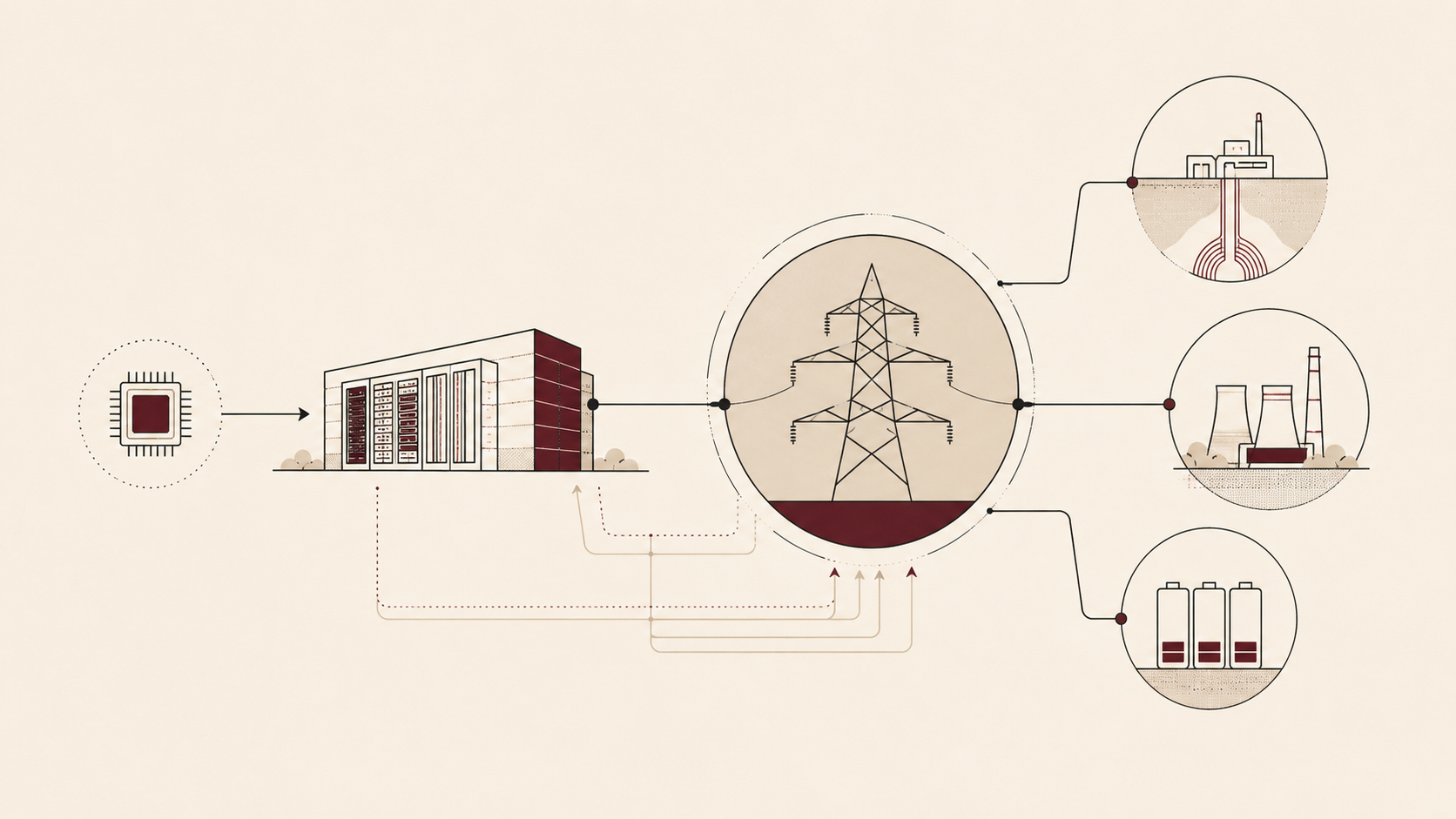
AI investment is expanding beyond processors and cloud computing into the physical systems required to keep those technologies running. Long-term power contracts and integrated data-center projects suggest that access to reliable electricity is becoming a strategic input for technology companies—and a new source of demand for energy infrastructure businesses.
- Fervo Energy signed a 396 MW geothermal power agreement with Google, with an option that could bring Google’s total purchases to nearly 1 GW by 2030.
- U.S. data centers consumed about 4.4% of national electricity in 2023, and a Berkeley Lab update estimates they could account for roughly 11.8% by 2030 under its central scenario.
- SB Energy’s IPO filing shows how energy developers are expanding into integrated data-center and power infrastructure as AI demand increases.
- The AI supply chain increasingly extends from chips and servers to land, generation, transmission, storage and long-term electricity contracts.
Artificial intelligence may run on chips, but those chips run on electricity.
That connection is becoming harder for the technology industry to ignore. On Tuesday, Fervo Energy announced a 396-megawatt power purchase agreement with Google for geothermal electricity from its Cape Station project in Utah. The agreement also gives Google an option to expand its purchases by roughly another 600 MW, potentially bringing the total close to 1 gigawatt by June 2030.
On the same day, another company offered a different window into the same shift. SB Energy, backed by SoftBank Group, publicly filed for a U.S. initial public offering. Once focused largely on renewable power, the company now describes itself as a power and data-center infrastructure business built for the AI economy. Its proposed Nasdaq ticker is SBE.
Taken together, the developments point to a broader change in the AI investment cycle. The race is no longer only about who can secure the most advanced processors. Increasingly, it is also about who can secure enough electricity to operate them.
Google Is Locking In Power Before the Data Center Arrives
Fervo’s agreement with Google is tied to Cape Station, an enhanced geothermal project under development in southwest Utah.
The initial agreement covers 396 MW of round-the-clock, carbon-free electricity and is intended to support a potential Google data center in Utah. Cape Station’s first phase is expected to begin operating in 2028. Google’s final data-center plans remain subject to engineering, regulatory and commercial considerations.
The structure matters.
A power purchase agreement, or PPA, is a long-term contract under which a customer agrees to buy electricity from a power producer. For the producer, that can create greater certainty around future demand and help support the economics of building a capital-intensive generation project. For a large technology company, it can provide greater visibility into the electricity available for future computing infrastructure.
Google and Fervo have already been working together for several years. Fervo’s Project Red in Nevada began supplying electricity to the grid in 2023, including power serving Google’s operations. In 2024, the companies expanded that relationship through a 115 MW agreement involving NV Energy.
The new Utah agreement is much larger.
It also illustrates an important change in how AI infrastructure is being planned: electricity can no longer be treated as something that simply becomes available after a data center is built. Power increasingly has to be secured as part of the project itself.
Why AI Needs So Much Electricity
The reason begins inside the data center.
Training and running advanced AI models requires large clusters of processors operating continuously. Those processors consume electricity directly, while data centers also need power for networking equipment, storage and cooling.
As AI infrastructure expands, those individual facilities can become enormous electricity consumers.
The U.S. Department of Energy said data centers consumed about 176 terawatt-hours of electricity in 2023, equal to roughly 4.4% of total U.S. electricity consumption. A 2025 update from Lawrence Berkeley National Laboratory estimates that data centers could account for about 11.8% of U.S. electricity use by 2030 under its central scenario, with estimates ranging from 9.5% to 15.3%.
That makes electricity one of the physical constraints on AI expansion.
A company can order more servers. Building the generation, transmission and grid connections required to power them can be considerably more complicated.
That difference is creating a new infrastructure market around AI.
Power Companies Are Moving Closer to the Technology Stack
SB Energy provides an especially clear example.
The company publicly filed its Form S-1 with the Securities and Exchange Commission on Sept. 1 after submitting draft registration documents earlier this year. It plans to list on the Nasdaq Global Select Market and Nasdaq Texas, although the number of shares and proposed price range have not yet been determined.
More interesting than the IPO itself is how SB Energy now defines its business.
The company describes itself as a “power-first” infrastructure company developing and owning both gigawatt-scale data-center capacity and the power infrastructure needed to support it.
That model brings businesses that were once easier to separate much closer together.
Traditionally, a technology company could build or lease computing capacity while utilities and power developers handled electricity generation. The AI buildout is encouraging a more integrated model:
AI demand creates the need for more computing capacity. More computing capacity creates large, concentrated electricity loads. Those loads require new generation, storage, grid connections and long-term power agreements. Infrastructure developers that can assemble those pieces become part of the technology supply chain.
SB Energy’s relationship with OpenAI shows how far that integration can go. Earlier this year, OpenAI selected SB Energy to build and operate a 1.2 GW data-center campus in Milam County, Texas, while OpenAI and SoftBank each committed $500 million to the company.
Nvidia disclosed another large infrastructure commitment in August. The chipmaker said it had agreed to provide credit support for land, power and building infrastructure at SB Energy’s PORTS Technology Campus in Pike County, Ohio. The planned campus covers leases for approximately 4.25 GW of IT load, with Nvidia’s aggregate guarantee capped at $105 billion under specified conditions.
The companies involved span chips, AI models, data centers and electricity. That is exactly the point: those layers of the AI economy are becoming increasingly connected.
Why Geothermal Fits the AI Power Problem
Not every source of electricity has the same characteristics.
Data centers operate continuously, which makes access to dependable power especially valuable. The Department of Energy has specifically identified next-generation geothermal as one technology that could help serve growing data-center loads because it can provide firm electricity around the clock.
Traditional geothermal development is limited to locations where naturally accessible underground heat, fluids and rock conditions align.
Enhanced geothermal systems, or EGS, attempt to expand that geography by using drilling and reservoir-engineering techniques to access heat in places where conventional geothermal development may not have worked.
Fervo has been developing that approach at commercial scale.
For Google, that makes geothermal more than an environmental commitment. It is potentially another source of dependable electricity for computing infrastructure.
For Fervo, AI creates something equally important: large customers willing to sign long-term agreements for substantial amounts of new power.
That can change the economics of developing new generation.
The AI Supply Chain Is Getting Longer
For much of the AI boom, attention has concentrated on the most visible layer of the supply chain: semiconductors.
But computing infrastructure depends on a much longer chain.
Advanced chips require semiconductor equipment, wafers, packaging and memory. Servers require data centers. Data centers require land, cooling systems, transmission infrastructure and enormous amounts of electricity.
As investment moves through that chain, businesses far outside traditional software can gain exposure to AI-related capital spending.
That does not mean every announced data-center project will ultimately be built. In fact, grid operators and regulators are increasingly trying to distinguish firm projects from speculative power requests. Reuters reported Tuesday that requests from large electricity users, primarily data centers, exceed 700 GW across U.S. grids, although many may be duplicative or insufficiently financed.
But the underlying demand shift is substantial enough that power availability is already influencing where and how computing infrastructure gets developed.
The technology industry is discovering that building more intelligence in the cloud requires building considerably more infrastructure on the ground.
And that means the next phase of the AI race may depend as much on megawatts as on processors.
The important shift is not simply that AI uses a lot of electricity. It is that power is moving upstream in technology strategy. If electricity availability determines how quickly a data center can be built and how reliably it can operate, securing generation becomes similar to securing chips or manufacturing capacity: something companies may need to plan years in advance. That creates a wider AI economy in which energy developers, utilities and infrastructure companies can become strategic suppliers to the technology industry.
- Official release Fervo Energy — Fervo Energy and Google Sign 396 MW PPA, Sept. 1, 2026
- SEC filing SB Energy, Inc. — Form S-1 Registration Statement, filed Sept. 1, 2026
- Official release SB Energy — Public Filing of Registration Statement for Proposed Initial Public Offering, Sept. 1, 2026
- Government data U.S. Department of Energy — Powering America’s AI Future: Data Center Resource Hub
- News Reuters — Fervo signs 396-MW geothermal power supply deal with Google, Sept. 1, 2026