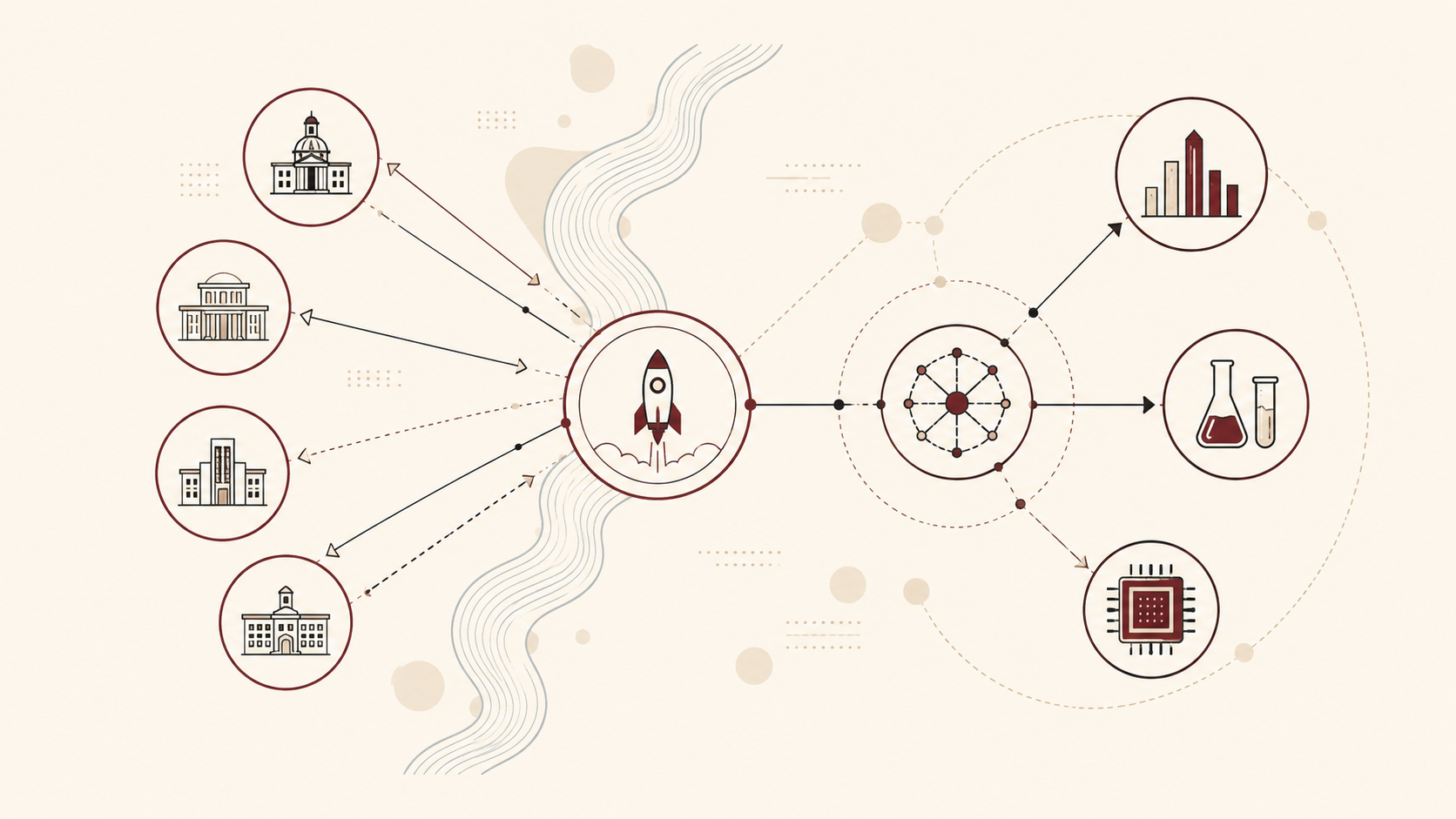
For a student founder, Boston’s value is not simply the reputation of its universities. The region compresses several parts of the startup-building process — research, collaborators, mentors, accelerators, industry and capital — into one ecosystem. That can reduce the friction between having an idea and actually testing it.
- Harvard, MIT, BU and Northeastern each operate infrastructure that helps students move from early ideas toward real ventures.
- Massachusetts biopharma companies raised $3.45 billion in venture capital in the first half of 2026, representing about one-quarter of U.S. biopharma VC.
- Massachusetts is also building an AI commercialization ecosystem around universities, startups, computing infrastructure and accelerators.
- Boston’s biggest advantage for college founders may be density: people and resources needed at different stages of a startup are unusually close together.
Boston is known as a college town. But for students interested in building something of their own, that description misses part of the story.
Within a relatively small area, students can find major research universities, teaching hospitals, venture investors, startup accelerators and established technology and life-sciences companies. Harvard and MIT sit across the Charles River in Cambridge. Boston University and Northeastern are embedded in the city. Kendall Square, one of the country’s most concentrated biotechnology and technology clusters, is only a few subway stops away from several campuses.
That proximity matters because startups rarely begin with capital alone. They need people with different skills, access to specialized knowledge, early feedback, mentors and eventually customers and investors.
Boston puts many of those pieces within reach before a student graduates.
The Advantage Is Density
The interesting part of Boston’s startup ecosystem is not any single institution. It is how closely the institutions sit next to one another.
A technical founder may need someone who understands business development. A healthcare startup may need researchers, clinicians and regulatory expertise. An AI company may need computing infrastructure, engineers and an industry where its technology can solve a real problem.
In Boston and Cambridge, those resources often exist within the same broader ecosystem.
MIT alone operates an extensive entrepreneurship network that includes the Martin Trust Center for MIT Entrepreneurship, MIT Sandbox Innovation Fund Program, Venture Mentoring Service and InnovationHQ. MIT describes InnovationHQ as a central home for its community of innovators and entrepreneurs.
Across the river, Harvard Innovation Labs provides another example of what university entrepreneurship infrastructure can look like. Its Student i-lab serves students across Harvard’s 13 schools and currently includes a community of more than 400 student ventures. The broader Harvard Innovation Labs says it has supported more than 7,000 ventures since 2011, which have collectively raised more than $15 billion.
The same pattern extends beyond Harvard and MIT.
Boston University’s Innovate@BU offers extracurricular entrepreneurship programs, mentorship, networking, venture support and funding opportunities to students across majors. Students do not need to arrive on campus with a company already formed; the programs range from developing an initial idea to growing an existing venture.
At Northeastern, IDEA operates as a student-led venture accelerator. The program reports supporting more than 2,800 ventures, whose companies have collectively raised more than $833 million, while providing mentorship, workshops, legal resources and up to $30,000 in non-equity funding.
The result is something more valuable than a collection of entrepreneurship clubs. Students can enter an infrastructure designed to help ideas move from concept to execution.
A Startup Does Not Have to Begin With a Startup
For a college student, “entrepreneurship” can sound like a much bigger commitment than it needs to be.
A company does not have to begin with a pitch deck, a venture-capital meeting or even a fully formed product.
It can begin with a problem noticed in a class, research lab, internship or student organization.
That distinction is important in Boston because universities provide relatively low-risk environments for testing those problems. A student can take a course in one discipline, meet a collaborator studying another, attend an entrepreneurship workshop, talk with an experienced founder and test a prototype without immediately leaving school or raising outside capital.
Some university programs are explicitly structured around that progression.
Harvard’s Student i-lab, for example, separates participation into Explore, Test and Propel stages. Early participants can investigate whether entrepreneurship is right for them, while more developed teams can work on customer research, prototypes, scalability and fundraising.
At BU, students with an existing venture can access coaching, mentorship and the Innovation Pathway, while students who are simply interested in entrepreneurship can begin with introductory programs and events.
This changes the economics of experimenting with an idea. Some of the resources that an independent founder would otherwise need to find or pay for — workspace, mentors, workshops, prototyping support and introductions — can already exist inside the university.
Then There Is the Industry Outside Campus
University entrepreneurship becomes more useful when there is an industry ecosystem outside the campus gates.
Boston has a particularly strong connection between academic research and life sciences.
The latest MassBio Industry Snapshot, released on Aug. 25, 2026, shows how much capital still moves through the region. Massachusetts-headquartered biopharma companies raised $3.45 billion in venture capital during the first half of 2026, up 25% from a year earlier. The state captured about 25% of all U.S. biopharma venture funding during the period.
That does not mean capital is equally accessible to every new founder. Early-stage financing remains selective: MassBio reported that the average seed round fell to $4.65 million in the first half of 2026 even as the average Series A round increased to $79.6 million.
But the larger point for students is that Boston is not only producing academic research. There is an established commercial system around that research — investors, startups, pharmaceutical companies, laboratories and experienced operators who understand how scientific discoveries become businesses.
That infrastructure creates opportunities even for students who never start a biotech company themselves.
AI Is Adding Another Layer
Boston’s startup story is also becoming less dependent on biotech alone.
Massachusetts has been building public infrastructure around artificial intelligence, including the Massachusetts AI Hub, which is intended to connect academia, startups, industry and government.
In 2025, the state announced a $31 million grant to expand high-performance computing access through the Massachusetts Green High Performance Computing Center. The broader collaboration involves Boston University, Harvard, MIT, Northeastern, UMass and Yale, with joint public and university investment expected to reach roughly $120 million over five years.
The ecosystem continued expanding in 2026. During Boston Tech Week in May, the Massachusetts AI Hub, IBM and Red Hat opened applications for The Open Accelerator, a program designed to help technical entrepreneurs develop and commercialize AI businesses.
And in August, MassVentures announced $4.5 million in grants to 26 Massachusetts startups working across areas including AI, robotics, life sciences, quantum computing and clean energy.
For students, these developments matter because technologies increasingly overlap.
A healthcare startup may also be an AI company. A robotics company may emerge from university research. A climate startup may require materials science, software and engineering expertise at the same time.
Boston’s advantage is increasingly the ability to connect those fields.
The Network Can Matter Before the Funding
It is tempting to measure startup ecosystems by venture-capital dollars.
For a college founder, however, the first valuable resource may be much smaller: a co-founder.
Then perhaps a professor who understands the technology. A graduate student who knows the research. An accelerator adviser who identifies a flaw in the business model. An alumnus who knows the industry. Eventually, an investor may enter the picture.
This is where geographic concentration becomes a business advantage.
Entrepreneurship depends partly on what economists call network effects: a network becomes more useful as the number of relevant participants and possible connections grows.
A startup ecosystem works in a similar way. More founders attract more investors. More investors make the region more attractive to founders. Successful companies produce experienced employees who can later become founders, advisers or early hires. Universities continually bring new research and talent into the system.
No individual student has automatic access to that entire network. University affiliation rules differ, competitive programs can be selective and simply living in Boston does not guarantee introductions to investors.
But being nearby lowers the distance between the pieces.
That can make experimentation easier.
College Can Be the Testing Ground
There is another reason building during college can make sense: the objective does not have to be creating the next billion-dollar company.
A student venture can fail commercially and still teach product development, customer research, hiring, sales, budgeting and leadership in ways that are difficult to reproduce in a classroom.
Boston provides an unusually dense environment for running those experiments.
The important question may therefore be less “Should I start a company in college?” and more “What could I test while I have access to this ecosystem?”
For students spending four years around Boston and Cambridge, universities are not simply places to earn degrees. They can also function as temporary access points to laboratories, mentors, technical talent, entrepreneurial programs and networks that become harder to assemble independently later.
The opportunity is not that Boston makes entrepreneurship easy.
It is that many of the ingredients required to begin are already nearby.
Boston can look surprisingly compact for an innovation economy with global reach. A student can move between BU, Northeastern, Harvard and MIT — and between university entrepreneurship programs, Cambridge technology companies, research institutions and startup events — without leaving the Greater Boston core. That physical proximity helps explain why studying here can offer more than classroom access: the surrounding city itself can become part of the education.
Greater Boston and Cambridge, Massachusetts | August 31, 2026The most interesting business lesson in Boston is not that great universities create great startups automatically. It is that entrepreneurship works as an ecosystem. Research creates ideas; universities concentrate talent; accelerators help test those ideas; established industries provide expertise and customers; investors supply capital. For a college student, being positioned where those networks overlap can be more valuable than trying to “become a founder” immediately. The smarter first move may simply be to start participating in the network.
- Government data Massachusetts Executive Office of Economic Development — Massachusetts Biopharma Sees Strong Resurgence of Capital Even as Workforce Numbers Lag, Aug. 25, 2026
- Government release Commonwealth of Massachusetts — Governor Healey Advances State’s AI Leadership with Major Investments in Massachusetts AI Hub, May 6, 2025
- University Harvard Innovation Labs — Student i-lab and Innovation Labs ecosystem, accessed Aug. 31, 2026
- University MIT — Innovation and Entrepreneurship ecosystem, accessed Aug. 31, 2026
- University Boston University — Innovate@BU entrepreneurship resources, accessed Aug. 31, 2026
- University Northeastern University — IDEA Student-Led Venture Accelerator, accessed Aug. 31, 2026