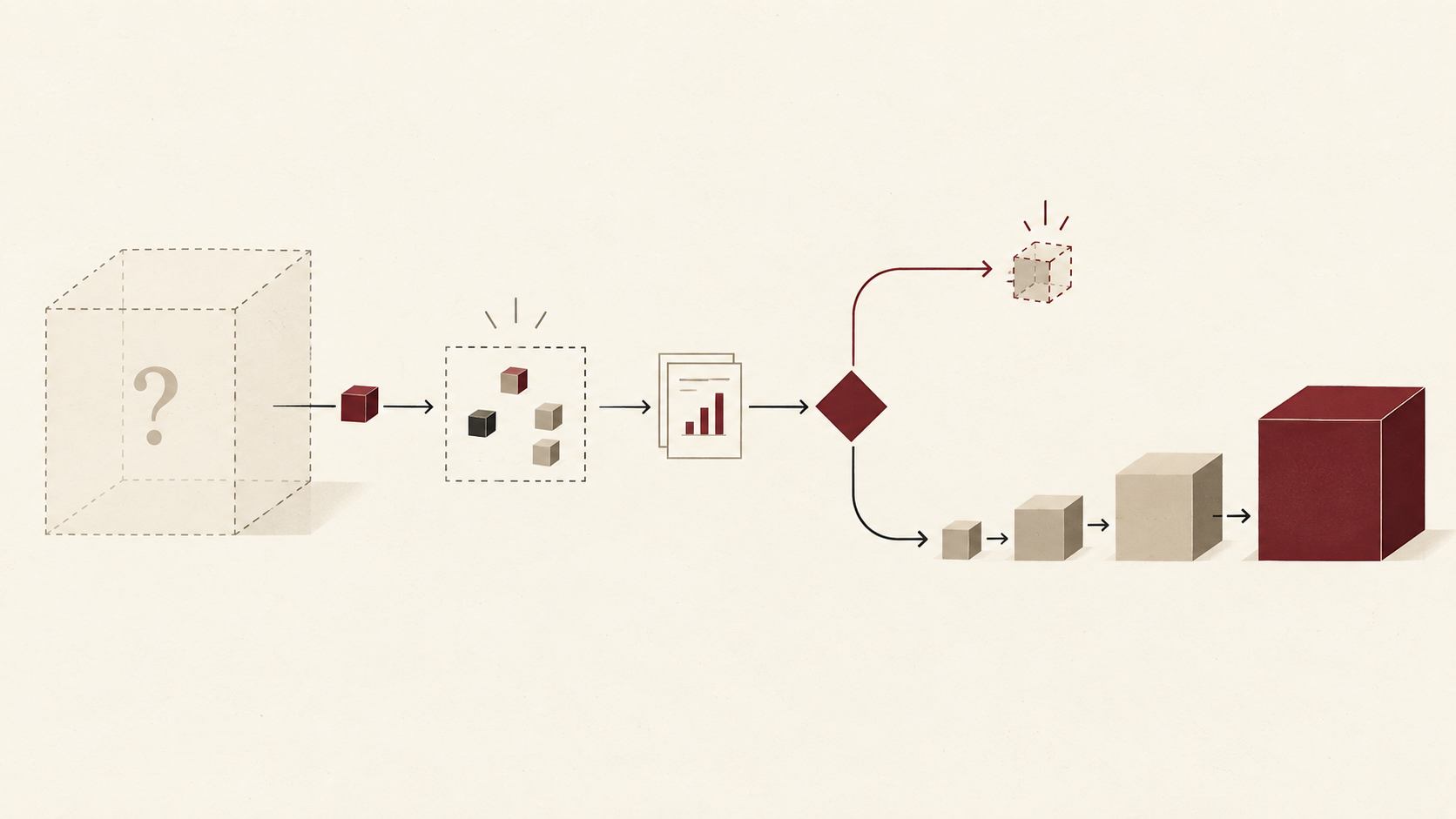
Uncertainty is unavoidable in business, but the size of the commitment made under uncertainty can often be controlled. Pilots and experiments let companies spend some resources to obtain information before deciding whether to deploy substantially more, turning learning itself into part of the investment process.
- Companies can divide a large uncertain commitment into smaller decisions that generate information along the way.
- Netflix has used limited tests before expanding products and features, including its gaming technology and playback controls.
- A/B tests allow digital companies to compare a proposed change with an existing product before exposing every user to it.
- Small bets do not eliminate uncertainty; they reduce how much a company must commit before learning more.
A company has a new idea. Maybe it is a different store format, a redesigned app, a new pricing model or an entirely new product.
The obvious question is whether the idea will work.
The harder question is what to do when nobody actually knows.
Businesses make decisions under uncertainty all the time. Customer behavior can be difficult to predict, competitors can react, technology can change and an idea that looks convincing in a meeting may perform very differently in the market.
One way companies manage that uncertainty is surprisingly simple: they make a smaller decision before making the larger one.
Instead of launching everywhere, they might begin in a few markets. Instead of rebuilding an entire digital product, they might expose a new feature to a limited group of users. Instead of committing a large budget immediately, they might fund a pilot and decide what to do after seeing the results.
The point is not to eliminate uncertainty.
It is to buy information before buying scale.
A Small Decision Can Produce Valuable Information
Imagine a retailer considering a new store concept.
Opening 500 redesigned locations at once would create a large commitment. The company would have to spend on construction, inventory, technology, training and marketing before knowing how customers would respond.
But suppose it redesigns five stores first.
Management can observe what happens. Do more customers enter? Do they stay longer? Does spending per visit change? Are operating costs higher? Does the concept work differently in different locations?
The five stores do not answer every question about the other 495. But they give managers something they did not have before: evidence.
That changes the next decision.
The basic sequence looks like this:
Uncertainty → Small Experiment → New Information → Decision → Larger Commitment
Seen this way, the experiment itself is an investment. The company spends a relatively small amount of resources to learn something before deciding whether a much larger investment makes sense.
Research on business experimentation makes a similar distinction. Historical data can describe what customers have done before, but genuinely new products or business changes create questions that existing data cannot always answer. Controlled experiments can provide evidence about how customers actually respond to a proposed change.
Digital Businesses Can Make the Bets Even Smaller
This approach becomes particularly visible online because digital products can often be changed for only part of their user base.
That is the logic behind an A/B test.
One group of customers continues seeing the existing version of a product while another receives a modified version. The company can then compare outcomes such as purchases, engagement or another relevant metric.
The proposed change therefore does not have to become an all-or-nothing company decision immediately.
Netflix provides a straightforward example.
When the company began expanding games beyond mobile devices, it did not immediately make cloud-streamed games broadly available to its entire membership. Netflix began in 2023 with a limited beta for a small number of members in Canada and the U.K. using select TVs. The company said the beta was designed to test its game-streaming technology and controller and improve the member experience. It subsequently expanded the test into additional countries, including the U.S. and, most recently, Brazil in April 2026.
The strategic idea is more important than the product itself.
Netflix could learn about the technology and user experience while the initiative was still limited. Expansion could then happen in stages rather than through one irreversible launch.
The same logic appears elsewhere in its product development. Netflix has previously tested features such as playback-speed controls with limited users before deciding whether to expand them. In that case, the company explicitly said broader introduction would depend on feedback from the test.
Experimentation Changes What Managers Are Deciding
This reveals something important about managerial decision-making.
Without experimentation, the question might be:
Should we launch this idea?
That can force managers to choose between two uncomfortable options: commit to something whose outcome is uncertain, or reject an idea that might have worked.
A staged approach creates another option:
What is the smallest useful test we can run before deciding?
That changes the economics of the decision.
An unsuccessful small experiment can consume some money and time. But an unsuccessful full-scale rollout can consume far more. At the same time, a promising experiment can give management stronger evidence for allocating additional resources.
In other words, managers are not necessarily trying to make one perfect prediction about the future. They can structure the decision so that the company learns along the way.
That is especially useful when decisions are reversible. A website feature can often be switched off. A pilot can end. A limited rollout can stop before becoming a national one.
The company retains the ability to change direction as information arrives.
Experimentation Is Becoming Business Infrastructure
For some digital companies, testing is not an occasional exercise but part of how products are managed.
Booking.com describes experimentation as part of its core product culture, allowing hundreds of product teams to test ideas, learn and make product decisions. Its experimentation work increasingly includes the systems and guardrails needed to conduct those tests at scale.
Airbnb similarly continues to invest in experimentation and measurement research. Its 2025 technical research included work on measuring the longer-term effects of A/B tests and designing experiments for product launches involving interconnected groups of users.
That matters because experiments themselves can become a capability.
A company that can cheaply test an idea, measure what happens and respond quickly may be able to explore more possibilities without treating every idea as a major strategic commitment.
Small bets therefore are not simply about being cautious. They can make exploration cheaper.
Small Bets Still Need Good Design
A small experiment is not automatically a good experiment.
A pilot conducted in an unusually strong market may not represent the rest of the country. An A/B test can measure the wrong outcome. A test can be too short. Customers in one group can behave differently for reasons unrelated to the change being studied.
Researchers have also warned that poorly designed A/B tests can produce misleading conclusions. The value comes from creating tests that can actually distinguish the effect of a change from what might have happened anyway.
There are also decisions that cannot easily be tested. Building a factory, acquiring another company or entering a highly regulated market may require substantial commitments before managers can observe meaningful results.
So experimentation does not replace managerial judgment.
It changes where that judgment is used.
Managers still have to decide what to test, how much to invest, which results matter and when the evidence is strong enough to justify the next step.
Managing Uncertainty One Decision at a Time
It is tempting to imagine management as choosing the correct answer from a set of alternatives.
Real businesses rarely have that luxury.
The future is uncertain precisely because managers do not yet have all the information they would like. Waiting until uncertainty disappears can mean waiting forever.
Small bets offer another approach.
Rather than asking the company to predict the entire future correctly, managers can divide one large commitment into a sequence of smaller decisions. Each step can generate information for the next.
The advantage is not certainty.
It is the ability to learn before committing more.
That simple idea explains why a limited beta, a five-store pilot or an A/B test can matter far beyond the experiment itself. They are tools for turning uncertainty from something managers merely worry about into something they can actively manage.
The interesting part of experimentation is not simply that companies “test before they launch.” It changes the structure of a managerial decision. Instead of treating uncertainty as a problem that must be solved before action, a company can make an action small enough that the result itself produces useful information. In that sense, good management under uncertainty is sometimes less about predicting the right future and more about designing decisions that leave room to learn.
- Academic / management research Harvard Business Review — “The Discipline of Business Experimentation,” Dec. 2014
- Academic / management research Harvard Business Review — “Avoid the Pitfalls of A/B Testing,” Mar.–Apr. 2020
- Official release Netflix — “Testing Games on More Devices,” Aug. 14, 2023; updated Apr. 27, 2026
- Official release Netflix — “Player Control Tests,” Oct. 29, 2019; updated Oct. 12, 2020
- Company research Airbnb Engineering & Data Science — “Academic Publications & Airbnb Tech: 2025 Year in Review”