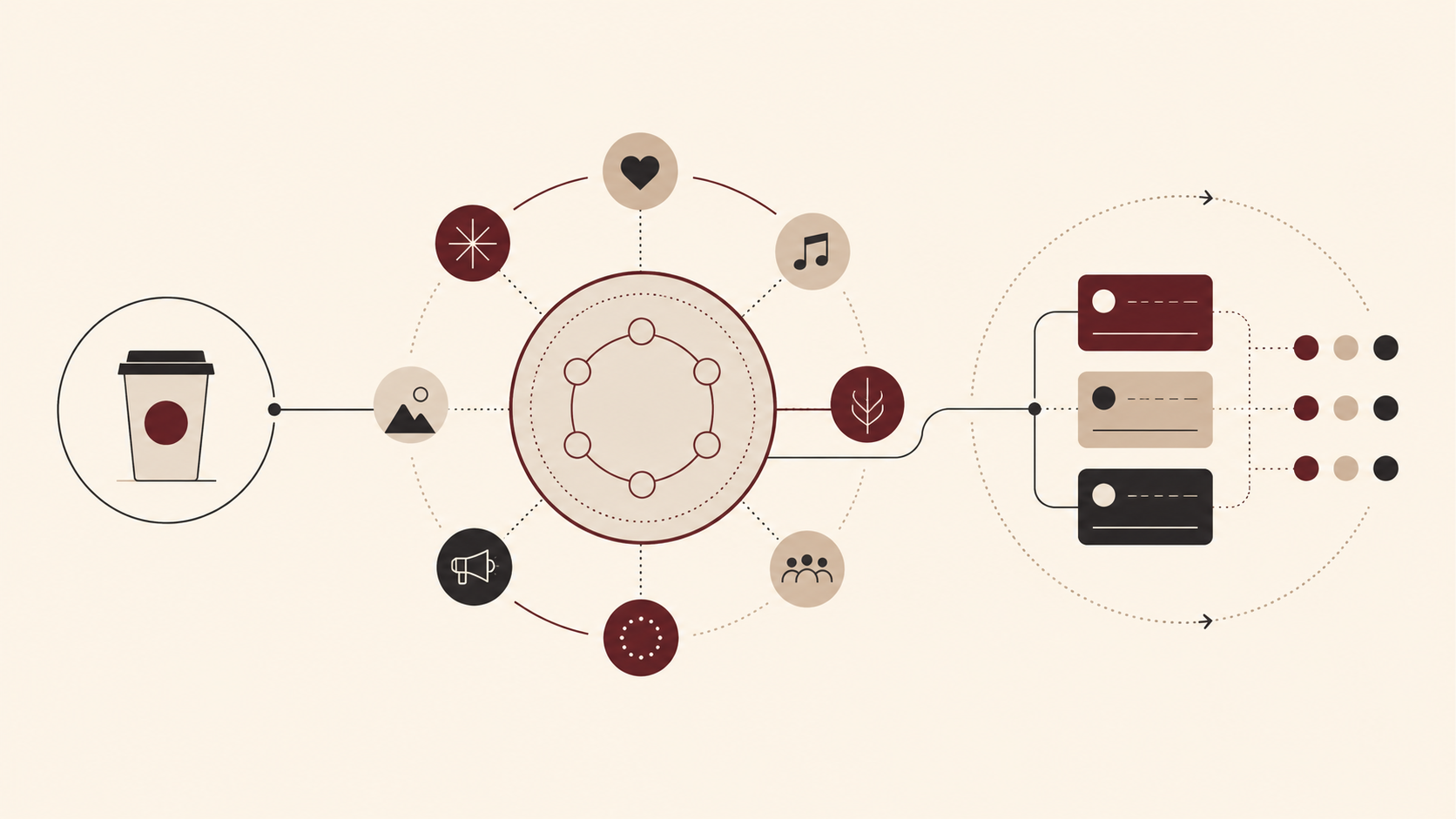
Starbucks' strategy highlights a broader shift in consumer branding. Companies increasingly compete not only through products and pricing, but through participation, identity, and community. If Starbucks can successfully link cultural relevance to loyalty and visit frequency, it could provide a model for how large consumer brands create growth beyond traditional advertising.
- Starbucks says culture-forward marketing and its new Rewards program are helping drive customer engagement and sales growth.
- Global comparable sales rose 7.9% in fiscal Q3 2026 as the Back to Starbucks strategy gained momentum.
- Starbucks is attempting to connect cultural relevance with loyalty, store experience, and customer habits rather than treating it as a standalone marketing campaign.
- The company's broader goal is to make Starbucks part of customers' routines, communities, and identities—not just a place to buy coffee.
The Turnaround Is About More Than Coffee
For much of the past decade, Starbucks focused heavily on convenience, digital ordering, and operational efficiency. The strategy helped the company scale, but it also created a growing concern: Starbucks was becoming easier to use without necessarily becoming more meaningful to customers.
Under CEO Brian Niccol, the company is attempting to reverse that trend.
Starbucks' ongoing Back to Starbucks strategy aims to restore the coffeehouse experience through store redesigns, service improvements, menu simplification, and a renewed emphasis on customer connection. But one element of the plan stands out from a branding perspective.
The company increasingly talks about cultural relevance as a business objective rather than a marketing objective.
In its fiscal third-quarter 2026 earnings release, Niccol said Starbucks was becoming "more visible, more relevant, and more loved," adding that "culture-forward marketing" and the company's new Starbucks Rewards program were helping create new customer rituals. Starbucks also reported four consecutive quarters of comparable sales growth and two consecutive quarters of margin expansion. Global comparable sales increased 7.9% during the quarter.
Why Starbucks Is Talking About Culture Again
Most consumer brands invest in advertising. Fewer attempt to make cultural relevance part of the operating model itself.
Starbucks appears to be moving in that direction.
The company's recent messaging suggests it no longer views culture as something generated solely through campaigns. Instead, Starbucks is trying to connect culture with multiple parts of the customer experience:
- Rewards and loyalty programs
- Menu innovation
- Store atmosphere
- Social engagement
- Community gathering spaces
- Brand storytelling
At its 2026 Investor Day, Starbucks emphasized marketing that "truly resonates" alongside customer service and menu innovation as key drivers of its turnaround.
In practical terms, Starbucks wants customers to visit not only because they need coffee, but because Starbucks remains part of what people are talking about, sharing, recommending, and identifying with.
The Business Mechanism Behind Cultural Relevance
The concept may sound soft, but the economics are relatively straightforward.
A culturally relevant brand typically benefits from:
- Higher visit frequency
- Stronger loyalty program participation
- Greater social visibility
- Lower dependence on discounts
- More pricing power over time
For Starbucks, the Rewards ecosystem is becoming a key bridge between culture and revenue.
Traditional loyalty programs reward transactions. Starbucks increasingly appears to be using its Rewards platform to encourage participation in broader brand experiences. Exclusive offers, limited experiences, personalized engagement, and community-oriented initiatives can all deepen customer involvement beyond the purchase itself.
The goal is not simply to sell another latte.
The goal is to create habits.
Starbucks Wants to Reclaim the "Third Place"
Another important part of the strategy is Starbucks' effort to revive its role as a "third place"—a space that exists between home and work.
For years, rapid mobile ordering and grab-and-go behavior made many Starbucks locations function more like fulfillment centers than coffeehouses.
Niccol has repeatedly emphasized customer experience, human connection, and making stores places where customers want to spend time. Starbucks has renovated stores, invested in labor, and introduced initiatives designed to improve the in-store experience. The company says it has invested more than $500 million in additional labor hours as part of the transformation.
That effort is closely connected to culture.
A brand cannot easily become culturally relevant if customers interact with it only through a mobile app and a pickup shelf.
A Growing Trend Across Consumer Brands
Starbucks is not alone.
Many consumer companies are increasingly competing on community, identity, and participation rather than product alone.
Athletic brands build running clubs. Beauty companies build creator ecosystems. Restaurants build loyalty communities. Entertainment companies build fandoms.
The product remains important, but the relationship surrounding the product becomes part of the value proposition.
For Starbucks, coffee remains the product.
Culture may become the differentiator.
What to Watch
The key question is whether cultural relevance can continue translating into measurable business performance.
So far, Starbucks' recent results suggest momentum. Comparable sales growth has returned, customer traffic is improving, and management has raised its outlook as the turnaround gains traction.
The longer-term test will be whether Starbucks can consistently turn brand engagement into repeat visits without relying heavily on promotions or discounting.
If successful, the company may offer a broader lesson for consumer brands: cultural relevance is no longer just a marketing outcome.
It can become part of the business model itself.
The most interesting part of Starbucks' turnaround may not be coffee, pricing, or rewards. It is the company's attempt to operationalize culture. Traditionally, cultural relevance has been viewed as an outcome of successful branding. Starbucks increasingly appears to be treating it as an input—something that can be deliberately built through stores, loyalty programs, experiences, and customer rituals. That approach reflects a growing reality in consumer business: attention is valuable, but participation is often more valuable.
- Company IR Starbucks Reports Q3 Fiscal Year 2026 Results, July 29, 2026
- Official Release Starbucks Reports Q3 Fiscal Year 2026 Results, July 29, 2026
- Official Release Starbucks Is Back, Turning Momentum into Long-Term, Sustainable Growth, Jan. 29, 2026
- Official Release Recap: Starbucks 2026 Annual Meeting of Shareholders, Mar. 25, 2026
- News Reuters — Starbucks raises annual forecasts again as turnaround takes root, July 29, 2026