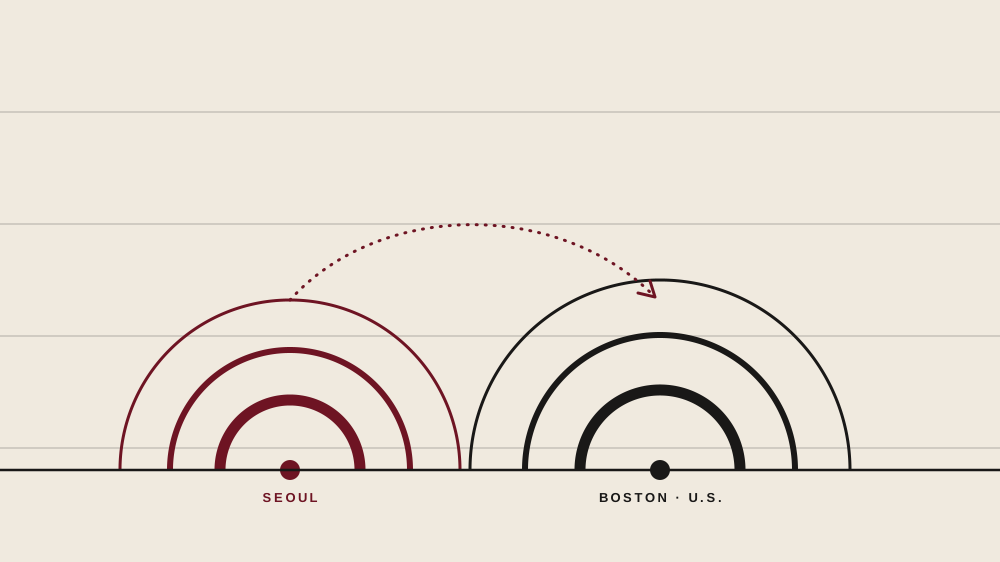
Korean beauty is one of the few consumer categories where a mid-sized economy consistently exports culture, product and pricing power to the U.S. at the same time. How this third cycle plays out will shape not just beauty shelves, but the playbook every Asian consumer brand uses to enter America.
- The current K-beauty cycle is driven by permanent U.S. retail shelf space, not viral discovery — a structurally different demand base than the first two waves.
- Clinical and ingredient-led claims are replacing Korean-ness as the primary selling proposition, which widens the addressable customer but weakens the origin story as a moat.
- Tariff exposure and copycat speed are the two forces most likely to compress margins before brands can build durable U.S. equity.
Walk into any large American beauty retailer this summer and count the Korean brands on the wall. A decade ago you would have found a single "K-beauty" endcap — a themed island, part product, part souvenir. Today the same brands sit unlabeled inside the skincare aisle itself, shelved by function rather than by flag. That quiet re-filing, from category to ingredient, is the clearest sign that Korean beauty has entered a third and structurally different American growth cycle.
The first cycle, roughly the mid-2010s, sold novelty: ten-step routines, snail mucin, sheet masks as an experience. The second cycle ran through e-commerce — marketplace algorithms surfaced Korean formulations at price points American brands couldn't match. Both cycles shared a weakness. Demand was rented, not owned: rented from an algorithm, a trend cycle, a single retail partner.
The third wave, defined
The third cycle looks different on three measurable fronts: distribution, claims and capital. Distribution has shifted from endcap to core shelf. Claims have shifted from origin story to clinical evidence. And capital has shifted from export-agency support to direct U.S. entity building — warehouses, regulatory teams, American hires.
What changed on the shelf
Shelf position is strategy made visible. When a Korean sunscreen sits between two American legacy brands rather than inside a "K-beauty" section, three things have happened. The retailer has decided the product wins on function; the brand has accepted competing without the origin halo; and the shopper has stopped needing a cultural on-ramp to buy it.
That normalization is commercially powerful and strategically double-edged. It expands the customer base far beyond enthusiasts — but it also means the next comparison is not "Korean versus not," it is price-per-efficacy against every brand on the wall.
"The moment K-beauty stopped being a section and became a shelf neighbor, the competition changed from curiosity to chemistry."
The claims economy
The second structural shift is the move from story to proof. Brands that once led with heritage now lead with percentages of active ingredients, dermatological testing and before-and-after data. Clinical claims scale across cultures in a way that origin stories do not — an efficacy claim needs no translation.
It also raises the regulatory floor. Claims invite scrutiny, and scrutiny favors brands with U.S. legal and compliance infrastructure. The brands that survive are not necessarily the most creative, but the ones organized enough to defend a sentence on a label.
What could break the cycle
Two forces could compress this cycle before brands build durable equity. The first is trade policy: tariff changes on Asian imports act as a direct margin tax on the value-for-formulation position that makes these brands competitive. The second is copycat velocity — once the selling proposition is an ingredient percentage rather than a story, it can be reverse-engineered by any contract manufacturer within a production cycle.
The defense against both is the same and unglamorous: owning distribution relationships and regulatory capability in the U.S. itself.
Over two July weekends I tracked which skincare products student shoppers picked up, asked about, and actually purchased at three Newbury Street retailers. The pattern was consistent: the question was never 'is this Korean?' — it was 'what percentage is the active?'
Newbury Street, Back Bay · Observed July 2026The third K-beauty cycle is the least exciting and the most durable of the three — and those two facts are related. Novelty and algorithms produce spikes; shelf space and claims produce annuities. My read: the winners of this cycle will look less like beauty brands and more like ingredient companies with excellent packaging. That is a compliment.
- Official data Korea Customs Service / KITA export statistics — cosmetics exports by destination
- Industry U.S. prestige beauty retail sales reports
- Field Author's retail observation notes, Newbury Street, Boston, July 2026